Taehyung Park, Shinhan Asset CIO: "The Least Attractive Cash"
Investment Strategies in an Era of Low Short-Term Interest Rates

[Asia Economy Reporter Junho Hwang] "At this point in time, the least attractive asset is cash."
Park Tae-hyung, Chief Investment Officer (CIO) of Shinhan Asset Management, summarized the current market, where low short-term interest rates are expected to continue, in his ‘CIO Weekly Letter’ on the 5th.
When low interest rates persist, a strategy emerges in the bond market to sell short-term bonds and buy long-term bonds. He explained, "Considering inflation, we will wait until long-term interest rates stabilize, but when the time comes that the income from the spread between long- and short-term interest rates outweighs the price loss risk caused by rising long-term rates, we start purchasing long-term bonds."
The enthusiasm in the stock market also intensifies. Park CIO said, "Margin trading, where funds are borrowed short-term to invest in stocks, increases," adding, "In the case of leveraged ETFs, costs decrease and performance improves when short-term interest rates are low, so they receive considerable benefits." The structured products market is similar. He said, "When the long- and short-term spread is high, deal arbitrage increases, leading to a large issuance of structured products and growing demand."
For these reasons, financial companies experience a boom. This is because they can sell a variety of products. Park CIO analyzed, "This is also why financial stocks have been performing well recently in the stock market."
Hot Picks Today
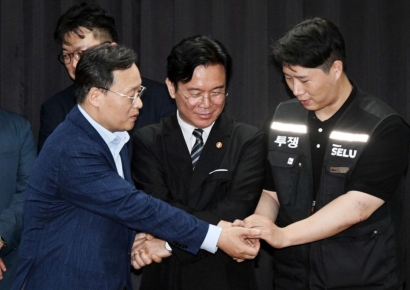 Dramatic Agreement Reached on Eve of Samsung Electronics General Strike... Minister Kim Young-hoon: "Showcased Korea's Strength in Dialogue" (Update)
- "It Has Now Crossed Borders": No Vaccine or Treatment as Bundibugyo Ebola Variant Spreads [Reading Science]
- "Need to Discuss Excluding Controlling Shareholders' Voting Rights in Dual Listings"
- "Stocks Are Not Taxed, but Annual Crypto Gains Over 2.5 Million Won to Be Taxed Next Year... Investors Push Back"
- "Who Is Visiting Japan These Days?" The Once-Crowded Tourist Spots Empty Out... What's Happening?
Park CIO expects the era of low short-term interest rates to continue. He said, "Considering recent remarks by Jerome Powell, Chairman of the Federal Reserve (Fed), it seems that low short-term interest rates will remain unchanged in the market for the time being." He added, "The probability of central banks raising policy rates over the next 1 to 2 years is almost zero," diagnosing, "Inflation indices may approach 3%, but the economy has not sufficiently recovered, and the unemployment rate is far from returning to pre-COVID-19 levels." Accordingly, he urged, "Investors should hold sufficient financial assets and also adopt appropriate hedging strategies against inflation."
© The Asia Business Daily(www.asiae.co.kr). All rights reserved.