Choi Jae-sung "Pardon, from the People's Perspective"... Divided Opinions Even Within the Ruling Party
Lee Jae-myung "If I did something wrong deserving punishment, it is natural to take responsibility" Expresses de facto opposition to 'pardon'

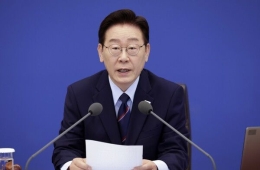
Choi Jae-sung, Senior Secretary for Political Affairs at the Blue House Photo by Yonhap News
View original image[Asia Economy Reporter Son Sun-hee] Choi Jae-sung, Senior Secretary for Political Affairs at the Blue House, expressed a principled stance on the possibility of pardoning former Presidents Lee Myung-bak and Park Geun-hye on the 13th, saying, "The decision should be made from the perspective of the people's expectations."
In an interview with CBS radio program 'Kim Hyun-jung's News Show' on the same day, Choi said in response to questions about pardons, "Pardoning is the president's inherent authority, which is power delegated by the people, and since the president is the head of the administration, it is difficult to think of it without the two words 'the people'." This appears to be a reserved attitude, indicating that he will observe public opinion movements further for now.
Choi said, "In the case of former President Park, although she herself did not apologize, the party did, but on the other hand, some say, 'It's a political trial, so why demand an apology?' which causes conflict," adding, "It is not an issue to be further discussed, and since the two words 'the people' are a premise, there is no need to engage in political disputes, nor should there be."
However, voices are divided not only within the opposition but also within the ruling party, which initially ignited the pardon debate. The first to express the intention to recommend pardons for the two former presidents was Lee Nak-yeon, leader of the Democratic Party of Korea. However, Lee Jae-myung, Governor of Gyeonggi Province and considered a leading presidential candidate in the ruling party alongside Lee, appeared on a radio program the day before and stated, "If one has committed a bad act deserving punishment, it is natural to take corresponding responsibility," effectively opposing the pardon.
If a pardon is granted, it is expected to be a special pardon decided by the president, not a general pardon requiring the consent of the National Assembly. It is essentially regarded as a political act, and in this case, it is difficult to avoid criticism that it violates President Moon's principle of excluding five types of pardons (corruption crimes such as bribery, solicitation, acceptance of bribes, breach of trust, and embezzlement) which he emphasized during the past presidential election.
President Moon is expected to directly express his thoughts on the pardon issue at the New Year's press conference anticipated around mid-month.
Hot Picks Today
 "Stocks Are Not Taxed, but Annual Crypto Gains Over 2.5 Million Won to Be Taxed Next Year... Investors Push Back"
- "Don't Throw Away Coffee Grounds" Transformed into 'High-Grade Fuel' in Just 90 Seconds [Reading Science]
- Despite Warnings of "Do Not Enter, You May Not Make It Out Alive"... Foreign Tourist Stranded After Unauthorized Climb on Jeju Sanbangsan
- Signed Without Viewing for 1.6 Billion Won... Jamsil and Seongbuk Jeonse Prices Jump 200 Million Won in a Month [Real Estate AtoZ]
- "Even With a 90 Million Won Salary and Bonuses, It Doesn’t Feel Like Much"... A Latecomer Rookie Who Beat 70 to 1 Odds [Scientists Are Disappearing] ③
Meanwhile, regarding the progress of talks between President Moon and Kim Jong-in, Emergency Committee Chairman of the People Power Party, Choi said, "We are keeping the door open and exploring. The sooner, the better," adding, "If Chairman Kim shows willingness, it is an issue that can proceed."
© The Asia Business Daily(www.asiae.co.kr). All rights reserved.