[New Year Special] "Let's Remove the Label of Being a Woman and Live Freely"
[Kim Ji-young Born 1982, and Lee Seo-yeon Class of 2020] We Dream of Genderlessness
![[New Year Special] "Let's Remove the Label of Being a Woman and Live Freely"](http://www.asiae.co.kr/news/img_view.htm?img=2021010411183297978_1609726712.jpg)
[Editor's Note] 'Kim Ji-young, Born 1982,' the first representative of the millennial generation, sparked discourse on the lingering gender discrimination in our society. For millennial women, Kim Ji-young, Born 1982 became an opportunity to recognize the internalized male-centered social structure passed down from their mothers' generation. With the social entry of those born in the 1990s, generational theory has risen, making 'intergenerational coexistence' a key challenge for our society to solve. Women in their twenties, at the tail end of the millennial generation, face not only employment difficulties due to low economic growth but also barriers of gender discrimination. The COVID-19 pandemic is poised to make the lives of these women in their twenties even more challenging. Asia Economy sheds light on women in their twenties through Lee Seo-yeon, a 2020 university entrant, and seeks directions for coexistence across all generations beyond gender. Lee Seo-yeon, a 2020 entrant, was named after the fact that 'Kim Ji-young, Born 1982' was the second most common female name among girls born in the 1980s, and she was chosen as the second most common female name among girls born in the 2000s.

The dream of Lee Seoyeon, a student who entered in 2020, is not grand. She wishes to be born as a person who is neither female nor male.
View original image"Because I'm a woman, it's more dangerous" ? Though thinking it's unfair, I have lived cautiously myself
When complaining about sexual harassment or appearance evaluations, responses are "It's your fault for going there" or "Are you a feminist?"
Companies still prefer male hires... Increasing number of women in their twenties refusing marriage and childbirth
"If I were born again, I want to be born as a 'person,' neither a woman nor a man."
Lee Seo-yeon (19), who entered university last year as part of the 2020 cohort, often had such thoughts. Growing up, she was tired of hearing the phrase "because you're a girl." Although her parents were relatively sensitive to gender issues, unlike her older brother who is one year older, Lee was prohibited from staying out overnight or going out late at night. She thought it was unfair and voiced her opinion several times, but the answer she received each time was, "Because you're a girl, it's more dangerous." Lee is the same age as the victim of the Jo Doo-soon case, who was released from prison in December last year. A few years ago, there was also an incident where a woman in her twenties was stabbed to death with a weapon in a unisex restroom in a karaoke building. She tried hard to understand her parents. In fact, Lee found herself checking every corner for hidden cameras whenever she used public restrooms such as those in shopping centers.
Lee Seo-yeon's 20 years trapped in "because you're a girl"
During high school, she was also a victim of so-called 'deepfake crimes,' where photos of about 50 female students were digitally altered into nude images by male peers. The photos were not ones the victims had posted on their social media but were pictures posted on the school's homepage. Because the photos showed the school emblem on the uniforms and revealed name tags and faces, the female victims collectively went to the police station. However, no punishment was given because the "level of the altered photos was low." After entering university, male classmates and seniors continued to evaluate her appearance. Comments such as "Why does a girl have a beard?" "Your legs are thick," and "Aren't you going to lose weight?" were made without hesitation. When she spoke about the unfairness of gender discrimination and fixed gender roles, the response was, "Are you a feminist?"
Deep-rooted gender discrimination still persisted in this land. Asia Economy conducted in-depth interviews with ten women in their twenties, and they unanimously reported increased social anxiety due to indiscriminate 'misogynistic crimes' and witnessed structural gender discrimination. Women spending their twenties marked by discrimination and inequality are also clearly showing movements to refuse marriage and childbirth.
"Men are the default qualification"… Male default culture
Lee Seo-yeon (27), in her late twenties, who joined a mid-sized company last year, succeeded in getting a job after submitting about 1,000 resumes over a year after graduating from university. What she felt in 15 interviews was that "men are the qualification." At her current workplace, 80% of the applicants she met in interviews were men. This is considered moderate. During her job-seeking days, in a study group composed equally of men and women, all female applicants failed the final interview, while all male applicants passed. Whether this was coincidence or discrimination could not be confirmed. Professor Bae Eun-kyung of Seoul National University's Department of Sociology pointed out, "Although not explicitly stated in new hires, there remains a habitual and tacit preference for male workers. It is easy to think gender inequality has disappeared, but due to many assumptions and premises that people do not even find strange, women often experience actual discrimination." The main reason women face gender discrimination in the labor market is the male default culture, which perceives men as good workers without childcare responsibilities.
The male default culture became even more entrenched in the labor market, which was hit hard by the COVID-19 pandemic. According to the Korea Women's Development Institute's analysis of Statistics Korea data on the population aged 15 and over, the number of employed women in September last year was 11.582 million, a 2.4% (283,000) decrease from the previous year (11.865 million). In comparison, the number of employed men decreased by 0.7% (109,000) from 15.539 million to 15.43 million during the same period, making the difference in the decline more than threefold. Especially, the unemployment rate for women aged 15-29 was 7.5%, more than double the 3.4% unemployment rate for women aged 15 and over. Kim Dong-sik, a researcher at the Gender Violence and Safety Research Center of the Korea Women's Development Institute, pointed out, "The idea that men must support their families as breadwinners operates from the start of social life, causing gender inequality to function even when men and women have the same education level, qualifications, and skills."
A dangerous world for my daughter... Declaration of refusal to marry
Lee Seo-yeon in her twenties has constantly experienced sexual violence and gender discrimination in daily life. When she was in the first year of middle school, at a jjimjilbang (Korean sauna) she visited with her father, an elderly man who put coins into an arcade game machine handed her a note that said "I like you." After joining the company, at company dinners where she was the only woman, she was teased with comments like "The atmosphere livens up because Seo-yeon is here," and was bombarded with questions such as "You drink so well," "Where did you learn to drink?" "Do you have a boyfriend?" and "Are you married?" On a late-night taxi ride, the driver asked about her sexual relations with her boyfriend. When she got off the taxi, the gaze that scanned her up and down left her with chills for a long time. The middle-aged owner of a stationery store near her workplace gave her stockings and pantyliners as gifts. When she confided in acquaintances, the response was, "It's your fault for going to such places." This was no different from blaming women who suffered sexual violence for wearing revealing clothes. Lee said, "Even when I'm home alone, I feel scared even if I lock the windows and door locks securely."
Lee, whose contract period is about to expire and is preparing to move, is concerned about many things, such as whether a man lives next door and whether the inside of her house is visible from outside the window. Although she has never experienced harm, the constant sexual crime incidents make her uneasy. According to Statistics Korea, the rate of sexual violence (including rape) criminal offenses in 2018 was 62.2 cases per 100,000 people, higher than 57.3 cases in 2016 when Kim Ji-young, Born 1982 was published. Crimes that sexualize women remain a tangible threat. Lee, a 2020 entrant, said, "Those born in 2001 are the same age as the victim of the Jo Doo-soon case, so sex crimes don't feel like someone else's problem," adding, "Seeing a vicious sex offender released back into society shows that Korean society is too lenient on sexual violence."
Hot Picks Today
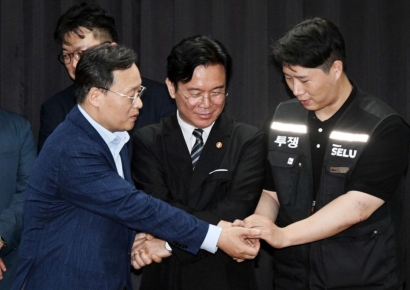 Dramatic Agreement Reached on Eve of Samsung Electronics General Strike... Minister Kim Young-hoon: "Showcased Korea's Strength in Dialogue" (Update)
- "It Has Now Crossed Borders": No Vaccine or Treatment as Bundibugyo Ebola Variant Spreads [Reading Science]
- "Even With a 90 Million Won Salary and Bonuses, It Doesn’t Feel Like Much"... A Latecomer Rookie Who Beat 70 to 1 Odds [Scientists Are Disappearing] ③
- "Stocks Are Not Taxed, but Annual Crypto Gains Over 2.5 Million Won to Be Taxed Next Year... Investors Push Back"
- "Who Is Visiting Japan These Days?" The Once-Crowded Tourist Spots Empty Out... What's Happening?
The choice for women in their twenties like Lee Seo-yeon to escape gender discrimination in the labor market and the threat of everyday sexual crimes is to refuse marriage and childbirth. Most of the Lee Seo-yeons who responded to the interview said, "I won't live like my mother." They feel sorry for both full-time housewives and working moms who have given up parts of their lives due to childbirth and childcare. Lee Seo-yeon in her late twenties said, "I also dislike the inequality of the institution called marriage," pointing out, "Childbirth and childcare force more sacrifices on women under the name of motherhood." Professor Bae explained, "The primary responsibility for childcare lies with women, and men's responsibility is still only auxiliary. Since women's childcare responsibilities act as obstacles to promotion at work, women who value their careers tend not to marry or have children." This is part of women's efforts to avoid indirect discrimination in the labor market.
© The Asia Business Daily(www.asiae.co.kr). All rights reserved.