Disease Control Headquarters Expands, Secures Experts as Priority... Allows Key Executives to Be Hired as Research Staff
Elevation of Korea Centers for Disease Control and Prevention... Korea Disease Control Agency Launches on the 12th
Many Research Positions Expected to Be Assigned to Affiliated Institutes and Centers as Well

The exterior view of the Korea Disease Control and Prevention Agency in Osong-eup, Heungdeok-gu, Cheongju-si, Chungbuk
[Asia Economy Reporter Choi Dae-yeol] According to the ordinance on the establishment of the Disease Control Agency confirmed at the Cabinet meeting on the 8th, the number of personnel under the Disease Control Agency (currently the Korea Disease Control and Prevention Agency) will increase to about 1,500. As the novel coronavirus infection (COVID-19) that emerged earlier this year escalated into a disaster situation, efforts have been made to enhance infectious disease response capabilities while reinforcing necessary positions in various fields. Since expertise is crucial in the health, medical, and disease control sectors, securing external experts is considered a key issue.
According to the ordinance on the establishment of the Disease Control Agency and the amendment of the Ministry of Health and Welfare’s organization announced by the Ministry of the Interior and Safety on the same day, the Korea Disease Control and Prevention Agency, which currently has a staff of 907, will be promoted to an agency on the 12th, increasing its staff to 1,476. This is an increase of 569 personnel (42%), with 384 being pure additional personnel excluding reassignments. The headquarters will have 438 personnel, and affiliated institutions such as the National Institute of Health, regional Disease Response Centers, and Quarantine Stations will have 1,038 personnel.
The first commissioner of the Disease Control Agency is expected to be Jeong Eun-kyung, the current head of the Korea Disease Control and Prevention Agency, who is leading the COVID-19 response control tower. The vice-ministerial level position will remain after the promotion. Notably, most of the key division and bureau chief positions (senior public officials grade A and B) can be held not only by civil servants but also by research personnel. This applies to all bureau chief positions, including the newly established Crisis Response Analyst and Deputy Commissioner directly under the commissioner, as well as departments related to infectious diseases, medical safety, and chronic diseases.

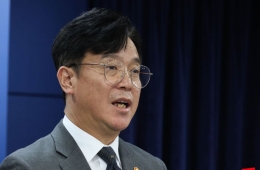
Jung Eun-kyung, head of the Central Disease Control Headquarters (Director of the Korea Disease Control and Prevention Agency, photo left), is having a discussion at the Central Disaster and Safety Countermeasures Headquarters meeting held on the 2nd.
Due to the nature of the health and medical fields, there are many health-related civil servants and research personnel recruited externally in the current Ministry of Health and Welfare and the Korea Disease Control and Prevention Agency. However, in the case of the Korea Disease Control and Prevention Agency, which requires more expertise compared to the Ministry of Health and Welfare, there have been controversies over professionalism as some administrative positions have been occupied by Ministry of Health and Welfare administrative staff through rotational assignments rather than based on job characteristics.
This is partly because the Korea Disease Control and Prevention Agency has faced difficulties in hiring experts. A clear example is that many physician civil servants resigned during the 2015 Middle East Respiratory Syndrome (MERS) outbreak. Previously, as an institution under the Ministry of Health and Welfare, positions were limited and projects and budgets were not free from the Ministry’s influence. One of the reasons for its independence as an external agency this time is that a considerable number of Ministry of Health and Welfare civil servants expressed their intention to transfer to the Disease Control Agency.
In addition to the newly established Disease Control Agency headquarters, research personnel recruitment is possible for positions such as the Director of the National Institute of Health, bureau chief level positions under the director (Research Planning Department, Future Medical Research Department, Chronic Disease Convergence Research Department), the Director of the National Infectious Disease Research Institute under the Disease Response Center, and each center chief (Emerging Virus Research, Infectious Disease Research, Public Vaccine Development Support Center). The position of the Director of the Infectious Disease Research Institute is explicitly designated as an open position. Since there has been a shortage of experts such as physicians, securing suitable experts in each field throughout the headquarters and affiliated institutions will be a key factor for the Disease Control Agency to fulfill its role going forward.
Hot Picks Today
 "Stocks Are Not Taxed, but Annual Crypto Gains Over 2.5 Million Won to Be Taxed Next Year... Investors Push Back"
- "Don't Throw Away Coffee Grounds" Transformed into 'High-Grade Fuel' in Just 90 Seconds [Reading Science]
- Signed Without Viewing for 1.6 Billion Won... Jamsil and Seongbuk Jeonse Prices Jump 200 Million Won in a Month [Real Estate AtoZ]
- "Groups of 5 or More Now Restricted"... Unrelenting Running Craze Leaves Citizens and Police Exhausted
- "Even With a 90 Million Won Salary and Bonuses, It Doesn’t Feel Like Much"... A Latecomer Rookie Who Beat 70 to 1 Odds [Scientists Are Disappearing] ③
© The Asia Business Daily(www.asiae.co.kr). All rights reserved.