National Debt per Child Reaches 133.31 Million KRW... 11-Fold Increase Over 18 Years
Annual National Debt of 64.84 Million KRW per Household of Four Members
[Asia Economy Reporter Kwangho Lee] The national debt per child aged 0 to 14 in Korea increased from 12.36 million won in 2001 to 133.31 million won in 2020, a staggering 10.8-fold increase. This is due to the sharp rise in national debt alongside a decrease of 3.55 million in the child population (0-14 years), from 9.85 million in 2001 to 6.3 million in 2020.
On the 2nd, the Korea Taxpayers Federation stated, "Our country's national debt is expected to surge 6.9 times from 122 trillion won in 2001 to 839 trillion won in 2020, and the national debt-to-GDP ratio is projected to jump from 17% to 44% during the same period."
The 2020 national debt figure reflects the 3rd supplementary budget (839.4 trillion won), and this year's GDP is estimated to decline by 1.3% compared to last year (based on the recent Bank of Korea announcement). Accordingly, this year's national debt increased by 110.6 trillion won from last year's 728.8 trillion won, while GDP decreased from 1,919 trillion won to 1,894 trillion won, down 1.3%.
National debt per capita was 2.57 million won in 2001 and increased 6.3 times to 16.21 million won in 2020. This means that the annual national debt per four-person household amounts to 64.84 million won.
The Federation expressed concern, saying, "Although the government claims that Korea's national debt level is favorable compared to OECD countries, Korea often classifies amounts that other advanced countries count as national debt as public enterprise debt. Given the global low-growth phase, the world's highest levels of aging and low birth rates, the fact that Korea is not a reserve currency country, and above all, the rapid decrease in tax revenue, the speed of national debt increase is too fast."
They added, "While a temporary increase in national debt is necessary during economic crises such as the COVID-19 pandemic, maintaining fiscal deficits and expanding welfare while cutting taxes even when the economy is good normalizes chronic deficits, which is a shortcut to becoming like Greece or Italy," criticizing the policy.
Furthermore, they argued, "To improve the efficiency of fiscal spending such as emergency disaster relief funds, an administrative infrastructure must first be established to reduce tax exemptions, reductions, separate taxation, and the underground economy, thereby creating a system for selective payments."
Kim Seontak, Chairman of the Federation, emphasized, "National debt involves different people spending and repaying money, which can lead to moral hazard and political populism. We must recognize that today's debt is tomorrow's tax, and the increased national debt today is money that our children and grandchildren will eventually have to repay."
He continued, "A prerequisite for successful expansionary fiscal policy is ensuring fiscal transparency. However, there are special activity budgets used without receipts for taxpayers' money, and the reality is that public officials' salaries are not disclosed by job type, rank, or step. It is very concerning that the government has prepared next year's budget at 555.8 trillion won, an 8.5% increase over this year's original budget."
Hot Picks Today
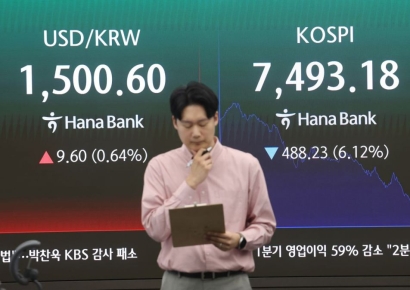 After Topping 8,000 Instead of Hitting 10,000... KOSPI Plunges—When Will It Rebound?
- "Samsung and Hynix Were Once for the Underachievers"... Hyundai Motor Employee's Lament
- [Breaking] Court Rules Against Samsung Electronics Union...1 Billion Won per Day Penalty for Exceeding Strike Scope
- Six Economic Organizations Urge Withdrawal of Samsung Electronics Strike Plan...Warn of National Loss of Opportunity
- "That? It's Already Stashed" Nightlife Scene Crosses the Line [ChwiYak Nation] ③
He added, "In a country with the world's highest levels of aging and low birth rates, careful management of national finances cannot be overemphasized. Politicians must be thoroughly scrutinized to ensure they do not waste unnecessary budgets for votes."
© The Asia Business Daily(www.asiae.co.kr). All rights reserved.







