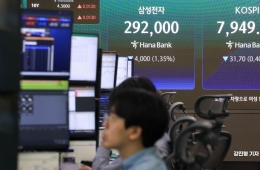
Foreigners Pull Out from Samsung Electronics, Buy Semiconductor Stocks on KOSDAQ Instead
Foreigners Net Sell About 250 Billion Won in Two Trading Days... Largest Scale Since May
Contrasting Mood to Over 2.6 Trillion Won Bought Last Month
Analyzed as Short-Term Profit Taking... Semiconductor Sector Has Ample Room for Growth

[Asia Economy Reporters Minwoo Lee, Minji Lee] Since the beginning of this month, foreign investors have started selling off Samsung Electronics, the 'blue-chip' of the domestic stock market. This contrasts with the nearly 2.7 trillion KRW they purchased until last month. However, it is uncertain whether this trend will continue in the long term. Given that the semiconductor sector's rise has been sluggish compared to major sectors that recently led the stock market such as bio, battery, and internet, there is a forecast that the semiconductor sector as a whole, including Samsung Electronics, may experience an upward trend in the future.
According to the Korea Exchange on the 5th, foreigners net sold Samsung Electronics shares worth 178.5 billion KRW on the 3rd. This is the largest single-day net selling amount since May 4th, when it was 287.1 billion KRW. They also sold 68.3 billion KRW worth the following day. In just two trading days at the beginning of this month, they net sold 246.8 billion KRW. This is in stark contrast to last month when buying surged amid expectations of strong second-quarter earnings this year. Earlier, Samsung Electronics announced on the 14th of last month that it posted sales of 50 trillion KRW and operating profit of 8.1 trillion KRW in the second quarter of this year. While sales decreased by 7.36% year-on-year, operating profit increased by 22.7%. It is regarded as a surprise performance despite the economic downturn caused by the COVID-19 pandemic. Foreign investors purchased over 2.6682 trillion KRW worth of Samsung Electronics shares last month alone, and more than 3 trillion KRW over June and July.
The stock price is also showing a downward trend. After surpassing the 60,000 KRW mark for the first time in about five months on the 29th, it has declined for four consecutive trading days. As of 9:10 AM on the day, it fell to 56,800 KRW. Just as it was about to settle as a '60,000 KRW stock,' it slipped back to the mid-50,000 KRW range.
Industry experts analyze that this is a temporary adjustment caused by short-term profit-taking, as various positive factors still remain. First, Intel's release of a vast amount of outsourced production due to delays in next-generation semiconductor production is expected to have a positive effect. Although the foundry (semiconductor contract manufacturing) business accounts for a small portion within the company, its scale ranks second in market share (18.8%) after Taiwan's TSMC (51.5%), which could create a kind of trickle-down effect. There is also anticipation of political benefits from the U.S. presidential election. If Joe Biden, the Democratic candidate, wins and tensions between the U.S. and China ease, foreign investors' interest in Samsung Electronics is expected to increase compared to TSMC, which has already clearly sided with China.
Compared to the 'BBIG' sectors?Battery (B), Bio (B), Internet (I), and Games (G)?which have recently led the domestic stock market rally, Samsung Electronics is considered undervalued, leaving room for growth. Hyunsoo Kwak, a researcher at Shinhan Financial Investment, explained, "While the BBIG sectors have driven the KOSPI index up by 5.3% since the beginning of the year, the semiconductor sector has only contributed 0.2%. Considering the possibility of a pause in the U.S. stock market and the domestic market entering the final phase of normalization, the semiconductor sector including Samsung Electronics could be an alternative."
In the KOSDAQ market, a semiconductor-focused trend is already emerging. Foreign investors who had heavily purchased COVID-19 related therapeutics, vaccines, and diagnostic kit stocks are shifting to semiconductor-related stocks. Since the beginning of this month, the top foreign net-sold stock is Seegene, the leading COVID-19 diagnostic kit company, with 141.7 billion KRW sold in just two trading days. Following are Enzychem Lifesciences (3.8 billion KRW), Huons (3.6 billion KRW), Bioneer (3.5 billion KRW), Sugentech (3.2 billion KRW), and Boditech Med (3.1 billion KRW), with therapeutic and diagnostic kit developers accounting for 60% of the top 10 net-sold stocks.
Hot Picks Today
 Up to 600 Million Won for Semiconductors, 160 Million Won Bonus for Loss-Making Non-Memory… Samsung Electronics Labor and Management Reach Tentative Deal on Unprecedented Performance Compensation (Comprehensive)
- "Could I Also Receive 370 Billion Won?"... No Limit on 'Stock Manipulation Whistleblower Rewards' Starting the 26th
- "From a 70 Million Won Loss to a 350 Million Won Profit with Samsung and SK hynix"... 'Stock Jackpot' Grandfather Gains Attention
- Opening a Bank Account in Korea Is Too Difficult..."It Costs 150,000 Won Just to Open a Child's Account or Check Card" [Foreigner K-Finance Status]②
- "Who Is Visiting Japan These Days?" The Once-Crowded Tourist Spots Empty Out... What's Happening?
Foreign investors have chosen semiconductor-related stocks over bio stocks. Among the top 10 foreign net-bought stocks this month are semiconductor and related companies such as Cheonbo (7 billion KRW), Duksan Neolux (5.8 billion KRW), Miko (5.7 billion KRW), Symtek (4.9 billion KRW), and BH (4.8 billion KRW).
© The Asia Business Daily(www.asiae.co.kr). All rights reserved.
!["Please Help": How Much Do Those Bowing 90 Degrees Really Earn? [Data Pick]](https://cwcontent.asiae.co.kr/asiaresize/307/2026052010120870131_1779239528.png)