Ruling Party Controls Legislation Committee, Deploys Legal Professionals for Aggressive Judicial Reform
Democratic Party Announces Strong Drive on Corruption Investigation Office
United Party Expected to Counterattack with Veto Power over Chief
Inevitable Confrontation between Ruling and Opposition in Legislation Committee
![[Image source=Yonhap News]](http://www.asiae.co.kr/news/img_view.htm?img=2020061519542596086_1592218465.jpg)
[Asia Economy Reporter Kang Nahum] With the Democratic Party of Korea taking control of the National Assembly's Legislation and Judiciary Committee, it is expected to accelerate judicial reforms, including the establishment of the High-ranking Officials' Crime Investigation Agency (Gong-su-cheo). However, it is highly likely that the United Future Party will use its veto power over the head of Gong-su-cheo as a retaliatory card in the negotiation over the organization of the National Assembly, making another clash inevitable.
On the 15th, the Democratic Party elected four-term party leader Yoon Ho-jung as the chairperson of the Legislation and Judiciary Committee during the plenary session. The chairperson position was the biggest point of contention in the 21st National Assembly's organizational negotiations. The chairperson of the Legislation and Judiciary Committee has played the so-called "gatekeeper" role by reviewing bills passed by each standing committee through the authority of "systematic and grammatical review" before sending them to the plenary session. This position holds strong power to control the passage of bills to the plenary session. Therefore, both ruling and opposition parties fiercely competed to secure this chairperson position during the organizational negotiations.
By ultimately securing this position, the Democratic Party is evaluated to be able to drive judicial reforms, including the launch of Gong-su-cheo, more strongly. In particular, appointing Yoon, a core figure of the party leadership faction who is not a legal professional, as the chairperson despite his non-legal background, is interpreted as an intention to smoothly push forward various legislative agendas through a weighty leadership appointment. In fact, right after his election, Chairperson Yoon expressed his determination for judicial reform, saying, "I will complete the reform of the judiciary and prosecution, which is one of the last reform tasks in our society."
The Democratic Party also demonstrated its commitment to completing judicial reform within the 21st National Assembly by assigning legal professionals to the Legislation and Judiciary Committee. Members with backgrounds as judges such as Park Beom-gye and Choi Ki-sang, former prosecutors Baek Hye-ryun, Song Ki-heon, and So Byung-chul, and lawyers Kim Yong-min, Kim Nam-guk, and Park Joo-min were assigned to the committee. However, former police officer Hwang Un-ha and judge Lee Soo-jin (Dongjak-eul) were assigned to the Industry, Trade, Energy, Small and Medium Business Committee instead of the Legislation and Judiciary Committee. Additionally, Choi Kang-wook, leader of the Open Democratic Party, classified as pro-ruling, was excluded from the Legislation and Judiciary Committee and placed in the Land, Infrastructure and Transport Committee.
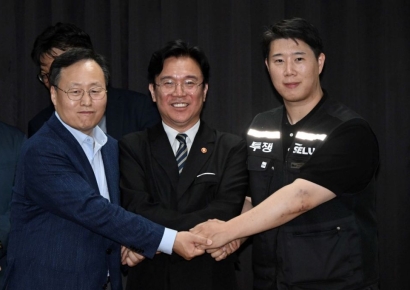
![[Image source=Yonhap News]](http://www.asiae.co.kr/news/img_view.htm?img=2020061607034696303_1592258626.jpg)
The first point of conflict within the Legislation and Judiciary Committee is expected to be the establishment of Gong-su-cheo. The Democratic Party has already proposed follow-up bills related to Gong-su-cheo, including partial amendments to the National Assembly Act, partial amendments to the Personnel Hearing Act, and rules concerning the operation of the candidate recommendation committee for the head of Gong-su-cheo. Since the majority of the committee members belong to the Democratic Party, these bills are expected to pass smoothly.
However, persuading the United Future Party after the passage of the laws is an unavoidable task for the Democratic Party. This is because the United Future Party holds both of the two candidate recommendation committee seats that can nullify the ruling party's sole recommendation of the Gong-su-cheo head candidate. According to related laws, if the United Future Party does not exercise its recommendation rights or if its two recommended members oppose the candidate recommendation, the launch of Gong-su-cheo will inevitably be indefinitely delayed.
Hot Picks Today
 Samsung Electronics Introduces New "Special Performance Bonus" for Semiconductors, Paid Entirely in Company Shares
- "Could I Also Receive 370 Billion Won?"... No Limit on 'Stock Manipulation Whistleblower Rewards' Starting the 26th
- "From a 70 Million Won Loss to a 350 Million Won Profit with Samsung and SK hynix"... 'Stock Jackpot' Grandfather Gains Attention
- Hyundai Mobis, Key Supplier for Hyundai’s Atlas, Target Price Raised [Click eStock]
- "Who Is Visiting Japan These Days?" The Once-Crowded Tourist Spots Empty Out... What's Happening?
It is a painful point for the Democratic Party that Joo Ho-young, the floor leader of the United Future Party, who had shown a favorable attitude toward the launch of Gong-su-cheo among opposition figures, announced his intention to resign from his floor leader position. This makes it even harder to expect the United Future Party to switch to a negotiation mode. There is also speculation that the United Future Party, which had been dragged along by the Democratic Party in the organizational negotiations, might use the "recommendation right for the Gong-su-cheo head" as a retaliatory card for losing major standing committees. Accordingly, it is anticipated that an extreme confrontation between the ruling and opposition parties, comparable to the organizational negotiations, will unfold within the Legislation and Judiciary Committee in the future.
© The Asia Business Daily(www.asiae.co.kr). All rights reserved.







