[People人] Byeon Chang-heum, LH President, Advocate of the 'Korean-style Green New Deal' Movement
[Asia Economy Reporter Yoo In-ho] Byun Chang-hoom, President of Korea Land and Housing Corporation (LH), recently became a hot topic due to the results of big data analysis by a private research institute.
It was found that among major public enterprise CEOs over the past three months since the COVID-19 outbreak, he received the most attention based on information volume.
The industry evaluates that the reason for this heightened interest is closely related to the government's 'Green New Deal,' presented as part of the Korean-style New Deal.
On the 29th of last month, he held a meeting with representatives of 19 construction companies and stated, "This year, we will invest the largest public sector project budget of 23.7 trillion won and actively support the Korean New Deal policy." This is unusual as an individual public enterprise's move, especially when even the government has not yet drawn a concrete plan for the Green New Deal.
Byun's recent actions remind one of a 'New Deal' and 'Green New Deal' evangelist. At a joint forum titled "Building Green Remodeling and the Korean New Deal," hosted by the Presidential Policy Planning Committee's Special Committee on Income-led Growth, he emphasized the definition of the Green New Deal.
Byun advocates that to realize the Green New Deal, the government must actively support and lead the public sector to induce private sector participation.
He argues that through large-scale renovation and remodeling projects for aging buildings, public investment should act as a catalyst to attract private investment. His idea is that eco-friendly urban regeneration and housing welfare projects can harmonize the two sides of the same coin: 'Green' and 'New Deal.'
Those around him say that Byun's confidence comes from his rich experience in urban administration. He is regarded as a domestic expert in urban regeneration and housing welfare, having served as the head of both SH Corporation and LH, the two major public enterprises in the urban and housing sectors.
Graduating from Seoul National University’s Department of Economics, he built his career in urban regeneration and housing welfare. He earned a master's degree in urban planning and a doctorate in public administration from Seoul National University Graduate School. He worked as a senior researcher at Seoul Metropolitan Development Corporation and as an associate researcher at Seoul Institute, establishing his ties to urban administration.
During this period, he participated in land use planning for Sangam DMC in Seoul and design for the Magok district. Later, he moved to Sejong University as a professor in the Department of Public Administration, where he worked as an expert proposing various models in housing welfare, urban development, and real estate policy, and served as the director of the Korea Urban Research Institute.
After Park Won-soon became mayor of Seoul in 2011, Byun participated in the Hope Seoul Policy Advisory Group. From 2014 to 2016, he served as president of SH Corporation and was recognized as a key figure leading Seoul’s urban regeneration policy framework that actively introduced preservation-type regeneration. At that time, Kim Soo-hyun, former Blue House Policy Chief, served as president of the Seoul Institute and worked with Byun to establish the policy framework for urban regeneration projects.
Byun is evaluated as having significant influence beyond the public enterprise’s inherent role of policy execution, impacting major policy processes. He has been involved in major policy issues such as housing supply, urban regeneration, housing welfare roadmaps, construction of the 3rd new town, and smart cities.
He is also transforming LH’s role. Beyond simply being a land and housing supplier, LH is expanding its role as a 'public developer' in urban regeneration projects. As of last year, LH participates in 47 urban regeneration New Deal projects.
However, he faces considerable challenges. The expansion of public rental housing projects and a large increase in public orders to stimulate economic recovery could burden LH’s already fragile financial soundness, which is a challenge Byun must address.
According to data submitted by LH to Assemblyman Joo Seung-yong during the National Assembly audit last October, LH’s rental housing business recorded a loss of 984.8 billion won in 2018. Although the debt ratio, which reached 408% in 2014, improved significantly to 254.2% last year, the debt scale still amounts to 126.68 trillion won.
Hot Picks Today
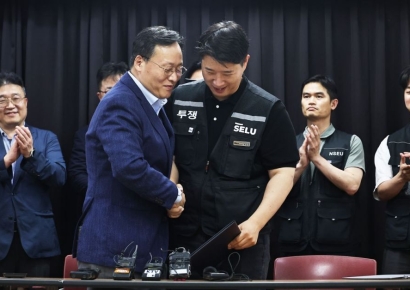 Up to 600 Million Won for Semiconductors, 160 Million Won Bonus for Loss-Making Non-Memory… Samsung Electronics Labor and Management Reach Tentative Deal on Unprecedented Performance Compensation (Comprehensive)
- "Could I Also Receive 370 Billion Won?"... No Limit on 'Stock Manipulation Whistleblower Rewards' Starting the 26th
- "From a 70 Million Won Loss to a 350 Million Won Profit with Samsung and SK hynix"... 'Stock Jackpot' Grandfather Gains Attention
- [Scientists Are Disappearing]④A Shaky Regional Research Ecosystem... "Professors Now Take the Initiative"
- "Who Is Visiting Japan These Days?" The Once-Crowded Tourist Spots Empty Out... What's Happening?
Entering his second year in office, Byun plans to devote himself to urban regeneration, housing welfare, and the Green New Deal, following his motto "Hangshim (恒心 - a heart that never changes)." Attention is focused on what achievements LH, under his leadership, will bring about in the Green New Deal policy.
© The Asia Business Daily(www.asiae.co.kr). All rights reserved.
!["Please Help": How Much Do Those Bowing 90 Degrees Really Earn? [Data Pick]](https://cwcontent.asiae.co.kr/asiaresize/307/2026052010120870131_1779239528.png)