Daejeon Station 'Jjokbangchon' Fades into History... Urban Regeneration Project Leads Old Downtown Transformation

[Asia Economy (Daejeon) Reporter Jeong Il-woong] The shantytown area around Daejeon Station is disappearing into the annals of history.
Daejeon Station, established in 1905 with the opening of the Gyeongbu Line, has positioned itself as a key hub for railway passenger and freight transport, becoming the gateway and face of Daejeon's commercial district.
However, during the Korean War, refugees gathered to form the shantytown, and following the IMF financial crisis, the number of homeless people surged. Along with the development of new towns on elevated roads, the commercial district gradually declined, and the proximity of aging low-rise residential areas led to the loss of its function as a central area.
In this regard, Daejeon City and the government are drawing up a blueprint to restore the function of the old downtown area around Daejeon Station and revitalize the local commercial district by promoting an urban regeneration project centered on the redevelopment of the shantytown.
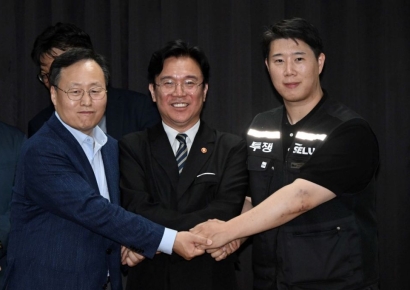
According to Daejeon City on the 22nd, the city, the Ministry of Land, Infrastructure and Transport, and Dong-gu Office of Daejeon announced the 'Daejeon Station Shantytown Urban Regeneration Plan' at the Korea Railroad (KORAIL) headquarters' main conference room.
The urban regeneration plan includes the participation of Dong-gu Office, LH Korea Land and Housing Corporation, and Daejeon Urban Corporation as joint project implementers to redevelop the Daejeon Station shantytown through a public housing project.
The public housing project will be carried out on a total area of 27,000㎡, combining the shantytown (15,000㎡) and nearby railway land (12,000㎡), creating 1,400 housing units including 250 permanent rental units, 450 happy housing units, and 700 private sale units, along with mixed-use office land.
Among these, the permanent rental housing will be used as living spaces for current residents of the shantytown. During the development period, shantytown residents will stay in temporary relocation spaces prepared nearby. To this end, the city and Dong-gu Office plan to rent lodging facilities within the urban regeneration project area to provide temporary housing for the shantytown residents.
In the future, shantytown residents will be able to use permanent rental housing of about 16㎡ (typically, shantytown rooms are within 6.6㎡) at an average rent of 31,000 KRW. Additionally, the complex will include a living support center and care facility Bethel House, which provide psychological therapy, vocational training, and self-sufficiency support to help residents settle into their new homes. Bethel House has been providing free meals and medical care to shantytown residents.

Daejeon City Urban Regeneration New Deal Project Plan (Draft). Provided by Daejeon City
View original imageHappy housing is expected to mainly accommodate newlyweds and young adults starting their social lives. The complex will also include social welfare facilities such as a health promotion center for local residents and a public library.
The public housing project will designate the public housing district in the second half of this year after collecting residents' opinions and completing related procedures, begin compensation work next year, and aim for construction to start in 2022 and occupancy in 2024.
Along with public housing, the mixed-use office land within the public housing district will introduce urban business complexes such as a railway industry complex cluster and central commercial facilities for conventions, exhibitions, and meetings. In particular, the railway industry complex cluster will serve as a space to consolidate aging railway office facilities scattered around Daejeon Station, the Railway Talent Development Institute, and research and development centers.
Hot Picks Today
 Samsung Electronics Introduces New "Special Performance Bonus" for Semiconductors, Paid Entirely in Company Shares
- "Could I Also Receive 370 Billion Won?"... No Limit on 'Stock Manipulation Whistleblower Rewards' Starting the 26th
- Opening a Bank Account in Korea Is Too Difficult..."Over 150,000 Won in Notarization Fees Just for a Child's Account and Debit Card" [Foreigner K-Finance Status]②
- Jeon Du-hwan with a Starbucks Tumbler, "Donjjul" Proof Shots... Has Starbucks Become a Far-Right Symbol?
- "Who Is Visiting Japan These Days?" The Once-Crowded Tourist Spots Empty Out... What's Happening?
Above all, the Ministry of Land, Infrastructure and Transport, the city, and the district office plan to attract various research institutes and high-tech industries to bring young talent into the old downtown area around Daejeon Station and lay the foundation for revitalizing the nearby commercial district.
© The Asia Business Daily(www.asiae.co.kr). All rights reserved.
!["Please Help Us": How Much Do Those Bowing Deeply for Your Vote Really Earn? [Data Pick]](https://cwcontent.asiae.co.kr/asiaresize/307/2026052010120870131_1779239528.png)






