Say "Contactless Service" as "Non-face-to-face Service"
Ministry of Culture and National Institute of Korean Language Announce Alternative Terms for 'Contactless Service' and 'Unique Local Attractions'

[Asia Economy Reporter Jonggil Lee] The Ministry of Culture, Sports and Tourism and the National Institute of the Korean Language recommended on the 14th that the terms ‘untact service’ and ‘unique venue’ be replaced with the Korean expressions ‘bidaemyeon service’ (non-face-to-face service) and ‘isaek jiyeok myeongso’ (distinctive local attraction), respectively.
‘Untact service’ refers to services provided without direct face-to-face contact between people. It allows customers to shop with minimal interaction with staff, reducing their burden. With the rise of unmanned kiosks due to minimum wage increases and other factors, this is commonly applied in fast food restaurants, convenience stores, and similar places. The two organizations decided to use ‘bidaemyeon’ (non-face-to-face) as the alternative to ‘untact.’ Accordingly, terms like ‘untact consumption,’ ‘untact method,’ and ‘untact recruitment’ can be refined and used as ‘bidaemyeon consumption,’ ‘bidaemyeon method,’ and ‘bidaemyeon recruitment.’
‘Unique venue’ is a compound of ‘unique’ and ‘venue.’ It refers to traditional houses, museums, villages, and other places where one can experience the unique culture or characteristics of a region. As more people seek locations equipped with meeting and lodging facilities as well as tourism and experiential content, this term has become frequently used.
Hot Picks Today
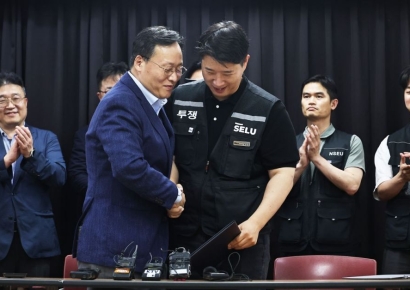 Up to 600 Million Won for Semiconductors, 160 Million Won Bonus for Loss-Making Non-Memory… Samsung Electronics Labor and Management Reach Tentative Deal on Unprecedented Performance Compensation (Comprehensive)
- "Could I Also Receive 370 Billion Won?"... No Limit on 'Stock Manipulation Whistleblower Rewards' Starting the 26th
- "From a 70 Million Won Loss to a 350 Million Won Profit with Samsung and SK hynix"... 'Stock Jackpot' Grandfather Gains Attention
- [Click eStock] "Hyundai Motor's New Business Value Reassessed... Target Price Raised to 770,000 Won"
- "Who Is Visiting Japan These Days?" The Once-Crowded Tourist Spots Empty Out... What's Happening?
The two organizations decided on these alternatives during the Saemal Meeting held from the 6th to the 8th. The Saemal Meeting is a committee that provides easy-to-understand Korean alternatives before difficult foreign loanwords and neologisms spread. Experts from various fields including Korean language, foreign languages, education, publicity and publishing, information and communication, and media participate. The Ministry of Culture, Sports and Tourism and the National Institute of the Korean Language plan to continuously promote the use of these alternatives, encouraging government ministries and media outlets to take the lead.
© The Asia Business Daily(www.asiae.co.kr). All rights reserved.







