Instead of Safe Assets, Increasing Fund Size with Equity Funds... Setting Amount Up↑
Domestic Equity Funds See Net Inflow of KRW 1.0573 Trillion
Index Rise Expectations...Bond Funds Experience Outflow of KRW 1.0479 Trillion
[Asia Economy Reporter Oh Ju-yeon] Following the US-China Phase One trade agreement, global stock market investment sentiment has recovered, leading to a surge in demand for products composed of risk assets in the domestic fund market. Last year, gold funds and bonds, considered safe assets that could provide stable returns in a low-interest-rate era, attracted attention. However, this year, the amount of stock-type exchange-traded funds (ETFs) has increased, indicating heightened expectations for stock price rises.

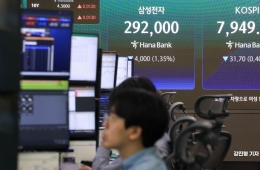
According to financial information provider FnGuide on the 20th, as of the closing price on the 17th, a total of 1.0573 trillion KRW flowed into domestic equity funds with assets under management of over 1 billion KRW in the past month. This is due to the risk asset preference trend strengthening as the KOSPI surpassed last year's high of 2250 at the beginning of the year and again exceeded the 2260 level during intraday trading. In particular, funds flowed more into index funds (1.4737 trillion KRW), which track stock index returns, rather than actively managed funds (-416.4 billion KRW), reflecting expectations for future index gains.
This contrasts with the decline in popularity of bonds, which were considered safe assets throughout last year, both domestically and internationally. Domestic bond funds saw an outflow of 1.0479 trillion KRW, and overseas bond funds experienced a net outflow of 184.5 billion KRW. Even gold funds, which attracted capital last year due to high returns, saw an outflow of 16 billion KRW in the past month.
Conversely, as expectations for Samsung Electronics' earnings increased, Samsung Group stock funds attracted 266.3 billion KRW, and IT funds saw an inflow of 46.4 billion KRW. The returns of these funds have also met investors' heightened expectations. Domestic bond-type ETFs yielded only 0.02%, but domestic equity-type ETFs recorded a one-month return of 6.39%, outperforming overseas equity-type ETFs, which returned 3.82%. In particular, supported by the stock price rally driven by expectations of semiconductor industry improvement, Samsung Group funds rose 7.36%, and IT funds increased 7.57% over the past month.
Although net outflows continue in overseas bond funds, high-yield bonds, which are high-risk and high-return bonds, attracted a net inflow of 2.7 billion KRW, drawing attention. This is analyzed as investors showing increased interest in high-yield corporate bonds, which have lower credit ratings and relatively higher investment loss risks among corporate bonds.
Researcher Cho Seung-bin of Daishin Securities said, "With the continuation of the low-interest-rate environment, it has become difficult to expect high returns from government bonds or investment-grade corporate bonds. Due to accommodative monetary policies by global central banks, the global liquidity environment remains favorable, and with expectations for US-China trade negotiations and global economic recovery, risk asset preference has strengthened, accelerating capital inflows into high-yield corporate bonds." He explained that as the anticipated signals of global economic recovery become visible, investors' interest in risk assets such as high-yield corporate bonds is expected to continue for the time being.
The preference for risk assets is also appearing in the commodity market, leading to expectations of price increases for copper and crude oil. Researcher Kim So-hyun of Daishin Securities predicted, "Commodity investment sentiment, suppressed by demand uncertainty since 2018, is expected to recover," adding, "Non-ferrous metals within the commodity market will be the biggest beneficiaries."
Hot Picks Today
 Up to 600 Million Won for Semiconductors, 160 Million Won Bonus for Loss-Making Non-Memory… Samsung Electronics Labor and Management Reach Tentative Deal on Unprecedented Performance Compensation (Comprehensive)
- "Could I Also Receive 370 Billion Won?"... No Limit on 'Stock Manipulation Whistleblower Rewards' Starting the 26th
- "From a 70 Million Won Loss to a 350 Million Won Profit with Samsung and SK hynix"... 'Stock Jackpot' Grandfather Gains Attention
- [Scientists Are Disappearing]④A Shaky Regional Research Ecosystem... "Professors Now Take the Initiative"
- "Who Is Visiting Japan These Days?" The Once-Crowded Tourist Spots Empty Out... What's Happening?
The outlook for the domestic stock market is also generally optimistic. Researcher Kwak Hyun-soo of Shinhan Financial Investment said, "Ahead of the Lunar New Year holiday, the KOSPI is expected to maintain a gentle rebound trend," and analyzed, "In the transition from a liquidity-driven market to an earnings-driven market, semiconductor stocks are playing a leading role. The additional upside potential for the semiconductor sector is around 20%, and if their market capitalization increases by 20%, the KOSPI could see a 5-10% rise." He added, "While uncertainties surrounding Trump should be monitored, if these issues are resolved, breaking through the 2300 level on the KOSPI within the first quarter is also possible."
© The Asia Business Daily(www.asiae.co.kr). All rights reserved.
!["Please Help": How Much Do Those Bowing 90 Degrees Really Earn? [Data Pick]](https://cwcontent.asiae.co.kr/asiaresize/307/2026052010120870131_1779239528.png)