![North Korea conducted a ground ejection test of a high-power solid propellant engine using carbon fiber composite materials, witnessed by State Affairs Commission Chairman Kim Jong Un, the Korean Central Television reported on March 29 last month. [Korean Central Television screen] 2026.3.29 Yonhap News Agency](http://www.asiae.co.kr/news/img_view.htm?img=2026040913590019859_1775710740.jpg)
North Korea conducted a ground ejection test of a high-power solid propellant engine using carbon fiber composite materials, witnessed by State Affairs Commission Chairman Kim Jong Un, the Korean Central Television reported on March 29 last month. [Korean Central Television screen] 2026.3.29 Yonhap News Agency
원본보기 아이콘North Korea Conducts Cluster Munition Test... Iran Used Them to Penetrate Air Defenses
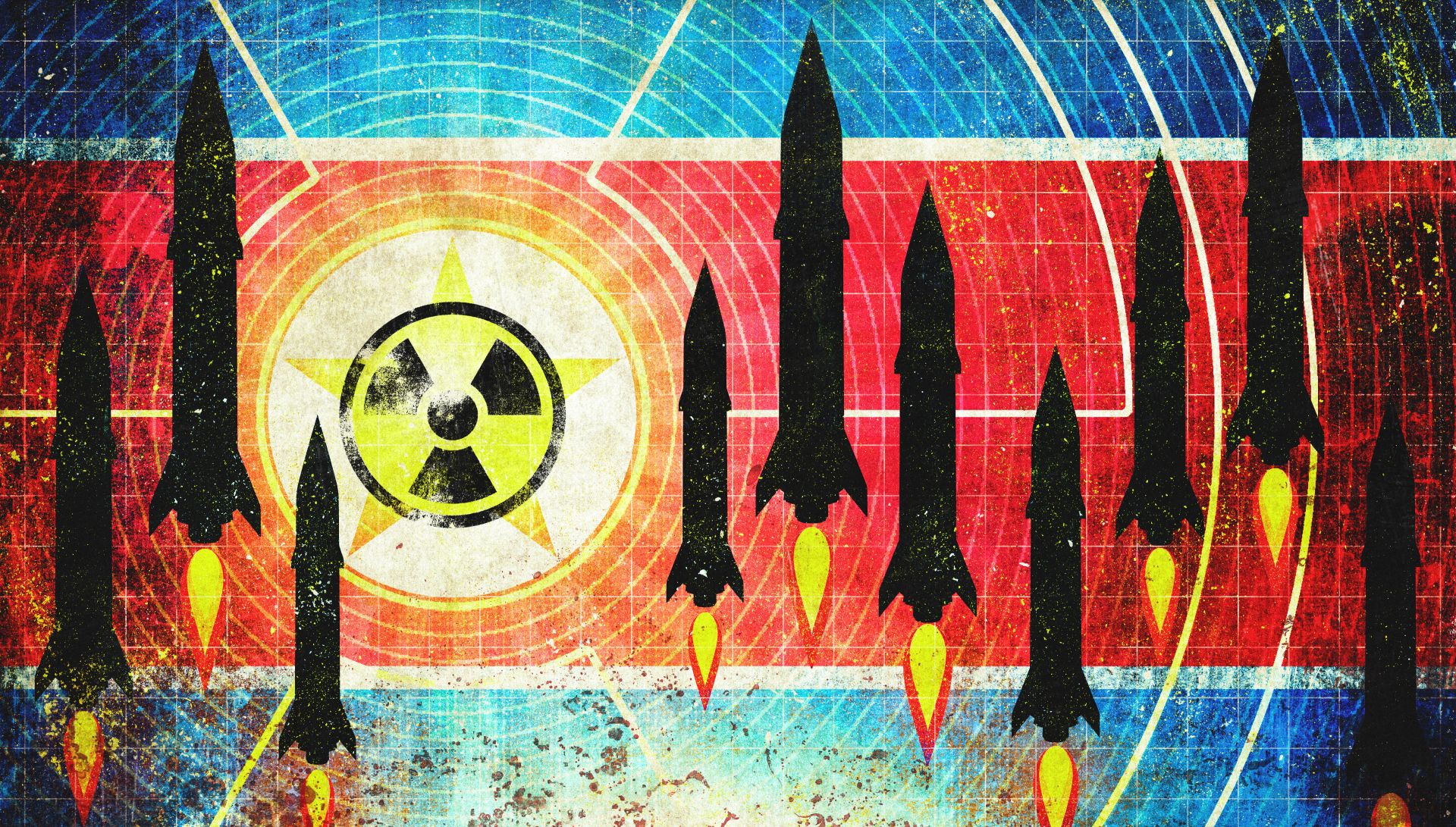
North Korea is accelerating improvements to its missile capabilities by observing recent trends in weapons development in global conflict zones. Analysts say North Korea is emulating Iran, which used cluster munitions to penetrate Israel's air defense systems, and is now targeting South Korea's air defenses.
On April 9, the Korean Central News Agency (KCNA) announced, "We conducted a test launch of the short-range ballistic missile (SRBM) 'Hwasong-11Ga' (KN-23) equipped with a cluster warhead," and added, "We confirmed that the submunition warhead can devastate a target area of 6.5 to 7 hectares with ultra-high density."

North Korea's Korean Central News Agency reported on the 15th that North Korean State Affairs Commission Chairman Kim Jong Un oversaw a strike drill involving 600mm ultra-precision multiple rocket launcher systems on the 14th of last month. Yonhap News Agency
원본보기 아이콘Cluster Munitions: Bombarding an Area Three to Four Times the Size of a Soccer Field... Aim to Neutralize KAMD
The cluster warhead mentioned by North Korea refers to cluster munitions. According to North Korea's claims, this marks a performance upgrade a decade after they first mounted cluster munitions on Scud missiles in 2016. Iran also fitted ballistic missiles with cluster warheads to destroy Israel's defense system. If a single ballistic missile descends with an intact large warhead, the defense system can intercept it relatively easily. However, the situation changes if the warhead separates into submunitions in the air, as with cluster munitions. The single incoming threat splits into multiple small targets, making tracking and interception much more complicated.
Typically, cluster munitions are anti-personnel weapons, and when the submunitions separate, they disperse over an area three to four times the size of a soccer field. However, North Korea claims a maximum impact area of 7 hectares (about 21,000 pyeong). This is three times larger than ordinary cluster munitions. The move is seen as an attempt to neutralize the Korea Air and Missile Defense (KAMD) system.

North Korean leader Kim Jong Un inspected an important military munitions factory under the Second Economic Commission, which produces portable light weapons such as pistols, together with his daughter Ju Ae on the 11th of last month, according to the Korean Central News Agency on the 12th. Kim was seen firing a pistol at the indoor shooting range set up within the factory. 2026.3.12 Photo by Yonhap News Agency
원본보기 아이콘Tests of Advanced Weapons Such as Power-Disruption Bombs... Advancing Asymmetric Capabilities
In addition, North Korea revealed that it had also conducted tests of electromagnetic weapon systems and dropped carbon fiber mock munitions. These carbon fiber munitions are known as power-disruption bombs. Such bombs are designed to paralyze the enemy's power grid in an emergency, cutting off critical electricity supplies necessary for operations. During the U.S. airstrikes on Yugoslavia in May 1999, F-117A stealth bombers dropped carbon fiber bombs, cutting off 70% of the electricity supplied across Yugoslavia and demonstrating their effectiveness. Experts assess that if North Korea uses power-disruption bombs, it could take seven hours to restore major facilities and more than twenty hours to restore general facilities.
Shin Jongwoo, Secretary General of the Korea Defense and Security Forum (KODEF), stated, "It appears that North Korea made this public to showcase the power of asymmetrical warfare, such as cluster munitions, as demonstrated in the Iran conflict," and added, "North Korea claims to have tested power-disruption bombs for attacks on industrial infrastructure-such as paralyzing the power grid in the event of a contingency on the Korean Peninsula. This suggests North Korea is now advancing its asymmetric warfare capabilities, as seen in recent developments."

Daughter of North Korean leader Kim Jong Un, Ju-ae, accompanied her father and military officials inside a tank during a coordinated attack tactical exercise held on the 19th of last month at Pyongyang's 60th Training Base, the Korean Central News Agency disclosed on the 20th. March 20, 2026 Yonhap News Agency
원본보기 아이콘-

Reporter Yang Nakgyu if@asiae.co.kr
-
Edit Sung Kiho kihoyeyo@asiae.co.kr
© The Asia Business Daily(www.asiae.co.kr). All rights reserved.

![[Exclusive] "Looking Beyond Financial Statements for Future Value"... IBK Injects 170 Billion Won into 72 Innovative Companies](https://cwcontent.asiae.co.kr/asiaresize/304/2026011314545989464_1768283699.jpg)