Adult reading rate collapses to 40%
Average annual reading volume is 2.4 books
Average annual reading volume is 2.4 books

by Kim Heeyun
by Choi Yujeong
Published 06 Mar.2026 14:13(KST)
Ministry of Culture, Sports and Tourism '2025 National Reading Survey'
While the adult reading rate has fallen below 40%, the student reading rate remains at a high level. However, among people in their 20s, there has been an increase in reading rates and a growing trend in the use of e-books and audiobooks, indicating a shift in reading habits.
The Ministry of Culture, Sports and Tourism announced on March 6 the results of the '2025 National Reading Survey', which was conducted with 5,000 adults aged 19 and older and 2,400 students from fourth grade and above in elementary school. The survey was carried out nationwide from September 1 to November 5, 2025.
According to the survey, the annual comprehensive reading rate for adults was 38.5%, a decrease of 4.5 percentage points compared to the 2023 survey. The average number of books read by adults over the past year was 2.4, which is 1.5 books fewer than in 2023.
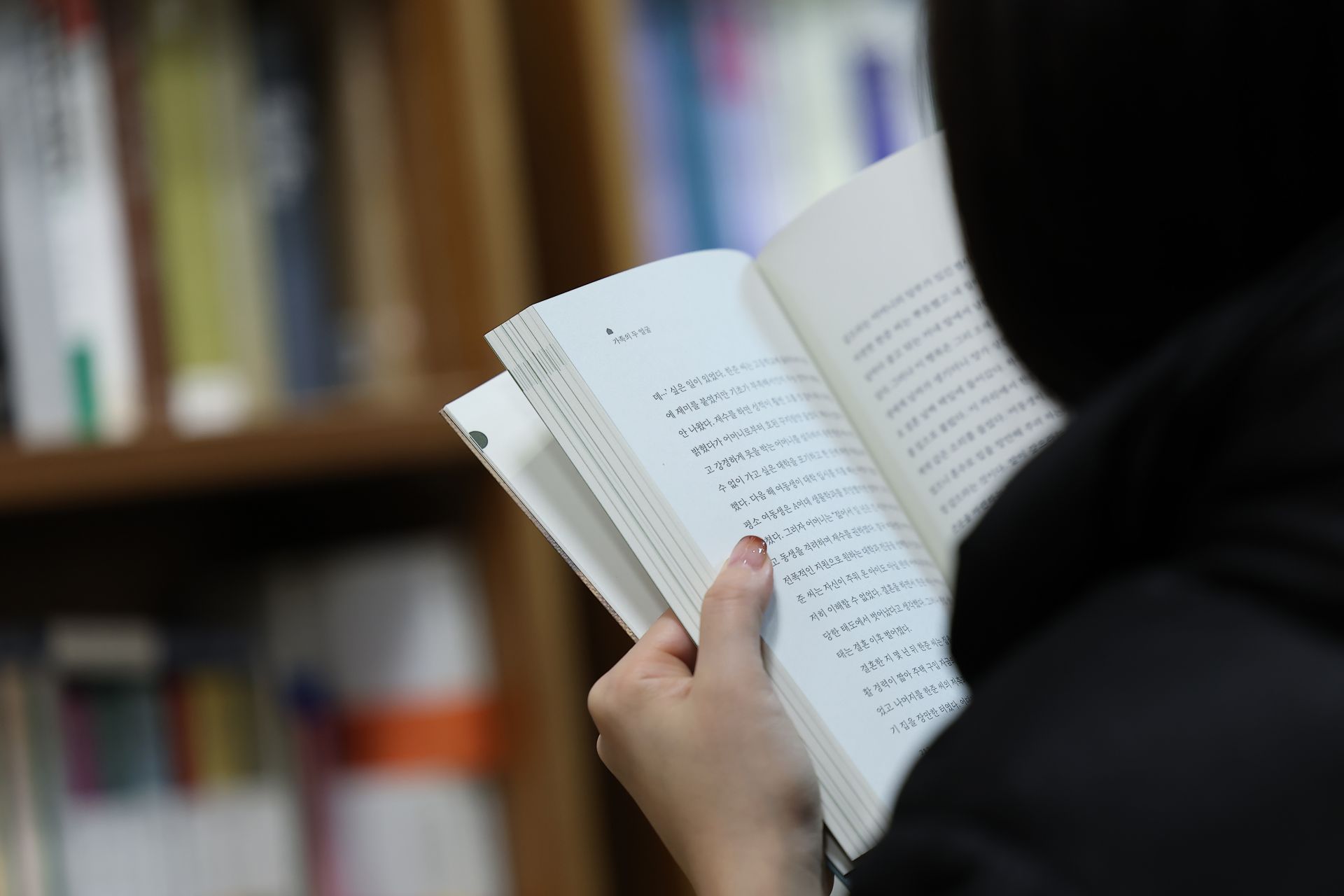
In contrast, the comprehensive reading rate for students was 94.6%, a decrease of 1.2 percentage points from 2023, but it still remained at a high level.
Among young adults, a trend of increased reading activity was observed. The annual comprehensive reading rate for people in their 20s (ages 19 to 29) was 75.3%, up by 0.8 percentage points compared to 2023. This is attributed to the spread of reading culture through activities such as library visits, outdoor reading, copying texts by hand, and book exchange reading.
By media type, digital reading is rapidly expanding. The e-book reading rate among people in their 20s was 59.4%, significantly higher than the paper book reading rate of 45.1%. Audiobook usage is also increasing among all age groups under 60, establishing itself as a new reading medium.

Children from Dalseong County Office Workplace Daycare Center visiting Dalseong Children's Forest Library in Dalseong County, Daegu are reading books. Photo by Yonhap News
원본보기 아이콘The most common reason adults read books was "because reading is enjoyable," accounting for 20.3%. The next most common reason was "for self-development" at 18.5%. For students, the largest proportion, 30.0%, cited "because it is required for studies," followed by "because reading is enjoyable" at 28.3%.
The main reason for not reading, cited by both adults and students, was "lack of time due to work or study." In addition, "using other media or content instead of books" was cited by 24.3% of adults and 19.1% of students.
Significant gaps in reading rates according to age and income still persist. The comprehensive reading rate for seniors aged 60 and above was 14.4%, showing a marked difference from the reading rate of people in their 20s (75.3%). Furthermore, the reading rate for the low-income group with a monthly average income of 2 million won or less was 13.4%, lower than the high-income group with a monthly average income of 5 million won or more, which was 56.1%.
Based on the results of this survey, the Ministry of Culture, Sports and Tourism plans to implement policies to promote reading culture in daily life.
An official from the Ministry of Culture, Sports and Tourism stated, "Books are an important asset in developing the ability to think in the era of artificial intelligence," and added, "We will work to spread reading culture in everyday life by expanding reading programs centered on local bookstores and workplace reading groups."

Kim Heeyun film4h@asiae.co.kr
Choi Yujeong yjchoi@asiae.co.kr
© The Asia Business Daily(www.asiae.co.kr). All rights reserved.
![[Exclusive] "Looking Beyond Financial Statements for Future Value"... IBK Injects 170 Billion Won into 72 Innovative Companies](https://cwcontent.asiae.co.kr/asiaresize/304/2026011314545989464_1768283699.jpg)