"There are plenty of stores that are a full year behind on rent."
"I held on here for 20 years... but I just couldn't endure anymore."

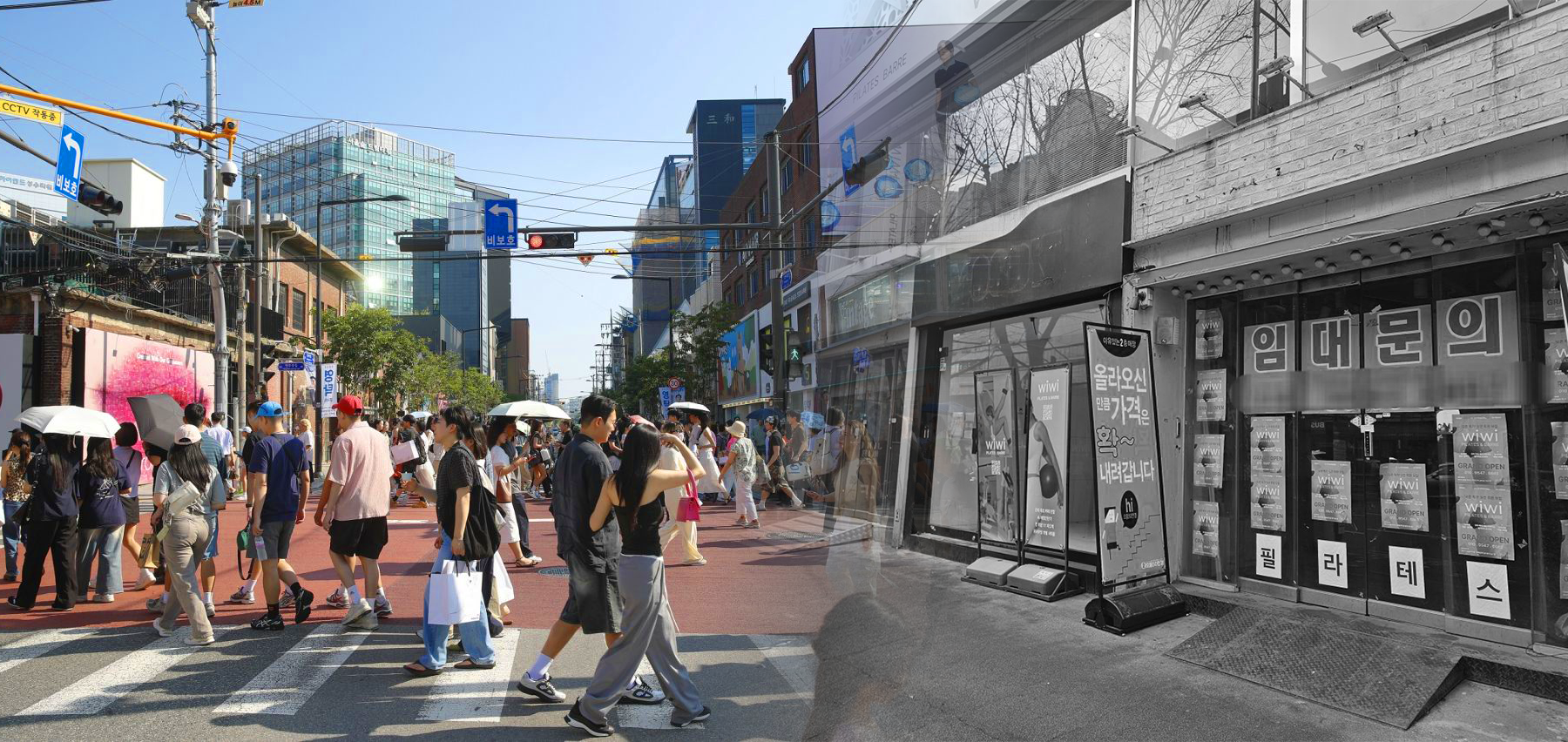
Vacant units bearing signs that read 'For lease inquiries' line the roadside near Konkuk University Station in Gwangjin-gu, Seoul. Reporter Park Jaehyun
원본보기 아이콘Merchant A, whom we met in the commercial district near Konkuk University Station in Gwangjin District, Seoul, let out a deep sigh. A said, "As Seongsu-dong has become a hot spot, people have all moved over there, so there are many stores whose business is nothing like it used to be," adding, "There are also many shops around here that are a full year behind on their rent."
A lounge bar that had been operating for nearly 20 years on the "Gourmet Street" near Konkuk University Station also closed its doors three months ago. It tried to hold on by even changing its business type to an izakaya (Japanese-style bar) when sales slumped, but it became impossible to just sit and wait for the dwindling customers to come. Realtor B, who runs a real estate brokerage business in the Konkuk University Station area, said, "The culture of having company dinners and then going on to a second or third round at karaoke or a beer hall has disappeared, and the commercial district has died along with it," adding, "In the places vacated by these shops, unmanned stores with lower labor costs are mainly moving in."
Seongsu is sucking customers away... Konkuk University area is lined with vacancies


As "Seongsu-dong" has emerged as a mecca of trends, the Konkuk University commercial district, long regarded as one of the core areas among Seoul's university zones, is on the decline. Analysts say this is a "straw effect," in which foot traffic in an existing commercial area is sucked into a newly popular hot place. With domestic demand in a record slump and consumer sentiment frozen, voices are calling for coexistence measures to support merchants suffering from rapidly rising labor costs and rent burdens.
According to the Seoul Commercial District Analysis Service on the 19th, the floating population (per hectare) of Seongsu 2-ga 3-dong in Seongdong District increased from 52,402 in the third quarter of 2024 to 55,499 in the third quarter of last year. In contrast, the floating population of Hwayang-dong in Gwangjin District decreased from 78,778 to 74,821 over the same period.

Closed storefronts with "For lease inquiries" signs line the street near Konkuk University Station in Gwangjin-gu, Seoul, where restaurants are concentrated. Lease inquiry notices have also been posted on the upper floors of the commercial building. Park Jaehyun, Reporter
원본보기 아이콘During an on-site visit to the Konkuk University Station area, it was easy to spot stores with signs reading "For lease inquiries" posted on them. On a street packed with bars, shuttered storefronts stood out every 3 meters, and "For lease inquiries" notices were also hung on the upper floors of commercial buildings. Only in unmanned stores, such as gacha shops (capsule toy vending rooms) and arcades, was lively music playing.
Can it become a 'second Haebangchon'... what are the coexistence measures?


Observers say that to prevent the decline of commercial districts, local governments must work with local merchants to find coexistence measures. Sinhaeng Market near Haebangchon in Yongsan District is a leading success story of reviving a run-down commercial area. Selected in 2015 as a pilot site for Seoul's urban regeneration project, Sinhaeng Market underwent extensive environmental improvements and has since been reborn as a hot place attracting people in their 20s and 30s. As of the third quarter of last year, the average monthly sales per store in Yongsan 2-dong were 7.42 million won, up 2.49% from the same period a year earlier.
Lee Heejung, a professor in the Department of Urban Engineering at the University of Seoul, said, "When a new commercial district emerges, the old one often takes a hit, but in such cases it is desirable to move toward a model of coexistence through sweeping innovation," and advised, "Local governments should create forums for deliberation, such as by working with merchants to support the recovery of commercial districts."
-

Reporter Park Jaehyun now@asiae.co.kr
-
Edit Lee Seonju sjlee109@asiae.co.kr
© The Asia Business Daily(www.asiae.co.kr). All rights reserved.

![[Exclusive] "Looking Beyond Financial Statements for Future Value"... IBK Injects 170 Billion Won into 72 Innovative Companies](https://cwcontent.asiae.co.kr/asiaresize/304/2026011314545989464_1768283699.jpg)