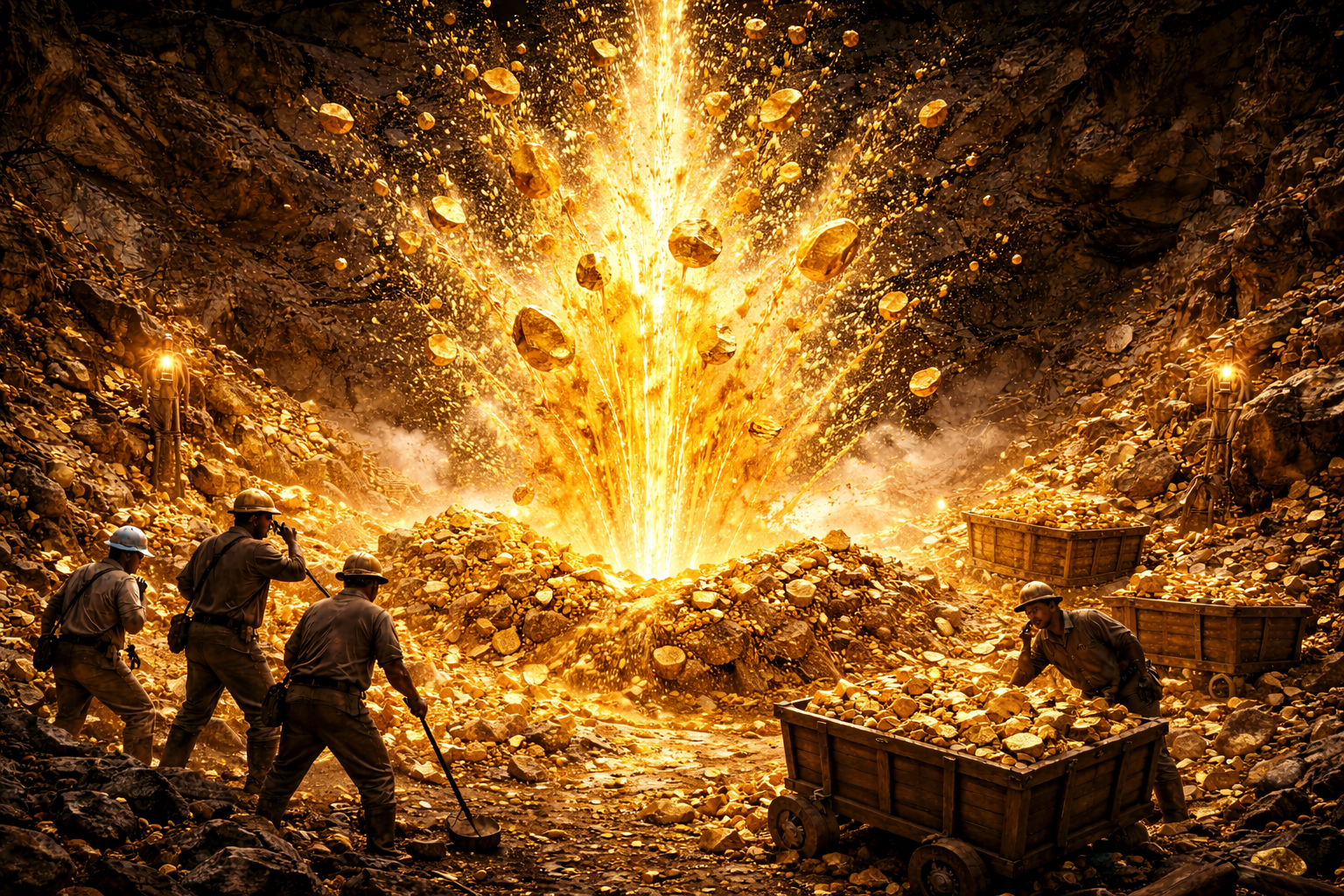
As international gold prices have surpassed $5,100 (735,000 KRW) per ounce, setting an all-time high, South Africa's previously stagnant gold mining industry is regaining momentum.
On January 26 (local time), The Wall Street Journal (WSJ) reported, "A site on the outskirts of Johannesburg, South Africa, which for years had been frequented by illegal miners, has been reborn as a new underground gold mine after 15 years," adding, "Record-high gold prices are triggering a global race to expand gold production."
According to the report, this area was previously known for hundreds of illegal miners, called 'zama zama,' who extracted gold by hand from tunnels they dug with hammers and chisels. It has now been transformed into the 'Qala Shallows' gold mine, operated by Australian mining company West Wits Mining.
Approximately $100 million (about 144.4 billion KRW) has been invested in this mine. Workers wear safety helmets and emergency breathing apparatuses and use advanced drilling equipment. The mine began recovering gold for the first time in October last year, and it is currently estimated that more than $4.5 billion (about 6.4976 trillion KRW) worth of gold could be produced based on current market prices.

Gold Prices Soar... Profitability of Gold Mines Increases
Recently, mining companies worldwide have been restarting closed mines, expanding existing operations, and launching new projects. The rise in gold prices has boosted profitability and stimulated investment sentiment across the industry. According to S&P Global Energy, the global gold exploration budget for 2025 reached $61.5 billion (about 89 trillion KRW), up 11% from the previous year.
Newmont, the world's largest gold producer, brought its Ahafo North mine in Ghana to commercial production in October last year. The second-largest producer, Barrick Mining, plans to begin underground development of the Fourmile project in Nevada, United States, this year.
South African Gold Mines Regain Attention... "Breathing New Life into Traditional Industry"
In South Africa, the surge in gold prices is revitalizing the once-declining industry. For most of the 20th century, South Africa was the world's top gold producer, supplying nearly half of all gold bars and jewelry ever produced in human history. However, due to a lack of investment, its production ranking fell to 12th place after 2007.
Investors have long viewed South Africa's aging and deep underground mines as risky and expensive ventures. Wages have risen significantly due to strong labor unions, and low mechanization has made mining costs among the highest in the world.
However, as gold prices have begun to rise sharply, the situation has changed. Qala Shallows has succeeded in securing funding from local banks, development finance institutions, and American mining finance companies.
Additionally, the mine's proximity-just about 16 kilometers from downtown Johannesburg-and its relatively shallow structure are key advantages. The current mining depth is about 60 meters, with a final target depth of about 850 meters, only a quarter of the depth of South Africa's deepest mines.

Inside the mine, workers operate in pairs, using hydraulic drills that spray high-pressure water to bore through rock. The break-even point is $1,291 (186,000 KRW) per ounce, which is lower than that of larger mines operating in deeper, harsher conditions.
The mine currently employs about 200 people, and this number is expected to increase to 400 by the end of the year.
WSJ noted, "While Qala Shallows' output alone may not change the industry's landscape, record gold prices are breathing new life into traditional industries, which is a positive sign."
-

Reporter Yun Seulgi seul97@asiae.co.kr
-
Edit Bae Byoungmin wuhaha@asiae.co.kr
© The Asia Business Daily(www.asiae.co.kr). All rights reserved.







![A Biopic That Locks the "King of Pop" Inside a Jukebox [Slate]](https://cwcontent.asiae.co.kr/asiaresize/304/2026051822483667824_1779112116.png)