Strike Continues for Over 24 Hours... Will the Commuting Crisis End Tomorrow?
On January 14, the second day of the Seoul city bus labor union strike, citizens commuting to work crowded into the subway, expressing their discomfort. As the bus labor and management agreed to resume negotiations later in the afternoon, attention is focused on whether a resolution to the general strike is in sight.

Most Seoul city buses have ceased operation as the Seoul City Bus Labor Union launched an indefinite full strike on the 13th. A citizen near Seoul Station is checking a notice related to the bus strike at a bus stop. 2026.01.13 Photo by Yoon Dongju
원본보기 아이콘According to the Seoul Metropolitan Government, as of 8 a.m. on this day, only 562 buses, or 8% of all city buses, were in operation. Since the vast majority of buses remain out of service, the city has maintained its policy that buses currently operating will not collect fares in consideration of the inconvenience to citizens.
Unlike the 2024 bus strike, which ended after 11 hours, this strike has continued for over 24 hours. The Seoul City Bus Labor Union and the management, represented by the Seoul City Bus Transportation Business Association, will enter the second post-mediation meeting at the Seoul Regional Labor Relations Commission at 3 p.m. today. Although a post-mediation meeting was held on January 12, labor and management failed to reach a compromise, resulting in the strike. This meeting is being held at the request of the Seoul Regional Labor Relations Commission. If labor and management reach an agreement before midnight, Seoul city buses are expected to resume normal operations starting with the first buses on January 15.
Taking the Subway, Hailing Taxis... Helpless on the Way to Work

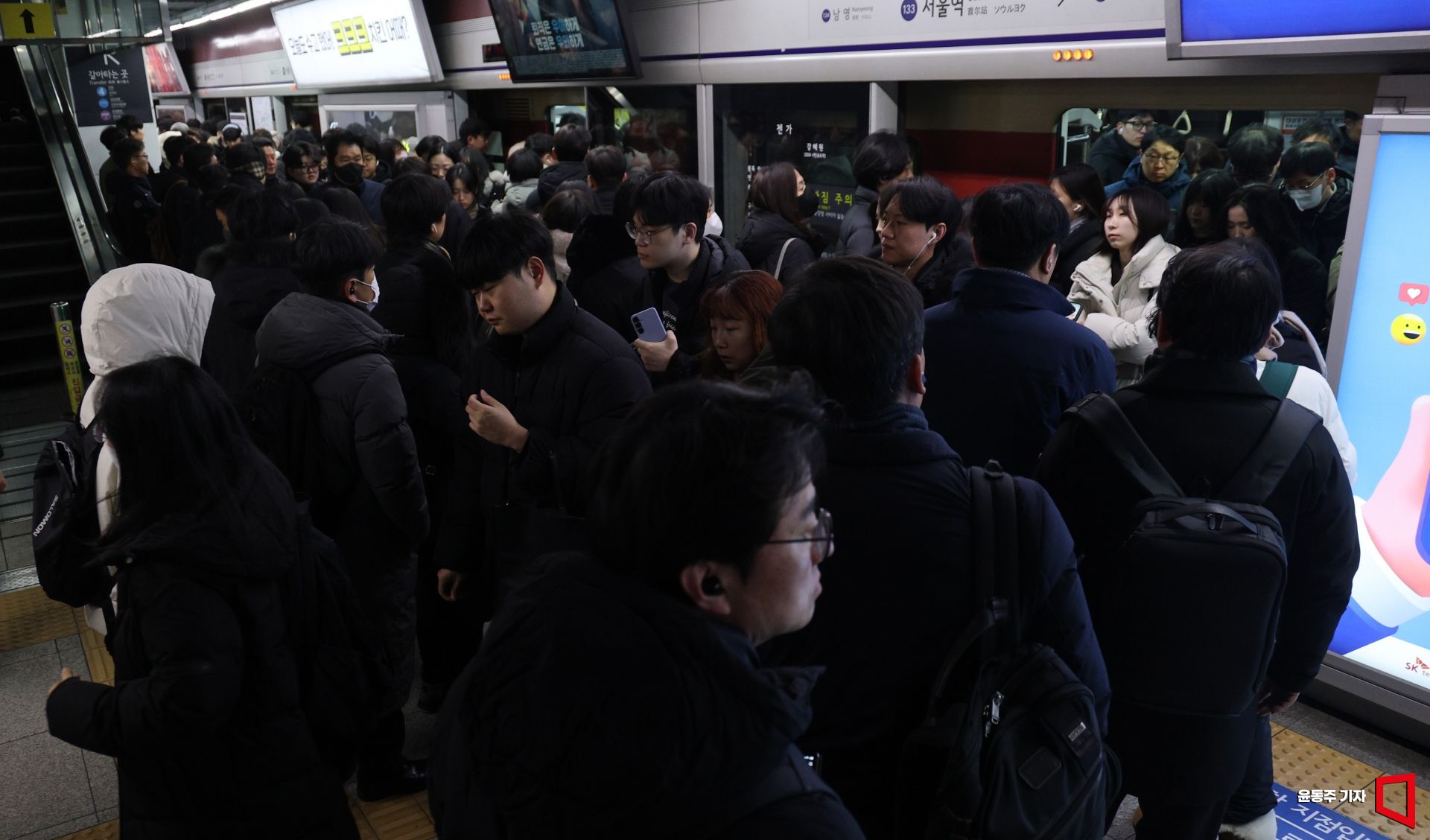
On the 14th, the second day of the Seoul city bus strike, the Seoul Station subway platform is crowded with passengers. 2026.01.14 Photo by Yoon Dongju
원본보기 아이콘
On the 14th, the second day of the Seoul city bus strike, citizens are using taxis at the Seoul Station taxi stand. January 14, 2026 Photo by Dongju Yoon
원본보기 아이콘With buses unavailable for the second consecutive day, another "commuting crisis" unfolded. In particular, Sindorim Station, a major transfer hub, was overwhelmed by crowds and became uncontrollable. Guides raised their voices, saying, "Please form four lines," "Do not push the person in front of you," and "Move in an orderly and slow manner," but the platform was already packed. Many passengers had to let several trains pass because they were full, and continuous announcements in the station warned, "Due to the strike, congestion is expected. Please be careful for your safety."
Even citizens who left home earlier than usual to avoid the "hell train" found themselves helpless. Mr. Jung (35), whom we met at Gangnam Station, said, "I thought more people would crowd the subway because of the bus strike, so I left about 15 minutes earlier, but the situation was the same." Ms. Kim (31) also said, "I hurried 20 minutes earlier than usual, but the subway was so crowded that I barely got on. The commute is extremely inconvenient."
The situation was similar at other major downtown stations such as Gwanghwamun Station and Seoul Station. Some people adjusted their wake-up times much earlier due to previous experience. Office worker Mr. Kim (45) said, "After experiencing yesterday, I realized how crowded it gets, so today I left for work a full hour earlier than usual."
There were also concerns about possible crowd-related accidents. Ms. Shin (40) said, "It feels even more crowded than yesterday. With all the people who usually take the bus now using the subway, I'm genuinely worried that an accident might happen."
Seoul City Responds with Emergency Subway Operations

On the 14th, the second day of the Seoul city bus strike, the bus stop at Seoul Station showed a quiet scene. 2026.01.14 Photo by Yoon Dongju
원본보기 아이콘As the strike drags on, the Seoul Metropolitan Government has further strengthened its emergency transportation measures. Anticipating an increase in subway passengers, the city extended intensive subway operations during rush hours by two hours compared to normal. As a result, the number of additional subway runs was increased from 172 to 203.
At stations with high congestion, empty trains will be deployed during both morning and evening rush hours, and the number of safety personnel will be more than doubled. The previous day, deploying empty trains at the most congested stations on Line 2 during the evening rush hour immediately eased platform congestion. To improve connections to subway stations, the city also added 86 chartered buses starting today, bringing the total to 763 chartered buses operating per day.
-

Reporter Kim Youngwon forever@asiae.co.kr
-

Reporter Choi Youngchan elach1@asiae.co.kr
-
Edit Lee Seonju sjlee109@asiae.co.kr
© The Asia Business Daily(www.asiae.co.kr). All rights reserved.

![[Exclusive] "Looking Beyond Financial Statements for Future Value"... IBK Injects 170 Billion Won into 72 Innovative Companies](https://cwcontent.asiae.co.kr/asiaresize/304/2026011314545989464_1768283699.jpg)