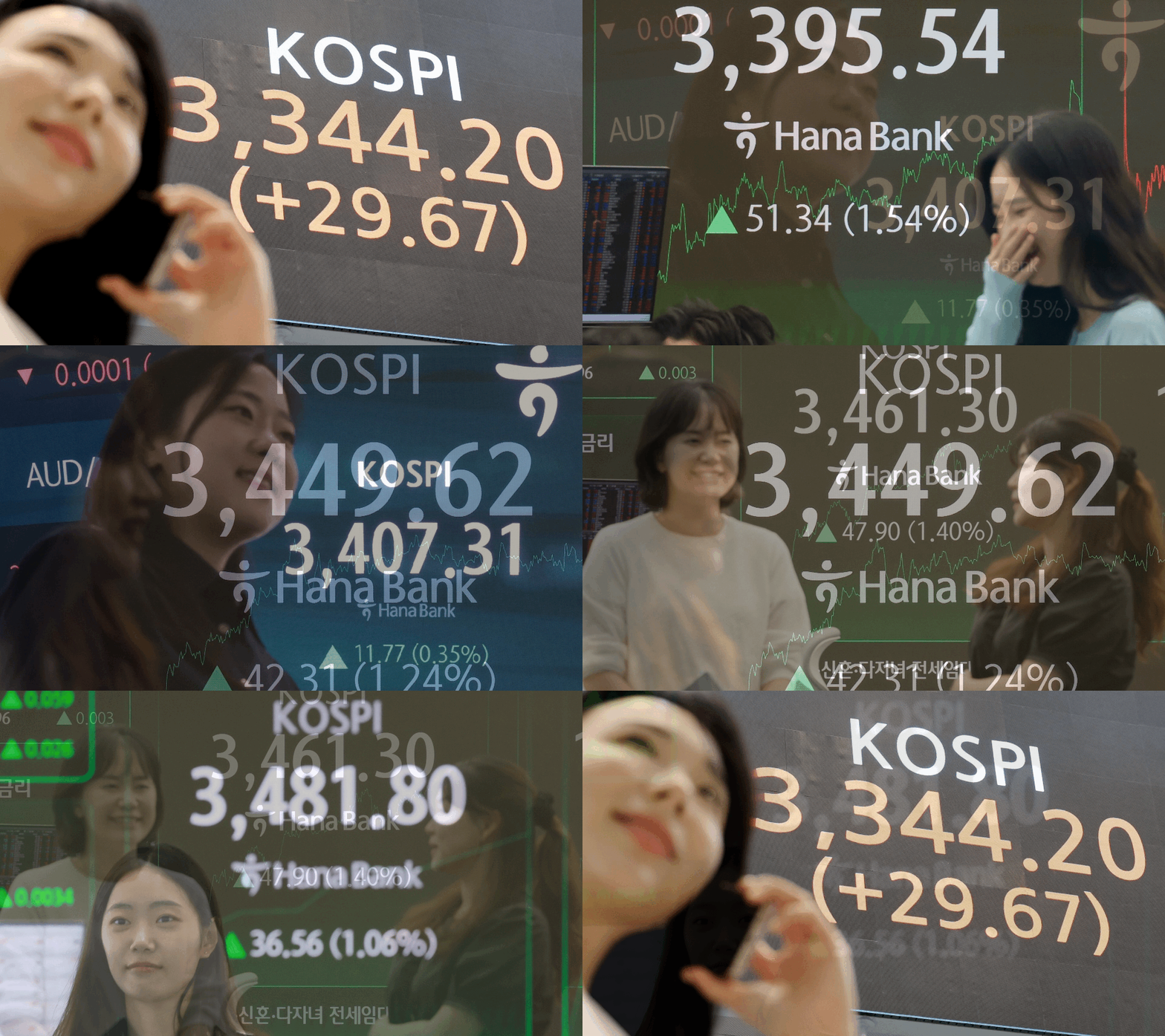
The KOSPI is breaking record highs day after day, heading toward the 3500 mark. With growing interest in how long this historic bull market will last, research center heads at major securities firms forecast that the uptrend will continue through the first half of next year. The main reasons cited are the rally in the semiconductor sector and solid foreign investor buying.

According to the Korea Exchange on September 22, the KOSPI rose by 1.46% over the past week. It has increased by 8.14% so far this month. On September 10, the KOSPI surpassed the 3300 mark for the first time in four years and two months, setting a new record high, and continued its upward momentum to settle above 3400 last week.
"KOSPI Uptrend Expected to Continue Through the First Half of Next Year... Upward Momentum May Slow"
There is a consensus that the historic strength of the KOSPI will persist through the first half of next year. Yoon Seokmo, head of research at Samsung Securities, stated, "Due to the base effect in domestic demand and the renewed strength in semiconductor prices, the trend of breaking record highs is likely to continue through the first half of next year." Choi Kwanghyuk, head of research at LS Securities, also predicted, "With ongoing stock market activation policies and continued global liquidity expansion, the bull market should last through the first half of next year."
However, it is expected that upward momentum will somewhat slow next year compared to this year. Yoon Changyong, head of research at Shinhan Investment & Securities, commented, "While net profit will increase due to higher operating profits among semiconductor companies, the earnings momentum is likely to peak in the second half of this year." He added, "In 2026, rather than explosive improvement, the market will enter a phase of stable growth, and performance gaps between sectors will widen. Therefore, unless there is diversification beyond improved semiconductor earnings by the second half of next year, the upward momentum will be limited."

On the 4th, visitors attending the "2025 International Advanced Semiconductor Substrate and Packaging Industry Exhibition" held at Songdo Convensia in Yeonsu-gu, Incheon, are watching the explanation of the CPU semiconductor package substrate manufacturing process at the Samsung Electronics booth. Photo by Yonhap News
원본보기 아이콘Semiconductor Rally and Robust Foreign Buying Are Driving Forces
The continued uptrend in the KOSPI is attributed to the rally in semiconductors and strong foreign investor buying. Foreign investors have made net purchases of over 6.6 trillion won in the KOSPI market this month, serving as a key driver of the index's rise. During the same period, institutional investors made net purchases of over 1.8 trillion won, while individual investors sold more than 9 trillion won.
Cho Suhong, head of research at NH Investment & Securities, analyzed, "Foreign buying continues due to the liquidity effects of the United States Federal Reserve's accommodative monetary policy and favorable conditions in the semiconductor industry. Additionally, expectations surrounding policy momentum, such as the Korean government's separate taxation of dividend income, are also attracting foreign capital. If the third amendment to the Commercial Act passes, it could lead to further inflows of foreign funds, providing mid- to long-term upward momentum for the market." Yoo Jongwoo, head of research at Korea Investment & Securities, added, "Given the cumulative or historical foreign ownership ratios since the beginning of the year, expectations for additional foreign inflows remain valid," and noted, "Signs of overheating have yet to be observed."
In particular, foreign buying is concentrated in the semiconductor sector, and given that semiconductor prices are expected to remain strong for the time being, foreign buying is also likely to continue. Yoon Seokmo stated, "Domestic funds enter the stock market for various reasons, but foreign, or global, funds generally respond to earnings momentum. Earnings momentum for IT companies has been solid in global, especially U.S., markets, and this has been linked to increased investment expectations for IT companies, improving the earnings outlook for Korean IT firms. This buying trend is expected to continue through the first half of next year as long as semiconductor prices remain strong." Lee Jonghyeong, head of research at Kiwoom Securities, pointed out, "About 86% of total foreign net buying is currently concentrated in the semiconductor sector. As favorable conditions for the semiconductor industry persist, there could be continued short-term inflows into semiconductors."


Resumption of Rate Cut Cycle Is Positive... Tariff Negotiation Uncertainty Is Negative
Factors expected to positively impact the stock market going forward include the resumption of the interest rate cut cycle and market-friendly policy stances, while negative factors include uncertainty surrounding Korea-U.S. tariff negotiations, concerns about a slowdown in the U.S. economy, worries over corporate earnings, and profit-taking pressures. In particular, attention should be paid to the 'three lows' environment (low dollar, low oil prices, and low interest rates). Kim Dongwon, head of research at KB Securities, explained, "The 'three lows' refer to a low dollar, low oil prices, and low interest rates-a combination that is extremely rare. It is being seen for the first time in 40 years since 1986-1988. This environment is especially positive for stock markets in non-dollar countries, those highly dependent on raw material imports, and countries with low national debt. The Korean stock market fits these criteria."
With the long Chuseok holiday approaching, it is necessary to be mindful of increased short-term volatility. Yoo Jongwoo noted, "With about 10 trading days left before the holiday, investors should be prepared for a possible slowdown in the short-term uptrend. It is difficult to respond to external issues during the holiday, and market volatility tends to increase immediately after the holiday. In particular, volatility tends to be higher after Chuseok than after Lunar New Year, as there are typically more issues around Chuseok. While this trend has eased since 2011, there was a case in 2023 where the KOSPI fell more than 2% in a single day immediately after Chuseok, reflecting uncertainty over the U.S. budget. However, a major correction is unlikely."
There is also a recommendation to focus on stocks among former leading sectors that have cooled off or undergone sufficient period adjustments. Ko Taebong, head of research at iM Securities, commented, "The reason individual investors fail to profit in a bull market is often because they sell too early, enter too late, or increase their investment after gaining confidence from small profits only to end up losing. Leading sectors such as semiconductors, artificial intelligence (AI), and robotics are expected to maintain favorable conditions, so it is advisable to either quickly enter stocks that have not yet risen much or select stocks among former leaders that have cooled off or undergone sufficient period adjustments."
![[Exclusive] "Looking Beyond Financial Statements for Future Value"... IBK Injects 170 Billion Won into 72 Innovative Companies](https://cwcontent.asiae.co.kr/asiaresize/304/2026011314545989464_1768283699.jpg)