'Chinese Waymo' Pony.AI Begins Robotaxi Pilot Operation in Seoul
Gangnam in Seoul, which has become a testbed for Chinese robotaxis, is now seen as a likely channel through which domestic driving data could be transferred to China. Driving data includes traffic signals, vehicle speed, road conditions, and traffic accidents. Since a Chinese autonomous driving company is conducting tests in the heart of Seoul, it is possible for them to collect key traffic information from core areas.

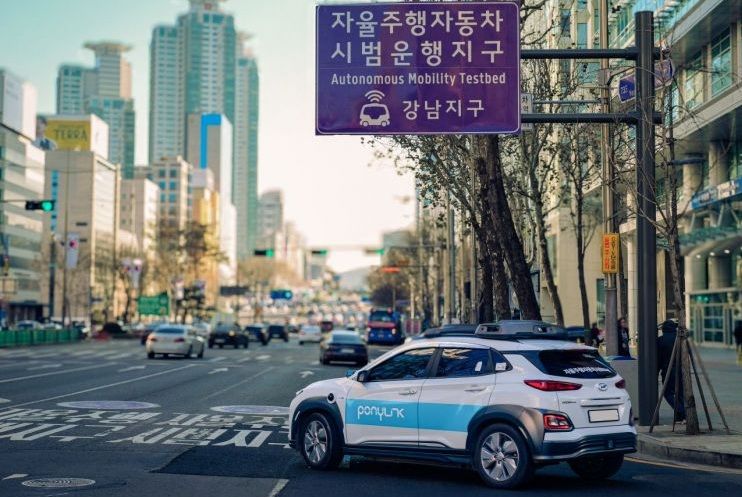
On the 18th, a PonyLink autonomous vehicle was conducting a test drive in the Gangnam district of Seoul. Photo by Youngju Jeon
원본보기 아이콘Domestic autonomous driving companies, which must compete not only locally but also globally, are deeply concerned that they may lose the market before Korean technology has a chance to flourish. Additionally, it is difficult for them to secure investment due to concerns from the taxi industry, leaving them facing a double burden. Some point out that the robotaxi business could become a repeat of the "Tada incident," where the introduction of a ride-hailing service was blocked due to opposition from the taxi industry.
Accumulating Core Area Driving Data... No Regulation on Overseas Transfer
According to industry sources on August 25, Pony.AI, known as the "Chinese Waymo," is conducting autonomous driving tests right in the center of Gangnam-daero. Four vehicles are being operated on a pilot basis: three are accumulating driving data in the autonomous driving pilot zone in Gangnam-gu, while one is being used for building high-precision maps and collecting terrain data.
An autonomous driving industry insider said, "Autonomous vehicles can freely move on the road and collect detailed information about locations, environments, and surrounding people. If driving data is directly transmitted overseas for technology development and business operations, it may be difficult to control how the data is used at the national level." Even if objects or people are blurred, there are concerns that the data could be misused.

When the PonyLink autonomous vehicle makes a right turn following the vehicle ahead, the passenger tablet displays the traffic lights, surrounding vehicles, and current speed. PonyLink
원본보기 아이콘Unlike personal information, there are no specific regulations restricting the overseas transfer of driving data. An official from the Ministry of Land, Infrastructure and Transport explained, "The ban on overseas transfer applies only to data related to personal information; there are no separate regulations for driving data." The official added, "Driving data can include how people move, the speed at which children or elderly people walk, etc. If personal information captured by cameras is blurred, it is considered de-identified and not personal information."
When issuing permits, only the presence of personal information de-identification technology is evaluated. Pony.AI, through the domestic company PonyLink, received a temporary autonomous driving permit from the Ministry of Land, Infrastructure and Transport in December last year.
Gangnam Is Optimal for Testing Due to High Vehicle and Population Movement... Korean Companies Fear Losing Market
The domestic industry is concerned about Gangnam itself becoming a testbed for Chinese companies. The area around Gangnam Station has well-organized lanes and traffic signal systems, and there is a high volume of both vehicle and pedestrian movement.

The PonyLink autonomous vehicle is a modified Kona Electric equipped with 16 sensors including cameras, radar, and lidar. Photo by Youngjoo Jeon
원본보기 아이콘In particular, strong reflections from buildings create conditions that can actually enhance the performance of sensors such as cameras, radar, and lidar installed on autonomous vehicles. Because Gangnam is an optimal location for autonomous driving tests, the more high-quality data Pony.AI accumulates, the more advanced its technology becomes, which may leave domestic companies further behind in commercialization.
Yoo Minsang, Chief Strategy Officer (CSO) of the domestic autonomous driving startup Autonomous A2Z, said, "Large overseas robotaxi companies are entering foreign markets to verify the commercial potential of their technologies. The entry of foreign companies into Korea is a significant threat to our industry." He added that while Autonomous A2Z is also conducting overseas business, it mainly participates in national-level smart city projects, which is fundamentally different from the entry of Chinese companies into the Korean market.
Chinese Companies Like Baidu, the World’s Second Largest, Step Up Offensive... Korean Companies’ Technological Independence at Risk
The invasion of Chinese companies into the domestic market is expected to intensify. Following Waymo in the United States, Baidu, the world’s second-largest autonomous driving company, is also seeking to enter Korea through a partnership with Kakao Mobility, the country’s largest mobility platform. Baidu is operating robotaxi services in China using its autonomous driving technology "Apollo Go." The moment Kakao Mobility, which owns the taxi-hailing application KakaoT, launches a robotaxi service, it is expected that the domestic robotaxi market will be quickly dominated. For this reason, the industry argues that the overseas transfer of driving data should be blocked and Korean companies should be given more freedom to operate.
Kim Pilsoo, a professor at Daelim University, said, "Chinese autonomous driving technology is three to four years ahead of ours. The more we rely on foreign technology, the more we become dependent, and the less self-reliant our companies and technologies will be."
IndexKorean Birth Rate Policy That Failed in China
- Autonomous Driving Tests in the Heart of Gangnam... Are They Chinese Cars, Not Korean?
-
Reporter Oh Hyungil ohk0414@asiae.co.kr
-

Reporter Jun Youngjoo ange@asiae.co.kr
-
Edit Kim Yumi ymkim91@asiae.co.kr
© The Asia Business Daily(www.asiae.co.kr). All rights reserved.

![[Exclusive] "Looking Beyond Financial Statements for Future Value"... IBK Injects 170 Billion Won into 72 Innovative Companies](https://cwcontent.asiae.co.kr/asiaresize/304/2026011314545989464_1768283699.jpg)