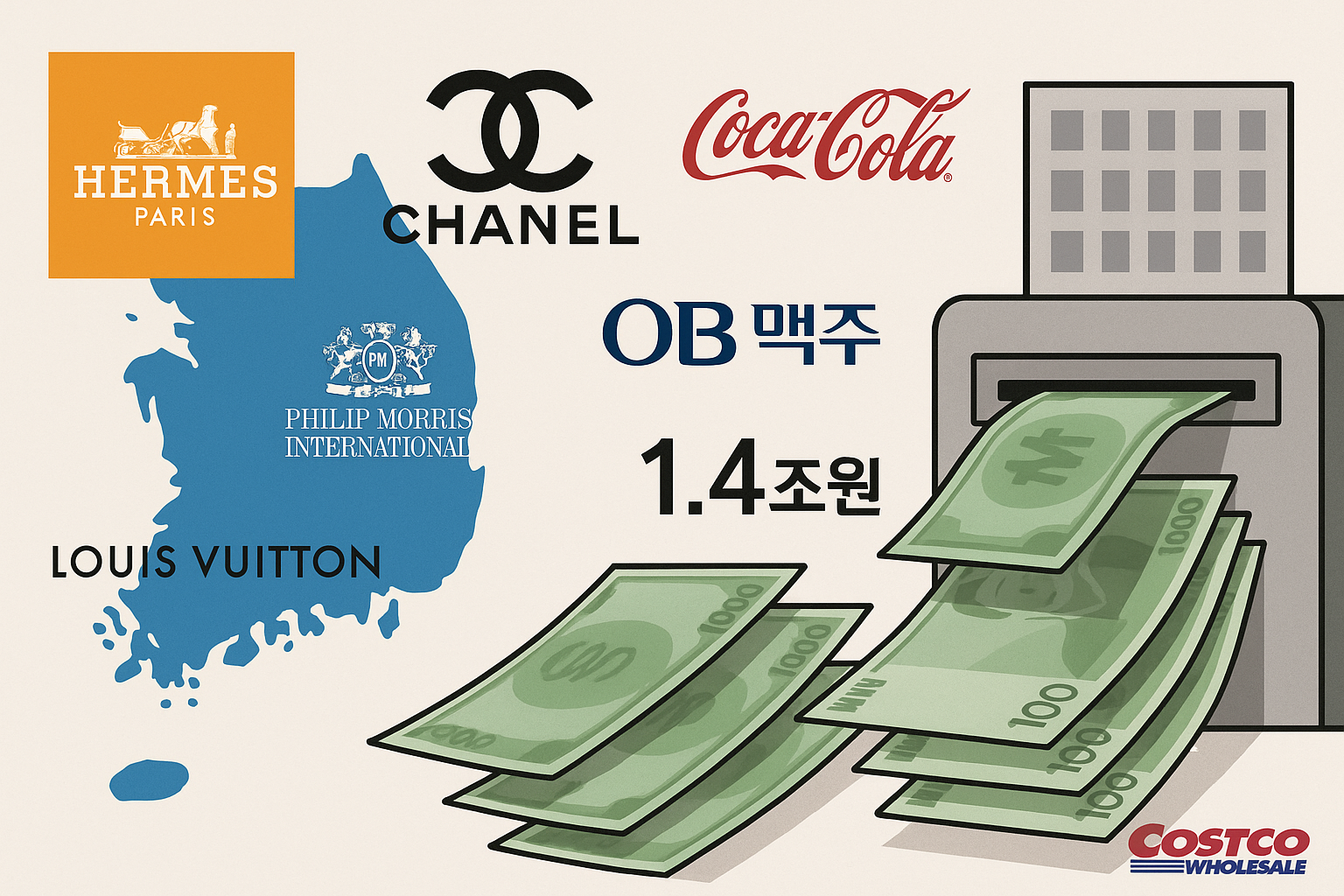
It has been revealed that seven major foreign consumer goods and distribution companies?Chanel Korea, Louis Vuitton Korea, Hermes Korea, Coca-Cola Korea, Philip Morris Korea, OB Beer, and Costco Korea?remitted more than 1.4 trillion won to their headquarters last year in the form of dividends and royalties. These companies sent abroad an amount that far exceeds their management earnings generated in Korea, thereby reducing their corporate tax burden. However, this large-scale outflow of funds has worsened Korea's current account balance.

According to the Financial Supervisory Service's electronic disclosure system on June 11, the total amount of dividends remitted by these seven foreign companies to their headquarters for the 2024 fiscal year was tallied at 1.4129 trillion won. This represents an increase of about 26% compared to the previous year. During the same period, the combined net profit generated by these companies was 1.2944 trillion won. The amount remitted to headquarters exceeded net profit by 118.5 billion won.
By company, Coca-Cola Korea sent 114.3 billion won to its headquarters, which is 222% of its net profit of 51.6 billion won. This amount includes dividends (51 billion won), trademark royalties (41.6 billion won), and service fees (21.6 billion won).
Philip Morris Korea showed a similar pattern. Philip Morris Korea paid 123.8 billion won to its headquarters, exceeding its net profit of 80.8 billion won. This included an interim dividend of 44.4 billion won and royalties of 79.4 billion won for brand usage. The remittance ratio compared to net profit was 153%.
Costco Korea remitted 264.8 billion won to its headquarters, which is 118% of its net profit of 224 billion won. Of this, 200 billion won was paid as dividends and 64.8 billion won as royalties. The royalties are structured as a fixed 1% of sales, meaning this expense is incurred regardless of profit size. OB Beer sent 332.8 billion won in dividends to its headquarters. With a net profit of 241 billion won, its payout ratio was 138%.
The three luxury brands also carried out large-scale dividend payments. Louis Vuitton Korea paid 217 billion won in dividends out of a net profit of 281.5 billion won, resulting in a payout ratio of 77%. Hermes Korea paid 195 billion won out of a net profit of 209.5 billion won, and Chanel Korea paid 130 billion won out of a net profit of 206 billion won. Their payout ratios were 93% and 63%, respectively.
In contrast, the total corporate tax paid by these seven foreign companies in Korea last year amounted to only 366.2 billion won. This is less than half the amount remitted to headquarters as dividends and royalties. In particular, Costco Korea paid only 2.2 billion won in corporate tax, which is just 1% of its net profit. This has fueled criticism that foreign companies perceive their Korean branches as "cash dispensers."

Offshore remittances by foreign companies also impact the current account balance. In April, when dividend remittances by foreign companies are concentrated, the primary income balance?which reflects the difference in "wages and salaries" and "investment income" between residents and non-residents?often records a deficit. According to the Bank of Korea, the current account balance in April was $5.7 billion (about 7.725 trillion won), which is more than $3 billion less than in March due to foreign dividend payments. The primary income balance shifted from a $3.23 billion surplus in March to a $190 million deficit in April. Since 2010, except for 2012 (when the primary income balance was $22.41 billion), the primary income balance in April has posted a deficit every year through last year.

![[Exclusive] "Looking Beyond Financial Statements for Future Value"... IBK Injects 170 Billion Won into 72 Innovative Companies](https://cwcontent.asiae.co.kr/asiaresize/304/2026011314545989464_1768283699.jpg)