Constitutional Court Concludes: President Yoon Suk-yeol Dismissed
"Betrayed Duty to Uphold the Constitution"
'Politician Arrests and Forcible Removal of Lawmakers' Recognized as Fact
Yoon's Side's Procedural Objections Not Accepted
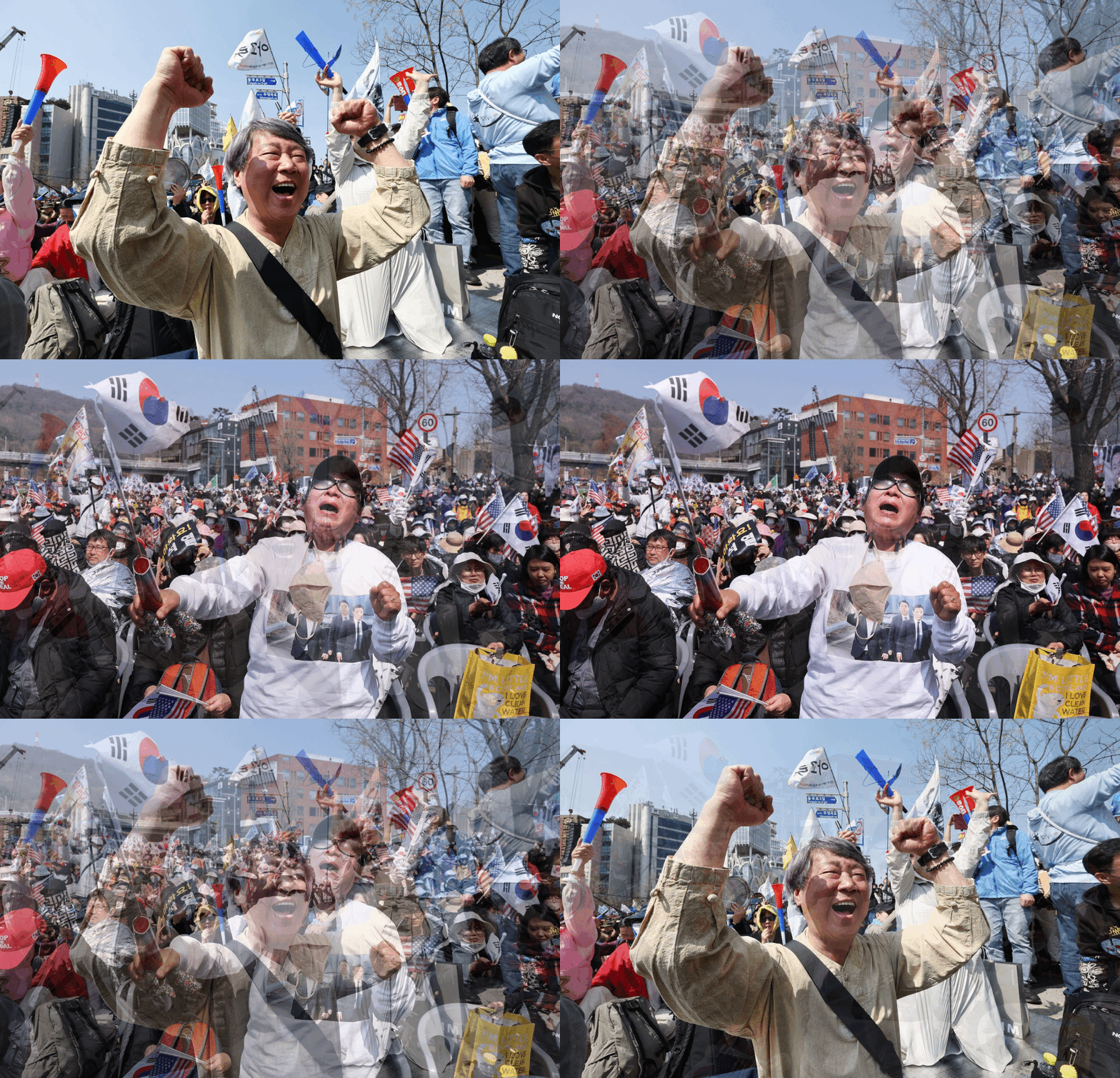
Despite the Court's Ruling, Pastor Jun Kwang-hoon: "Cannot Accept"
"Will Continue Civil Disobedience Movement"

The Constitutional Court dismissed President Yoon Suk-yeol on the 4th. With this, President Yoon became the second president in the history of the Republic of Korea to be impeached, following former President Park Geun-hye.
Moon Hyung-bae, Acting Chief Justice of the Constitutional Court, read the verdict at around 11:22 a.m. that day, stating, "President Yoon Suk-yeol is hereby dismissed." The dismissal took effect immediately, resulting in President Yoon losing his position from that moment.
At 11 a.m. in the Grand Courtroom, the Constitutional Court held the impeachment trial for President Yoon and unanimously upheld the National Assembly's impeachment motion. This came 122 days after President Yoon declared martial law on December 3, and 111 days after the impeachment bill was submitted on December 14 last year.
Constitutional Court Accepts All Five Grounds for Yoon's Impeachment
The Constitutional Court addressed each of the five key issues in President Yoon's case: ▲ the unconstitutionality and illegality of the December 3 martial law ▲ obstruction of parliamentary activities ▲ issuance of emergency decrees ▲ attempts to seize control of the National Election Commission ▲ orders to arrest politicians and other key figures, and found all to be valid grounds for impeachment.
First, the Court found that on December 3 last year, despite the absence of a national emergency, President Yoon illegally declared martial law in violation of constitutional requirements. Regarding the so-called "chain impeachment" and the opposition's budget cuts, the Court pointed out, "Even if the National Assembly's exercise of power is unlawful or improper, such matters can be addressed through regular means such as impeachment trials by the Constitutional Court or the president's right to request reconsideration of bills, and cannot justify the exercise of emergency powers."
Regarding President Yoon's claim that it was a "warning or appeal-based martial law," the Court stated, "This is not the purpose of martial law as defined by the Martial Law Act," and "the respondent's argument cannot be accepted." The Court also found that the "election fraud theory" cited as a background for martial law was not valid, and that "the mere existence of suspicions does not constitute a real and grave crisis," thus it could not justify the declaration of martial law.


The Court also recognized as fact the allegation that President Yoon attempted to remove lawmakers gathered at the National Assembly to prevent the passage of a motion to lift martial law. The Court determined, "The respondent gave instructions to the Army Special Warfare Commander and others, saying, 'It appears there is no quorum; break down the doors and remove those inside.'"
Regarding the emergency decree and the search and seizure of the National Election Commission, the Court explained that these actions "violated constitutional provisions, the principles of representative democracy and separation of powers, and the people's fundamental political rights," and that the warrantless search "violated the principle of requiring a warrant and infringed upon the independence of the Election Commission."
The Court also recognized as fact that President Yoon attempted to ascertain the whereabouts of key politicians and legal figures at the time of the martial law declaration. The Court stated, "The Minister of National Defense ordered the Director of the Defense Security Command to locate 14 individuals, including the Speaker of the National Assembly and party leaders, for the purpose of arrest if necessary. The respondent called the First Deputy Director of the National Intelligence Service to request support for the Defense Security Command, and the Commander requested that the Deputy Director confirm the locations of these individuals."
The testimonies of Hong Jang-won, former First Deputy Director of the National Intelligence Service, and Kwak Jong-geun, former Commander of the Army Special Warfare Command, who appeared as witnesses during the impeachment trial, also appear to have been accepted as fact. President Yoon's side had previously challenged their credibility.
Regarding the so-called "withdrawal of insurrection charges" controversy, the Court stated, "This cannot be seen as a change in the grounds for impeachment," and found that "the National Assembly's impeachment was procedurally legitimate."

"Declared Martial Law in Violation of Constitution and Law... Shocked the Nation"
After addressing all the issues, the Constitutional Court concluded that there were grave unconstitutional and illegal acts warranting the removal of the president. The Court stated, "The respondent (President Yoon) mobilized the military and police to undermine constitutional institutions such as the National Assembly and infringed upon the fundamental rights of the people, betraying the duty to uphold the Constitution," and "this is a serious violation of the law that cannot be tolerated from the perspective of constitutional protection, as it betrays the trust of the people."
The Court added, "By declaring martial law in violation of the Constitution and law, the respondent revived the history of abuse of emergency powers, plunging the nation into shock and causing chaos across all sectors?social, economic, political, and diplomatic. The benefit to constitutional protection from dismissing the respondent far outweighs the national losses resulting from the dismissal."
Some justices, while agreeing with the overall conclusion, offered supplementary opinions on specific issues. Justice Jeong Hyeong-sik suggested that legislation is needed to limit the number of times an impeachment bill can be proposed in different sessions, in relation to the principle of non-repetition of motions.
Regarding evidentiary rules, Justices Lee Mi-seon and Kim Hyeong-du believed that the rules of hearsay in criminal procedure could be relaxed in impeachment trials, while Justices Kim Bok-hyeong and Jo Han-chang argued for stricter application of those rules.
There were no dissenting opinions differing from the majority.
The Constitutional Court completed all procedures after receiving the impeachment case against President Yoon on December 14 last year, holding 11 hearings by February 25 this year. After more than a month of deliberation, the verdict was delivered today.


Jun Kwang-hoon: "Civil Disobedience Movement Against Unjust Ruling of the Constitutional Court"
Meanwhile, the Liberty Unification Party, led by Pastor Jun Kwang-hoon, responded to the Constitutional Court's dismissal of President Yoon Suk-yeol by stating, "This impeachment is an unjust decision driven by political offensives and biased media manipulation, and therefore cannot be accepted."
In a statement, the Liberty Unification Party described the decision as "deeply regrettable and unfortunate, leaving a significant scar on the constitutional history," expressing their position as above.
The party declared, "We will not stop our struggle to defend Korea's liberal democracy and the rule of law," and added, "From this moment on, we will launch a civil disobedience movement against the unjust ruling of the Constitutional Court to achieve greater solidarity and national unity."
The Presidential National Defense Counsel, a group supporting former President Yoon, also announced through the media, "We will not be discouraged by today's verdict and will continue the fight for a 'second founding' of the nation together with the people."
-

Reporter Yeom Dayeon allsalt@asiae.co.kr
-
Reporter Lim Chunhan choon@asiae.co.kr
-
Edit Choo Myeonghoon chox2mh@asiae.co.kr
© The Asia Business Daily(www.asiae.co.kr). All rights reserved.

![[Exclusive] "Looking Beyond Financial Statements for Future Value"... IBK Injects 170 Billion Won into 72 Innovative Companies](https://cwcontent.asiae.co.kr/asiaresize/304/2026011314545989464_1768283699.jpg)