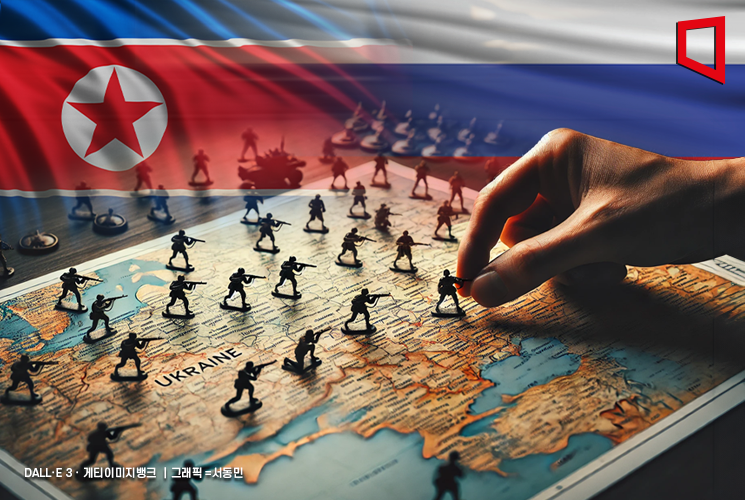
Kursk, located in southwestern Russia, is a border region adjacent to Sumy in northeastern Ukraine. It covers an area of 29,800 square kilometers and has a population of 1.08 million (as of 2021). The Ukrainian military support group 'Blue-Yellow' claimed on the 28th (local time) that North Korean troops deployed to Russia engaged in their first skirmish with Ukrainian forces here on the 25th of last month. All North Korean soldiers except one, who was carrying a Buryat identification card, were reportedly killed, and as evidence, a photo of a seized North Korean flag was released.
![Artificial flag believed to have been captured by the Ukrainian military [Image source=LRT capture]](http://www.asiae.co.kr/news/img_view.htm?img=2024103114035681371_1730351036.jpg)
Artificial flag believed to have been captured by the Ukrainian military [Image source=LRT capture]
원본보기 아이콘Kursk: A Key Strategic Point in World War II and the Ukraine War
Kursk was the first Russian mainland region occupied by Ukraine. After focusing on defending its own territory for more than two years since the outbreak of the war, Ukraine launched a surprise assault on Kursk using troops assembled in Sumy on August 6. This marked the first time Russian territory had been attacked since World War II.
This was a strategic move by Ukraine to create a buffer zone and gain an upper hand in ceasefire negotiations. Ukraine claimed to have captured more than 100 villages and about 1,200 square kilometers in this operation. Military experts have offered various interpretations. Some praised it as a bold attempt to shift the momentum of the war. Others downplayed its significance, arguing that it would only prolong a war of attrition that favors resource-rich Russia.

Russian forces are firing 122mm self-propelled howitzers "Gvozdika" at Ukrainian military positions in the Kursk region of Russia. This photo is part of a video released by the Russian Ministry of Defense Public Relations Office on the 30th of last month. Photo by AP
원본보기 아이콘For Russian President Vladimir Putin, Kursk is a strategic point that must be recaptured due to its geopolitical significance. Kursk lies at the crossroads connecting Europe, Ukraine, and Russia. The region is rich in iron ore and features vast plains that provide a direct route to Moscow, the Russian capital. The straight-line distance from Kursk to Moscow is only 530 kilometers. Even the forests here are belt-shaped strips of trees.
One of Russia's three major nuclear power plants, the Kursk Nuclear Power Plant, is located in this region. The city of Sudzha, also in Kursk, is home to the final transit metering station of the Urengoy-Pomary-Uzhgorod gas pipeline, which supplies Russian natural gas to Europe via Ukraine.
Previously, the Financial Times (FT) of the UK assessed that the deployment of North Korean troops could numerically aid Russia in reclaiming the Kursk region lost to Ukraine. However, there is also considerable analysis suggesting that North Korean forces may not be able to demonstrate effective combat capabilities. The Wall Street Journal (WSJ) of the United States noted that North Korean training focuses on infiltration, assassination, and infrastructure sabotage suited for the mountainous terrain of the Korean Peninsula, making it difficult to operate effectively in unfamiliar open plains. Conversely, this is also why Ukrainian drone attacks against Russian forces from the air have proven effective.
![[Image source=AP Yonhap News]](http://www.asiae.co.kr/news/img_view.htm?img=2024110413192285158_1730693962.jpeg)
Kursk: Site of the Largest Tank Battle in History
Due to these geopolitical factors, the Kursk region has historically been the site of many battles. Most notably, the Battle of Kursk during World War II was the largest engagement between Germany and the Soviet Union. In 1943, on these wide-open plains, the largest tank battle in history took place. Although records vary slightly, it is said that both sides mobilized 3 million troops, 30,000 artillery pieces, 8,000 tanks, and 5,000 aircraft. The Soviet victory in this battle shifted the balance on the Eastern Front and is considered a turning point in the war.
-

Reporter Choi Hokyung hocance@asiae.co.kr
-
Edit Sung Kiho kihoyeyo@asiae.co.kr
© The Asia Business Daily(www.asiae.co.kr). All rights reserved.
!["Please Help Us": How Much Do Those Bowing 90 Degrees These Days Actually Earn? [Data Pick]](https://cwcontent.asiae.co.kr/asiaresize/323/2026052010120870131_1779239528.png)