"Vicious Cycle of Tariff Retaliation Must Be Prevented"... Government Urges Multilateral Cooperation at WTO
Director-General Kwon Hyejin Attends WTO General Council
Raises Concerns Over Protectionist Measures, Including Steel TRQ

The government has emphasized the need for joint action against the recent spread of protectionism and trade-restrictive measures at the World Trade Organization (WTO) General Council, urging member countries to refrain from actions that hinder trade liberalization.
Kwon Hyejin, Director-General for Trade Negotiations at the Ministry of Trade, Industry and Energy, attended the WTO General Council in Geneva, Switzerland, on May 6–7 (local time) as the chief representative of the Korean delegation. Kwon participated in follow-up discussions to the 14th WTO Ministerial Conference (MC-14) and placed the agenda item, "Collective Restraint by WTO Members on Measures Reversing Trade Liberalization," on the table.
This General Council meeting was the first high-level multilateral meeting since MC-14, which was held in Yaoundé, Cameroon, in March this year. The session included follow-up discussions on key issues unresolved at MC-14, such as the WTO reform work program, the extension of the moratorium on customs duties on electronic transmissions, the e-commerce agreement, and the Investment Facilitation for Development (IFD) agreement.
Previously, at MC-14, Korea served as the coordinator for ministers on WTO reform and played a leading role in reaching an agreement on the "WTO reform work program." Korea and Chile, as co-chairs, have also continued to lead discussions on the official adoption of the IFD agreement within the WTO legal framework.
During the meeting, Director-General Kwon stressed, "Restoring trust in the multilateral trading system is urgent," and emphasized the need to advance reform discussions swiftly, based on the WTO reform work program. Kwon also expressed regret that the moratorium on customs duties for electronic transmissions, which has been maintained for about 30 years, was not extended at MC-14, stating, "Extending the moratorium is crucial to ensuring the stability and predictability of digital trade."
Regarding the IFD agreement, Kwon proposed starting concrete discussions on the implementation and entry into force of the agreement to ensure it can make a meaningful contribution to improving the investment environment in developing countries.
The Korean government, in particular, expressed concern about the spread of import restriction measures and the strengthening of tariffs, especially in the steel sector. Director-General Kwon stated, "Relying on short-term tariff increases can trigger a vicious cycle of retaliatory measures between countries," and added, "Issues such as oversupply or subsidies should be addressed by tackling their structural causes."
During the meeting, Director-General Kwon also held bilateral consultations with key countries, including the United Kingdom, Japan, and Türkiye. Kwon conveyed Korea's concerns regarding the steel safeguard tariff-rate quota (TRQ) measures recently introduced by the EU and the UK, and exchanged views on broader trade issues.
Hot Picks Today
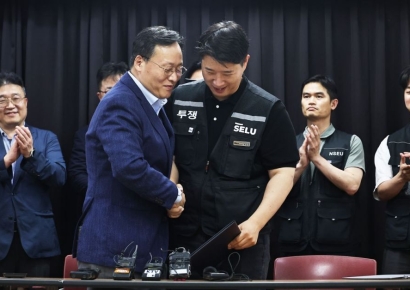 Up to 600 Million Won for Semiconductors, 160 Million Won Bonus for Loss-Making Non-Memory… Samsung Electronics Labor and Management Reach Tentative Deal on Unprecedented Performance Compensation (Comprehensive)
- "Could I Also Receive 370 Billion Won?"... No Limit on 'Stock Manipulation Whistleblower Rewards' Starting the 26th
- "From a 70 Million Won Loss to a 350 Million Won Profit with Samsung and SK hynix"... 'Stock Jackpot' Grandfather Gains Attention
- Opening a Bank Account in Korea Is Too Difficult..."It Costs 150,000 Won Just to Open a Child's Account or Check Card" [Foreigner K-Finance Status]②
- "Who Is Visiting Japan These Days?" The Once-Crowded Tourist Spots Empty Out... What's Happening?
Kwon stated, "Amidst the global spread of protectionism, we proactively raised the TRQ issue faced by Korea's steel industry through both multilateral and bilateral channels," adding, "We will continue to strengthen trade diplomacy to restore the WTO multilateral trading system and protect the interests of our companies."
© The Asia Business Daily(www.asiae.co.kr). All rights reserved.