Korean Stock Market Rises to 8th Largest Globally, Surpassing the UK
The Korean stock market has emerged as the world's eighth largest, surpassing the United Kingdom. Expectations for the growth of the artificial intelligence (AI) industry have driven up the share prices of semiconductor-related stocks, led by Samsung Electronics and SK hynix.

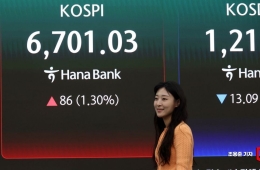
On the 28th, following the KOSPI surpassing the 6600 level the previous day and breaking through the 6700 level, an employee is monitoring the stock market and exchange rates in the dealing room at Hana Bank Headquarters in Jung-gu, Seoul. On this day, the KOSPI opened the trading session at 6646.80, up 0.48% from the previous trading day. April 28, 2026 Photo by Jo Yongjun
View original imageOn April 28 (local time), Bloomberg reported that the total market capitalization of listed companies in Korea has surged more than 45% this year, reaching 4.04 trillion dollars, while the UK saw an increase of only 3% to 3.99 trillion dollars. As recently as 2024, the size of the UK market was about twice that of Korea.
Bloomberg also evaluated that the sharp rise in the Korean stock market demonstrates that global capital is moving into AI-related companies. Samsung Electronics and SK hynix together account for more than 40% of the entire KOSPI market capitalization, which is comprised of over 800 listed stocks. In addition, President Lee Jaemyung’s efforts to boost stock prices through corporate governance reform and market-friendly policies have also served as additional positive factors.
Francesco Chan, an emerging markets and Asia-Pacific investment specialist at J.P. Morgan Asset Management in Hong Kong, said, "The rapid rise in Korea and Taiwan reflects a structural rebalancing of global equity markets driven by dominance in AI hardware, rather than tactical asset allocation." He added, "As central players in the AI supply chain, with a 'super-cycle' advantage in advanced foundries and memory, these countries are attracting sustained structural capital inflows."
Korea’s rally is similar to that of Taiwan. This month, Taiwan surpassed the UK to become the world’s seventh largest stock market, thanks largely to TSMC, the world’s largest semiconductor foundry. TSMC currently accounts for about 45% of the total market capitalization in Taiwan. Taiwan's market capitalization now stands at 4.48 trillion dollars, closing in on Canada.
The UK’s FTSE 100 Index has risen about 4% this year. While this is not significantly lower than the MSCI World Index, it lags far behind the gains seen in markets benefiting from the AI boom. The UK stock market, the largest in Europe, is still dominated by traditional sectors such as finance, consumer staples, energy, and mining companies.
Patrick Kellenberger, emerging markets equity strategist at Lombard Odier in Geneva, said that factors such as AI’s potential, global defense spending, and corporate governance reform "are supporting a much steeper growth trajectory for Korean and Taiwanese equities compared to Europe." He added, "Europe continues to struggle in commercializing and scaling innovation. While it is important to create conditions for innovative companies to emerge and grow, this is a process that takes considerable time."
Although the stock markets of Asia’s semiconductor powerhouses have surged, the size of their economies remains smaller than those of the major European countries. According to estimates from the International Monetary Fund (IMF), Korea’s gross domestic product (GDP) is expected to reach 1.9 trillion dollars this year, and Taiwan’s is projected at 977 billion dollars. In comparison, Germany, the UK, and France are each expected to have GDPs exceeding 3 trillion dollars.
Hot Picks Today
![The "Heater" Beneath the Glaciers Turns On... Antarctica's "Hidden Variable" Advances 1km Toward the Continent Each Year [Reading Science]](https://cwcontent.asiae.co.kr/asiaresize/93/2026042813505043637_1777351851.jpg) The "Heater" Beneath the Glaciers Turns On... A...
The "Heater" Beneath the Glaciers Turns On... A...
- "You'll Regret Not Buying Now"... Minister Urges Travelers to Purchase Airline T...
- "I Love Korea" Tourists Spent $435 More Per Person... Want to Stay Longer, But "...
- To Withdraw His Late Sister’s $300 Deposit, 50-Year-Old Indian Man Brings Her R...
- "It Was Fantastic" Jensen Huang's Daughter Seals 'Robot Alliance' with LG throug...
Currently, Wall Street maintains an optimistic outlook on the Korean stock market, citing upward revisions in earnings forecasts driven by AI demand and attractive valuations. Goldman Sachs has raised its KOSPI target to 8,000, mainly due to projections that the 2026 earnings growth estimate has been revised upward by more than 200%.
© The Asia Business Daily(www.asiae.co.kr). All rights reserved.