Sierra Leone in West Africa to Establish Departments of Saemaul Studies at Two Public Universities
Minister of Higher Education Visits Yeungnam University
The government of Sierra Leone, located on the West African Atlantic coast of the African continent, has taken active steps to establish a “Department of Saemaul Studies” at local public universities. Through the sharing of Korea’s indigenous academic discipline, Saemaul Studies, Yeungnam University and the Sierra Leonean government have entered a new phase of international development cooperation that aims not only to innovate higher education in Sierra Leone, but also to contribute to community development and national economic growth.
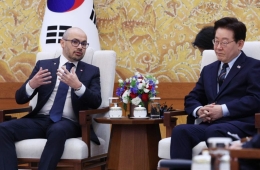
On April 21, Minister Haja Ramatulai Wurie of the Ministry of Technical and Higher Education of Sierra Leone, Paul Sobba Massaquoi, Sierra Leonean Ambassador to Korea, along with other high-ranking government officials and public university professors from Sierra Leone, visited Yeungnam University. The purpose of the visit was to sign agreements to establish “Departments of Saemaul Economic Development” at two public universities in Sierra Leone.

Minister Haja Ramatulai Wurie of the Ministry of Technical and Higher Education of Sierra Leone (right) and Choi Oechul, President of Yeungnam University, are holding their certificates after completing the Saemaul Undong and Saemaul Development training at Yeungnam University and posing for a commemorative photo.
View original imageYeungnam University signed separate agreements with Milton Margai Technical University (MMTU) and Eastern Technical University (ETU) in Sierra Leone. Minister Haja Ramatulai Wurie, who visited Yeungnam University as a representative of the Sierra Leonean government and on behalf of both universities, personally signed the agreements. Minister Wurie holds a master’s degree in Life Sciences from the University of Wolverhampton and a doctorate in Medicine from the University of Warwick in the UK. She is recognized as a next-generation leader, overseeing higher education in Sierra Leone and leading national innovation and the cultivation of future talent.
This agreement aims to accelerate the practical implementation of the Memorandum of Understanding (MOU) signed between Yeungnam University and the Sierra Leonean government in December 2025, and to expand the scope of cooperation to the university level. Under the agreement, universities in both countries will pool their capabilities for curriculum development and consulting collaboration for establishing the Department of Saemaul Economic Development, support for the establishment and operation of Saemaul Movement research institutes, faculty, student, and staff exchanges, sharing of academic information and materials, and the promotion of joint research.
In accordance with the agreement, Yeungnam University will provide phased support for the establishment of departments and the development of educational and research systems at universities in Sierra Leone. The university also plans to concretize a cooperation model that links the training of experts in the field of Saemaul development with community development.
Minister Haja Ramatulai Wurie stated, “Education has always been at the center of the national development agenda. Today’s agreement with Yeungnam University marks a turning point in Sierra Leone’s national system for technological and educational innovation. By sharing Korea’s development experience, Sierra Leone will also place technological and educational innovation at the heart of its development agenda and follow in Korea’s footsteps.” She added, “Through this partnership with Yeungnam University, we aim not only for simple cooperation, but to redesign how educational innovation functions throughout Sierra Leone. We will localize Saemaul Studies across all educational institutions in Sierra Leone and establish research institutes. The principles of diligence, self-help, and cooperation will serve as practical tools for community and national economic development.”
Paul Sobba Massaquoi, Sierra Leonean Ambassador to Korea, remarked, “This visit is not a ceremonial diplomatic event, but a historic moment where the seeds of exchange and trust cultivated over time have borne fruit as a comprehensive partnership.” He continued, “Yeungnam University’s special interest in the African Saemaul Movement project and Sierra Leone’s development has made today’s achievements possible. I hope the results of this visit will be widely shared at the level of our home government, and I look forward to our government officially inviting President Choi Oechul to further strengthen ties and build a lasting relationship between the two countries.”
After the signing of the agreement, the delegation led by the Minister of Technical and Higher Education of Sierra Leone participated in a four-day, three-night training program on the Saemaul Undong and Saemaul Development. Hosted by the International Development Cooperation Center at Yeungnam University, the program included lectures and discussions on topics such as connecting Saemaul Study ideas with Sierra Leone’s national development strategy, an introduction to the curriculum of the Park Chung Hee School of Policy and Saemaul, and sharing Korea’s development experience through the Saemaul Movement. An exchange of opinions on actual study and research experiences, as well as their applicability in Sierra Leone, took place during a meeting with international students at the Park Chung Hee School of Policy and Saemaul. The delegation also visited the Cheongdo Saemaul Birthplace Memorial Park, the National Institute of Crop Science in Miryang, the Samsung Electronics Promotion Hall in Gumi, and the Park Chung Hee Presidential Museum, allowing them to gain a multidimensional understanding of Korea’s development experience through field trips.
After completing the training, Minister Haja Ramatulai Wurie commented, “I applaud Yeungnam University’s efforts to expand the Saemaul Undong and Saemaul Studies to other countries. I highly appreciate the support provided so that young people from other countries can come to Yeungnam University, learn, and share this knowledge and experience in their home countries. This will greatly contribute to fostering global citizenship and harmony in the international community.”
She added, “My vision is for the Saemaul Movement to be fully institutionalized in Sierra Leone, becoming a ‘way of life’ for the country. I believe this will drive Sierra Leone’s sustainable development. The Saemaul Movement should be localized to reflect Sierra Leone’s socio-cultural norms, and it is important to ensure that its core principles are firmly rooted, extending even into primary and secondary education curricula.”
Yeungnam University plans to use this agreement as an opportunity to move beyond simple visits and exchanges, establishing a practical cooperation system with Sierra Leone that encompasses the creation of departments, development of research hubs, as well as human exchanges and joint research.
Hot Picks Today
 "Prices Triple but Still Unavailable"...Hospita...
- Lingering at the Olive Young Shelf, Then Straight Into the Basket... "Not Cosmet...
- [Breaking] Industry Minister Kim Jungkwan: "Are Samsung Electronics' Profits Onl...
- "Mom, Did You Buy Stocks in My Name Too?"... 3 Trillion Won Accumulated in Child...
- Once a Leading 'Outdoor Legend'...Is Nepa Headed Down the Same Path as Homeplus?...
President Choi Oechul stated, “The Saemaul Undong, which embodied the ‘Hongik Ingan’ spirit in policy, was a vital asset that enabled Korea to overcome poverty and achieve national development. The academic systematization of this movement as Saemaul Studies has also been recognized for its effectiveness by the international community. Following the agreement with the Sierra Leonean government last December, we have now materialized practical cooperation with public universities in Sierra Leone. We will proceed with a strong sense of responsibility to ensure that the results of education, research, and talent development lead to real change in Sierra Leone.”
© The Asia Business Daily(www.asiae.co.kr). All rights reserved.