Gwangyang Steelworks Successfully Transplants Marine Forest in Gwangyang Bay... Ecosystem Restoration
Gwangyang Steelworks and RIST Create Eelgrass Forest
On November 6, POSCO Gwangyang Steelworks, in collaboration with RIST (Research Institute of Industrial Science & Technology), undertook an initiative to restore the ecosystem of Gwangyang Bay by planting 1,000 mature eelgrass (Zostera marina) and 5,000 seeds-both classified as marine protected species-across a 1,000-square-meter area at Jangnae Port in Gwangyang.
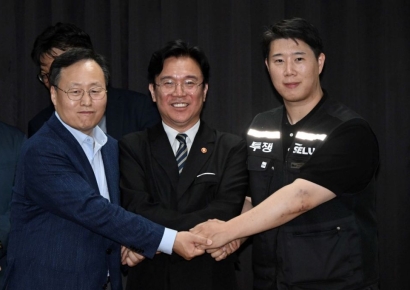
The eelgrass forest creation event held that day was attended by Yang Junseok, Director of the Tourism, Culture, and Environment Bureau of Gwangyang City; Choi Deungmo, Deputy Director of Safety and Environment at Gwangyang Steelworks; Kim Maengcheol, Chairman of the Gwangyang Fishermen's Association; as well as members of the Gwangyang Steelworks Environmental Resources Group, RIST, and the Gwangyang Sustainable Environment Council, totaling around 40 participants.

From the left, the seventh person is Kim Maengcheol, Fishermen's Association Chairman; Choi Deungmo, Deputy Director of Safety and Environment at Gwangyang Steelworks; and Yang Junseok, Director of Tourism, Culture, and Environment Bureau of Gwangyang City. Provided by Gwangyang Steelworks.
View original imageEelgrass is a representative marine plant that performs photosynthesis underwater and is recognized as a key resource of "Blue Carbon" due to its exceptional ability to absorb and store carbon dioxide. It can sequester carbon up to 50 times faster than terrestrial forests, playing a crucial role in combating climate change. Eelgrass meadows also provide spawning grounds and habitats for a wide variety of fish and crustaceans, making significant contributions to marine biodiversity.
The Gwangyang Bay area has long been known as an ideal environment for eelgrass habitats, and there have been reports of natural eelgrass meadows forming in certain waters. However, ongoing coastal development and changes in water quality have led to a continuous decline in eelgrass coverage, highlighting the need for marine ecosystem restoration. This transplantation project was launched at Jangnae Port after careful consideration of the optimal timing and methods, based on these circumstances.
For the newly created eelgrass forest, Gwangyang Steelworks plans to use marine fertilizer made from slag to promote the growth of eelgrass. In addition, the company will continuously monitor the development of the eelgrass forest and identify optimal growth conditions, with active consideration being given to expanding the project to other coastal areas in need of marine ecosystem restoration.
Hot Picks Today
 Samsung Electronics Introduces New "Special Performance Bonus" for Semiconductors, Paid Entirely in Company Shares
- "Could I Also Receive 370 Billion Won?"... No Limit on 'Stock Manipulation Whistleblower Rewards' Starting the 26th
- Opening a Bank Account in Korea Is Too Difficult..."Over 150,000 Won in Notarization Fees Just for a Child's Account and Debit Card" [Foreigner K-Finance Status]②
- Jeon Du-hwan with a Starbucks Tumbler, "Donjjul" Proof Shots... Has Starbucks Become a Far-Right Symbol?
- "Who Is Visiting Japan These Days?" The Once-Crowded Tourist Spots Empty Out... What's Happening?
A representative from Gwangyang Steelworks stated, "It is very meaningful for us to take the lead in establishing a sustainable marine ecosystem in the Gwangyang community through this initiative," adding, "We hope that, based on the results of this research, the 'POSCO-Style Marine Forest' model will be widely adopted."
© The Asia Business Daily(www.asiae.co.kr). All rights reserved.
!["Please Help Us": How Much Do Those Bowing Deeply for Your Vote Really Earn? [Data Pick]](https://cwcontent.asiae.co.kr/asiaresize/307/2026052010120870131_1779239528.png)