Incheon Gyeyang Industrial Complex Begins Second Round of Industrial Site Sales
Five Industrial Lots Including Knowledge Industry Center Sites Offered
The Korea Industrial Complex Corporation announced on September 29 that the Incheon Gyeyang Industrial Complex, which is being developed jointly with Gyeyang District in Incheon, will begin the official process for the second round of industrial site sales with the announcement of the new offering.
The Gyeyang Industrial Complex is an industrial park being established on a 243,000-square-meter site at 255-2 Byeongbang-dong, Gyeyang District, Incheon. It offers excellent transportation accessibility due to its proximity to the Gyeyang Interchange on the Seoul Metropolitan Area First Ring Expressway. The current construction progress rate is 62%, and the project is scheduled for completion in December 2026.

The second round of sales covers five industrial lots totaling 19,859 square meters, including two lots for knowledge industry centers. The lots will be supplied for various industries, including: ▲manufacturing of electronic components, computers, visual, audio, and telecommunications equipment, ▲manufacturing of automobiles and trailers, and ▲automobile repair. In the first round of sales held last year, all 23 lots were sold out early, with an average competition rate of 7.9 to 1 and a maximum of 12 to 1.
The Gyeyang Industrial Complex has been designed from the outset as a 'next-generation industrial park reflecting the needs of future innovative companies.' The plan includes the introduction of Artificial Intelligence Transformation (AX), Green Transformation (GX), and Youth-friendly cultural elements (YX). Currently, the Korea Industrial Complex Corporation and Gyeyang District Office are systematically managing the construction site by implementing AI-powered smart safety solutions. The industrial complex will also feature digital-based smart infrastructure, such as smart surveillance CCTV and a real-time bus arrival information system.
Hot Picks Today
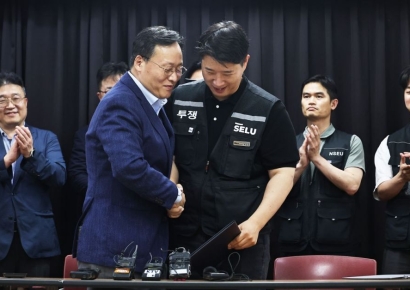 Up to 600 Million Won for Semiconductors, 160 Million Won Bonus for Loss-Making Non-Memory… Samsung Electronics Labor and Management Reach Tentative Deal on Unprecedented Performance Compensation (Comprehensive)
- "Could I Also Receive 370 Billion Won?"... No Limit on 'Stock Manipulation Whistleblower Rewards' Starting the 26th
- "From a 70 Million Won Loss to a 350 Million Won Profit with Samsung and SK hynix"... 'Stock Jackpot' Grandfather Gains Attention
- [Exclusive] 450 Billion Won Korean Investment at Risk as Canadian PE Moves to Acquire US Ascend for $99.2 Million
- "Who Is Visiting Japan These Days?" The Once-Crowded Tourist Spots Empty Out... What's Happening?
In addition, by mandating rooftop solar panels, the complex aims to generate 20% of its total electricity consumption on-site, thus realizing a low-carbon industrial park model. Accordingly, companies moving into the Gyeyang Industrial Complex will be required to install solar panels on their factory roofs in accordance with the district unit plan, and are expected to play a significant role in expanding renewable energy and reducing carbon dioxide emissions.
© The Asia Business Daily(www.asiae.co.kr). All rights reserved.







