Disposable Cup Entry Rate at Incheon Public Institutions Drops to 5.55%... Effectiveness of Reusable Cup Sharing System Proven
The use of disposable cups at public institutions in the Incheon area is gradually decreasing, with the average rate of disposable cup entry recorded at 5.55%.
On July 15, the Incheon city government announced that, together with environmental organizations, it had checked the status of disposable product use at 35 public institutions during the first half of this year. The results showed an entry rate of 0% for the Incheon city government itself and an average of 6.11% for district and county offices.
This represents a decrease of approximately 16.56% compared to the average entry rate of 22.11% in the second half of last year, indicating a noticeable reduction in the use of disposable cups within public office buildings. In particular, the Incheon City Hall and Incheon City Council, which are piloting a reusable cup sharing system, saw a significant drop in disposable cup entry rates, demonstrating the effectiveness of the system.
The city plans to continuously expand the adoption of the reusable cup sharing system and will reflect the results of disposable cup entry rate surveys in the administrative performance evaluations of district and county offices, awarding additional points accordingly.

An official from the Incheon city government stated, "Public institutions must take the lead in order for the culture of using reusable cups to take root in citizens' daily lives." The official added, "This year, we additionally supplied the reusable cup sharing system to the Human Resources Development Institute, Women's Plaza, Dong-gu, and Michuhol-gu, and we plan to continue expanding the related infrastructure in the future."
This survey was conducted using a random sampling method at a total of 35 public institutions, including Incheon City Hall, its affiliated agencies and corporations, Incheon City Council, and district and county offices, in order to verify the effectiveness of the disposable product reduction policy and to establish a monitoring system. To ensure objectivity, five environmental organizations?Incheon Federation for Environmental Movement, Incheon Green Union, Incheon Green Consumer Network, Catholic Environmental Solidarity, and Ganghwa Citizen Solidarity?jointly conducted the inspections.
Hot Picks Today
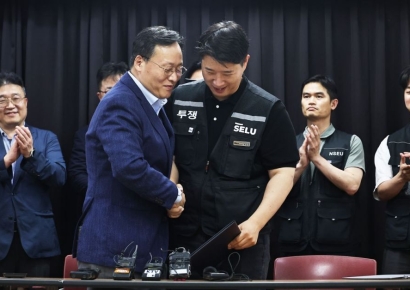 Up to 600 Million Won for Semiconductors, 160 Million Won Bonus for Loss-Making Non-Memory… Samsung Electronics Labor and Management Reach Tentative Deal on Unprecedented Performance Compensation (Comprehensive)
- "Could I Also Receive 370 Billion Won?"... No Limit on 'Stock Manipulation Whistleblower Rewards' Starting the 26th
- "From a 70 Million Won Loss to a 350 Million Won Profit with Samsung and SK hynix"... 'Stock Jackpot' Grandfather Gains Attention
- [Exclusive] 450 Billion Won Korean Investment at Risk as Canadian PE Moves to Acquire US Ascend for $99.2 Million
- "Who Is Visiting Japan These Days?" The Once-Crowded Tourist Spots Empty Out... What's Happening?
The survey was carried out across seven categories, including the entry rate of disposable cups within office buildings, whether there was guidance on the ban of disposable products, and the status of separate waste collection operations. The findings will be used as basic data for establishing future resource circulation policies.
© The Asia Business Daily(www.asiae.co.kr). All rights reserved.