US Steel and Aluminum Tariffs Put SMEs on Alert... "Difficult to Accurately Understand Policy"
Emergency Survey by Ministry of SMEs and Startups and Korea Federation of SMEs
"Difficulty Understanding Tariff Policies" Cited as Biggest Challenge
Most Needed Government Support is "Provision of Information"
As the United States has implemented tariffs on steel, aluminum, and related derivatives, domestic small and medium-sized enterprises (SMEs) cited 'lack of information' as their biggest challenge.
The Ministry of SMEs and Startups announced the results of the 'Survey on SMEs Exporting Steel, Aluminum, and Derivatives,' conducted jointly with the Korea Federation of SMEs and cooperatives related to steel and aluminum on the 31st.

This urgent survey was conducted to identify the difficulties faced by companies and their policy needs following the full-scale implementation of U.S. tariffs on steel, aluminum, and derivatives on the 12th. The survey targeted 600 companies exporting steel, aluminum, and derivatives who responded.
First, the most frequently cited current or anticipated difficulty due to U.S. tariffs was 'difficulty in accurately understanding U.S. tariff policies' (41.8%).
Other challenges included 'increased logistics costs due to tariff risks' (38.2%), 'costs incurred from diversifying export countries' (36.5%), 'difficulty confirming whether products are subject to U.S. tariffs' (28.2%), 'management difficulties caused by delays or cancellations of export contracts with U.S. clients' (25.7%), 'reduction in order volumes from domestic clients exporting to the U.S.' (23.3%), and 'deterioration of export competitiveness in third countries outside the U.S.' (22.7%).
Among the respondents, 32.5% are currently preparing to respond to tariffs. The preparation measures included 'efforts to reduce internal costs such as production expenses' (52.8%), 'discussions with U.S. clients regarding tariff burdens' (51.8%), 'information gathering through participation in briefings by related organizations' (30.8%), 'signing long-term contracts with clients' (14.4%), and 'direct local entry into the U.S. market' (12.3%).
The area where government support is most needed was identified as 'provision of tariff-related information' (51.3%). This was followed by 'strengthening support for logistics costs' (46.7%), 'policy fund support' (40.5%), 'tariff consulting by legal and accounting firms' (24.8%), and 'support for diversifying export countries to third countries' (19.2%).
Among companies that reported exporting derivatives, 43.4% said they are experiencing difficulties in exports. The government support needs included 'professional consulting for confirming U.S. HS codes' (42.4%), 'consulting on calculating steel and aluminum content' (41.4%), 'document handling services for customs clearance procedures' (33.5%), 'education to strengthen rules of origin' (25.6%), and 'training on using HS code inquiry systems such as the Korea Customs Service and the U.S. International Trade Commission (ITC)' (23.6%).
Based on this survey, the Ministry of SMEs and Startups plans to promptly support export SMEs facing difficulties through the Complaint Center. Export specialists will provide primary consultation and guidance through 15 regional complaint centers, and companies requiring funds will be recommended by local SME offices to receive expedited support through exemption from policy priority evaluations and fast-track procedures.
Hot Picks Today
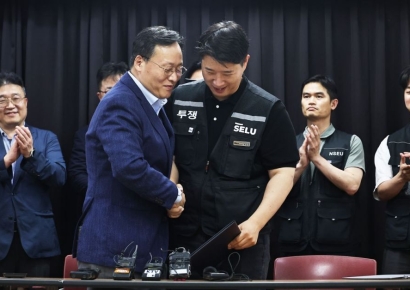 Up to 600 Million Won for Semiconductors, 160 Million Won Bonus for Loss-Making Non-Memory… Samsung Electronics Labor and Management Reach Tentative Deal on Unprecedented Performance Compensation (Comprehensive)
- "Could I Also Receive 370 Billion Won?"... No Limit on 'Stock Manipulation Whistleblower Rewards' Starting the 26th
- "From a 70 Million Won Loss to a 350 Million Won Profit with Samsung and SK hynix"... 'Stock Jackpot' Grandfather Gains Attention
- [Current State of Foreigner K-Finance]③"The Essence Is Ultimately Communication... Lending and Financial Education Must Go Hand-in-Hand"
- "Who Is Visiting Japan These Days?" The Once-Crowded Tourist Spots Empty Out... What's Happening?
No Yong-seok, Director of SME Policy at the Ministry of SMEs and Startups, stated, "We will continue to monitor the damages and difficulties faced by SMEs due to U.S. tariffs and provide tailored support suited to the situation of export SMEs to resolve their challenges and uncertainties."
© The Asia Business Daily(www.asiae.co.kr). All rights reserved.
!["Please Help": How Much Do Those Bowing 90 Degrees Really Earn? [Data Pick]](https://cwcontent.asiae.co.kr/asiaresize/307/2026052010120870131_1779239528.png)