"US Asia Allies Uneasy Over Trump's Approach to Ukraine"
WSJ: Asian Allies Fear U.S. Security Commitments May Be Broken
The Wall Street Journal (WSJ) reported on the 23rd (local time) that Asian allies are expressing concerns about the sustainability of U.S. security cooperation amid President Donald Trump's sidelining of Ukraine in ceasefire negotiations.

Recently, after a phone call with Russian President Vladimir Putin on the 12th, President Trump held ceasefire talks between U.S. and Russian officials in Saudi Arabia, excluding not only Ukraine but also European countries that could be seen as direct or indirect parties to the war threat.
In response, WSJ reported that there is growing vigilance among the U.S.'s Asian allies that America's commitment to regional security could be broken.
In particular, WSJ analyzed that the shift in U.S. policy toward Russia is raising concerns that it could lead to changes in the U.S. approach to North Korea. Amid President Trump's emphasis on his personal friendships with Chinese President Xi Jinping and North Korean Supreme Leader Kim Jong-un, the international community is raising the possibility that he may engage in direct talks with Kim Jong-un, excluding South Korea.
Furthermore, the renegotiation and adjustment of South Korea's cost-sharing for the stationing of U.S. troops in Korea is also considered an issue that could arise throughout President Trump's administration. During the last presidential election, Trump referred to South Korea as a "money machine" and argued that the cost-sharing should be increased to $10 billion (approximately 14.5 trillion won), nine times the amount to be applied in 2026. WSJ predicted that if the size of U.S. forces in Korea is actually reduced, demands for South Korea to develop its own nuclear weapons could increase.
Additionally, WSJ reported that Foreign Minister Cho Tae-yul affirmed that there is "no doubt" about the U.S.'s commitment to security on the Korean Peninsula, stating, "We must be fully prepared for every imaginable scenario to address threats from North Korea and other regional security challenges."
Hot Picks Today
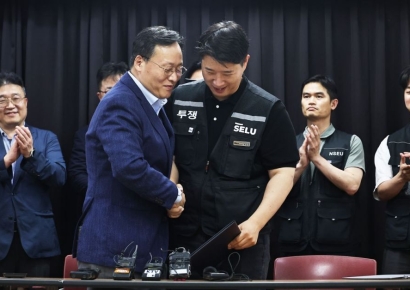 Up to 600 Million Won for Semiconductors, 160 Million Won Bonus for Loss-Making Non-Memory… Samsung Electronics Labor and Management Reach Tentative Deal on Unprecedented Performance Compensation (Comprehensive)
- "Could I Also Receive 370 Billion Won?"... No Limit on 'Stock Manipulation Whistleblower Rewards' Starting the 26th
- "From a 70 Million Won Loss to a 350 Million Won Profit with Samsung and SK hynix"... 'Stock Jackpot' Grandfather Gains Attention
- [Current State of Foreigner K-Finance]③"The Essence Is Ultimately Communication... Lending and Financial Education Must Go Hand-in-Hand"
- "Who Is Visiting Japan These Days?" The Once-Crowded Tourist Spots Empty Out... What's Happening?
Analysis suggests that not only South Korea but also other countries in Asia, such as Taiwan and the Philippines, which have established close security cooperation systems with the U.S., are closely monitoring the situation. Lin Kuok, a researcher at the Brookings Institution, a U.S. think tank, emphasized, "President Trump may ultimately want an economic agreement with China," adding that Trump's changing stance on Ukraine provides reasons for U.S. allies to reconsider their own situations.
© The Asia Business Daily(www.asiae.co.kr). All rights reserved.
!["Please Help": How Much Do Those Bowing 90 Degrees Really Earn? [Data Pick]](https://cwcontent.asiae.co.kr/asiaresize/307/2026052010120870131_1779239528.png)