Lee Changyong: "A 15-20 Trillion Won Supplementary Budget Is Desirable... Reviewing This Year's GDP Outlook"
Attendance at the National Assembly Planning and Finance Committee Plenary Session
"The Timing, Scale, and Content of the Supplementary Budget Are All Important"
On February 18, Lee Changyong, Governor of the Bank of Korea, stated, "Even under the current circumstances, it would be desirable for the supplementary budget to be in the range of 15 trillion to 20 trillion won."

Lee Changyong, Governor of the Bank of Korea (right in the photo), and Kim Beomseok, First Vice Minister of Economy and Finance, are attending and conversing at the Planning and Finance Committee plenary session held at the National Assembly on the 18th.
View original imageGovernor Lee made this remark in response to a question from Representative Yoon Hojoong of the Democratic Party of Korea regarding the appropriate size of the supplementary budget, during his appearance at the plenary session of the Planning and Finance Committee at the National Assembly that morning. He explained, "When I previously mentioned that a 20 trillion won supplementary budget was necessary, I was taking into account the current political uncertainty," and emphasized, "The timing, scale, and content of the supplementary budget are all important." He further added, "The supplementary budget alone cannot resolve all the issues faced by the self-employed," and noted, "We have taken into consideration long-term fiscal soundness and other factors."
Regarding this year's real GDP growth rate forecast for Korea, he said, "We are reviewing it again." The Bank of Korea had projected an economic growth rate of 1.9% for this year in November last year, but unusually revised it down to 1.6% to 1.7% last month. Explaining the decision to lower the bottom end of the forecast to 1.6%, he said, "In addition to political uncertainty, multiple factors are at play, such as U.S. economic policy and the Federal Reserve's interest rate policy." The Bank of Korea will announce its revised economic outlook on February 25.
Regarding the actual fourth-quarter growth rate last year, which was 0.4 percentage points lower than the expected 0.5%, he explained, "About half of this was due to a decline in investment spending, which was caused by weakened consumer sentiment stemming from the imposition of martial law and political uncertainty."
Hot Picks Today
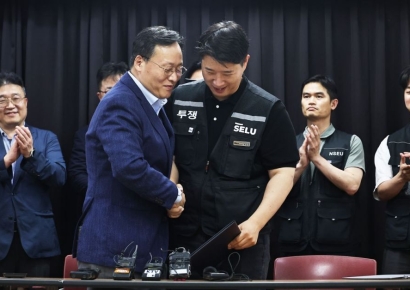 Up to 600 Million Won for Semiconductors, 160 Million Won Bonus for Loss-Making Non-Memory… Samsung Electronics Labor and Management Reach Tentative Deal on Unprecedented Performance Compensation (Comprehensive)
- "Could I Also Receive 370 Billion Won?"... No Limit on 'Stock Manipulation Whistleblower Rewards' Starting the 26th
- "From a 70 Million Won Loss to a 350 Million Won Profit with Samsung and SK hynix"... 'Stock Jackpot' Grandfather Gains Attention
- [Current State of K-Finance for Foreign Nationals]①From Niche to Core... Banks Go All-In on First-Mover Competition
- "Who Is Visiting Japan These Days?" The Once-Crowded Tourist Spots Empty Out... What's Happening?
Meanwhile, he reaffirmed his existing stance that the high price level of low-cost goods will be difficult to resolve in the short term without structural reforms, such as expanding imports.
© The Asia Business Daily(www.asiae.co.kr). All rights reserved.