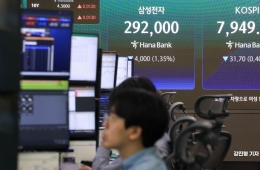
[Good Morning Stock Market] KOSPI Sector Differentiation Amid US Trump Tariffs
On the 3rd, the KOSPI is expected to be influenced by issues such as U.S. tariff impositions and the release of key economic indicators like employment data.
On the 31st of last month (local time), the Dow Jones Industrial Average at the New York Stock Exchange (NYSE) closed at 44,544.66, down 337.47 points (0.75%) from the previous trading day. The S&P 500 index fell 30.64 points (0.50%) to 6,040.53, and the Nasdaq Composite index dropped 54.31 points (0.28%) to 19,627.44.
![[Good Morning Stock Market] KOSPI Sector Differentiation Amid US Trump Tariffs](http://www.asiae.co.kr/news/img_view.htm?img=2025011506280389199_1736890083.jpg)
The decline in the New York stock market that day is attributed to investor sentiment freezing after news that U.S. President Donald Trump would impose tariffs on Canada, Mexico, China, and others starting from the 1st of this month. Additionally, the impact of the low-cost Chinese artificial intelligence (AI) model 'DeepSeek', which shook the U.S. stock market at the end of last month, continued.
Looking at individual stocks, Nvidia recorded a 3.67% drop to $120.07. Although it showed an upward trend temporarily following an emergency meeting between CEO Jensen Huang and President Trump, it turned downward in the latter part of the session after the tariff news was announced. Apple fell 0.67% amid slowing iPhone sales and tariff issues. Tesla and TSMC rose 1.08% and 0.56%, respectively, but also gave up some of their gains due to tariff concerns.
Last week, the domestic stock market closed lower due to a sell-off by foreign investors focused on large-cap stocks, influenced by the DeepSeek shock during the Lunar New Year holiday, big tech earnings, and the U.S. Federal Open Market Committee (FOMC) meeting.
This week, the domestic stock market is expected to show sectoral differentiation depending on U.S. tariff issues, key economic indicators such as U.S. January employment and manufacturing Purchasing Managers' Index (PMI), and earnings reports from U.S. big tech and major domestic companies.
Han Ji-young, a researcher at Kiwoom Securities, analyzed, “President Trump’s imposition of tariffs on Mexico, Canada, and China starting from the 4th, along with his meeting with CEO Jensen Huang and his expressed intention to control AI technology exports, shows a tough stance that disregards market reactions to tariffs, which will become a concern for the stock market.”
However, Han also noted, “The tariff imposition on the three countries has been mentioned several times through Trump’s statements since the November presidential election, so there is a pre-reflective aspect in the market. Especially, there are strong voices opposing tariffs within U.S. politics and businesses, and there are constraints such as insufficient legal grounds for tariff imposition.”
Hot Picks Today
 Up to 600 Million Won for Semiconductors, 160 Million Won Bonus for Loss-Making Non-Memory… Samsung Electronics Labor and Management Reach Tentative Deal on Unprecedented Performance Compensation (Comprehensive)
- "Could I Also Receive 370 Billion Won?"... No Limit on 'Stock Manipulation Whistleblower Rewards' Starting the 26th
- "From a 70 Million Won Loss to a 350 Million Won Profit with Samsung and SK hynix"... 'Stock Jackpot' Grandfather Gains Attention
- [Exclusive] 450 Billion Won Korean Investment at Risk as Canadian PE Moves to Acquire US Ascend for $99.2 Million
- "Who Is Visiting Japan These Days?" The Once-Crowded Tourist Spots Empty Out... What's Happening?
Domestically, earnings from shipbuilding and shareholder return stocks such as HD Hyundai Heavy Industries, KB Financial Group, and Shinhan Financial Group are expected to create sector rotation. Han predicted, “Although volatility will increase due to exposure to uncertainties from the U.S., the index’s downside will be limited by stock price resilience, resulting in a differentiated market by sector.”
© The Asia Business Daily(www.asiae.co.kr). All rights reserved.