Naju-si Selected for 'Bokamri Burial Mound Area' Historical and Cultural Zone Leading Project
Naju City in Jeollanam-do was selected last year for the ‘Historical and Cultural Zone Historical and Cultural Environment Maintenance and Promotion Leading Project’ announced by the Cultural Heritage Administration, with the Bokam-ri Burial Mounds area in Naju chosen.
According to the city on the 11th, through the selection of the leading project, from this year until 2026, a 12.1 billion KRW historical and cultural zone maintenance project will commence, including integrated maintenance of non-designated relics such as Jeongchon Burial Mounds and Jamae Mountain Fortress in Naju, as well as their surrounding areas.
The Historical and Cultural Zone Maintenance and Promotion Leading Project is a project based on the ‘Special Act on the Maintenance of Historical and Cultural Zones,’ which was enacted in 2020 and implemented in 2021.
![Naju Bogyamri Burial Mounds and Dasidul, Hoejin-ri area viewed from the sky. <br>[Photo by Naju City]](http://www.asiae.co.kr/news/img_view.htm?img=2024011115090326653_1704953343.jpg)
Naju Bogyamri Burial Mounds and Dasidul, Hoejin-ri area viewed from the sky.
[Photo by Naju City]
It focuses on highlighting the historical value of Korea’s ancient historical and cultural zones and cultural heritage, and promoting regional development through systematic maintenance.
The Cultural Heritage Administration established nine historical and cultural zones including Mahan, Goguryeo, Baekje, Silla, Gaya, Tamna, Jungwon, Yemaek, and Later Baekje, and held a nationwide competition for leading projects in February last year.
The city, which holds the largest number of Mahan relics and artifacts nationwide, derived eight Mahan historical and cultural zones, and after expert consultation and discussion, judged that the Bokam-ri Burial Mounds area in Dasim-myeon best fit the project’s purpose and participated in the competition.
Following the Cultural Heritage Administration’s evaluation and on-site investigation, four regions including Naju, Gangneung, Haman, and Haenam were finally selected as leading project sites.
The Bokam-ri Mahan Zone in Hoejin-ri, Dasim-myeon, Naju, selected for the leading project, is characterized as an ancient cultural convergence hub extending from ancient Mahan to Unified Silla, hosting non-designated cultural heritage sites such as Jeongchon Burial Mounds and Jamae Mountain Fortress, and forming a historical and cultural environment connected with natural heritage like Dasidul and the Yeongsan River.
The Bokam-ri Burial Mounds area leading project consists of ‘integrated maintenance of non-designated relics and surrounding areas,’ ‘creation of specialized landscapes around relics,’ and ‘establishment of historical and cultural enjoyment spaces.’
Since 2014, the city plans to develop new tourist resources through integrated maintenance such as opening trails, restoring fortress walls, and creating access roads centered on the Jeongchon Burial Mounds, where the most perfectly preserved gilt-bronze shoes were excavated, and the Jamae Mountain Fortress, built during the Three Kingdoms period.
Along with creating green spaces connecting to the Yeongsan River and historical trails at the access roads to the maintenance area, and landscaping the surroundings of the Bokam-ri Burial Mounds, historical and cultural spaces for tourists will also be established, including the Dasidul Mahan Relics Visitor Center, Mahan Historical and Cultural Exploration Experience Zone, Jeongchon Burial Mounds Rest Area, and Jamae Mountain Observatory.
The Naju Bokam-ri Burial Mounds Historical and Cultural Zone Leading Project will be actively promoted starting with the review of the historical and cultural zone maintenance implementation plan in March, followed by the establishment of basic and detailed plans.
Mayor Yoon Byung-tae said, “The selection for the historical and cultural zone leading project symbolizes Naju as a city representing and inheriting the ancient Mahan historical culture,” and added, “We will do our best to make Naju a successful model for historical and cultural zone maintenance projects through steady promotion of the leading project with active cooperation from residents, including the formation of a resident consultative body.”
Hot Picks Today
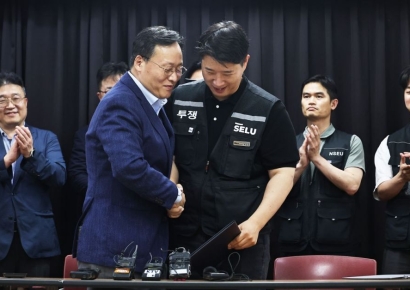 Up to 600 Million Won for Semiconductors, 160 Million Won Bonus for Loss-Making Non-Memory… Samsung Electronics Labor and Management Reach Tentative Deal on Unprecedented Performance Compensation (Comprehensive)
- "Could I Also Receive 370 Billion Won?"... No Limit on 'Stock Manipulation Whistleblower Rewards' Starting the 26th
- "From a 70 Million Won Loss to a 350 Million Won Profit with Samsung and SK hynix"... 'Stock Jackpot' Grandfather Gains Attention
- [Current State of K-Finance for Foreign Nationals]①From Niche to Core... Banks Go All-In on First-Mover Competition
- "Who Is Visiting Japan These Days?" The Once-Crowded Tourist Spots Empty Out... What's Happening?
Naju = Kim Yuk-bong, Honam Reporting Headquarters, Asia Economy baekok@asiae.co.kr
© The Asia Business Daily(www.asiae.co.kr). All rights reserved.