LegoChem Transfers '2.2 Trillion KRW' Anticancer Drug Technology to Janssen... Highest Ever Technology Export
LegoChem Biosciences has succeeded in exporting antibody-drug conjugate (ADC) technology worth up to $1.7225 billion (approximately 2.238 trillion KRW) to Janssen Biotech, a subsidiary of Johnson & Johnson (J&J). This is the largest technology export deal in South Korea's history.
![Kim Yong-ju, CEO of LegoChem Biosciences <br>[Photo by LegoChem Biosciences]](http://www.asiae.co.kr/news/img_view.htm?img=2022122308062861497_1671750388.jpg)
On the 22nd (local time), LegoChem Biosciences announced on the 26th that it had signed a technology transfer agreement with Janssen for the development and commercialization of 'LCB84 (Trop2-ADC)'. Under this contract, LegoChem Biosciences grants Janssen the global rights for the development and commercialization of LCB84. The two companies will jointly conduct ongoing Phase 1 and 2 clinical trials, and if Janssen exercises exclusive development rights thereafter, Janssen will take full responsibility for clinical development and commercialization.
The scale of this contract is said to be the largest ever for a single substance technology deal in South Korea, excluding multi-substance/platform technology transfers or returned transactions. The total contract value reaches $1.7225 billion, with an upfront payment of $100 million (approximately 130 billion KRW), tying for first place alongside the deal last November when Orum Therapeutics exported the leukemia treatment degrader/antibody conjugate (DAC) 'ORM-6151' to Bristol-Myers Squibb (BMS). Additionally, the contract includes a $200 million (approximately 260 billion KRW) exclusive development rights exercise fee and milestone payments totaling $1.4225 billion (approximately 1.8484 trillion KRW) based on development, approval, and commercialization.
ADC is a drug that links an antibody binding to cancer antigens with a cytotoxic payload drug that kills cancer cells via a linker. Often called a 'cruise missile' for its precision targeting of cancer, it is recognized as a next-generation cancer treatment technology. This field has seen major technology deals this year, such as Pfizer, a global big pharma, acquiring Seagen?which holds multiple FDA-approved ADCs?for $43 billion (approximately 56 trillion KRW). Riding this trend, LegoChem Biosciences also signed a contract last December to export ADC platform technology targeting five targets to Amgen in the U.S., worth a total of $1.2475 billion (approximately 1.62 trillion KRW), achieving a total technology export value of 8.7 trillion KRW to date.
The exported LCB84 is an ADC drug applying LegoChem Biosciences' next-generation ADC platform technology and a Trop2 antibody licensed from Mediterania. It recently entered Phase 1 and 2 clinical trials in the U.S. The Trop2 antigen targeted by LCB84 is an anticancer target protein excessively expressed in solid tumor cells but also distributed in normal cells, which has limited its effectiveness as a target until now.
However, LCB84 is said to have enhanced efficacy by targeting a cleaved form of the Trop2 antigen specifically expressed in cancer cells through its proprietary linker platform. Preclinical data demonstrated differentiated safety and efficacy across various cancer types, showing the potential of LCB84 as a Trop-2 ADC. Trop2-ADC technology is an active area of technology deals, with Merck signing a $936 million (approximately 1.216 trillion KRW) technology licensing agreement for 'SKB264' from Kelun Pharma last June, among others.
Hot Picks Today
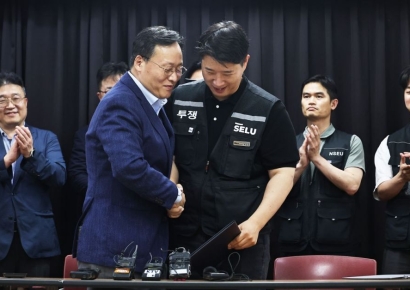 Up to 600 Million Won for Semiconductors, 160 Million Won Bonus for Loss-Making Non-Memory… Samsung Electronics Labor and Management Reach Tentative Deal on Unprecedented Performance Compensation (Comprehensive)
- "Could I Also Receive 370 Billion Won?"... No Limit on 'Stock Manipulation Whistleblower Rewards' Starting the 26th
- Opening a Bank Account in Korea Is Too Difficult..."Over 150,000 Won in Notarization Fees Just for a Child's Account and Debit Card" [Foreigner K-Finance Status]②
- "From a 70 Million Won Loss to a 350 Million Won Profit with Samsung and SK hynix"... 'Stock Jackpot' Grandfather Gains Attention
- "Who Is Visiting Japan These Days?" The Once-Crowded Tourist Spots Empty Out... What's Happening?
Kim Yong-joo, CEO of LegoChem Biosciences, said, “We are very pleased to collaborate with Janssen on LCB84, LegoChem’s first independently developed ADC drug in clinical development,” adding, “We will continue to strengthen our global clinical development capabilities and accelerate the clinical advancement of subsequent ADC programs.”
© The Asia Business Daily(www.asiae.co.kr). All rights reserved.
!["Please Help": How Much Do Those Bowing 90 Degrees Really Earn? [Data Pick]](https://cwcontent.asiae.co.kr/asiaresize/307/2026052010120870131_1779239528.png)