Candidate Kang Jeong-ae: "There is controversy over Hong Beom-do, so we need to review"
Adoption of the Confirmation Hearing Report for the Minister of Patriots and Veterans Affairs Nominee
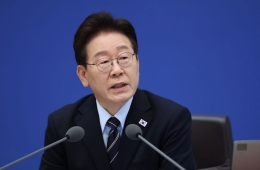
Candidate for Minister of Patriots and Veterans Affairs Kang Jeong-ae stated regarding the controversy over the removal of General Hong Beom-do's bust at the Korea Military Academy, "General Hong Beom-do should be honored as an independence activist, but since his actions have caused various controversies, it needs to be reviewed once again."
![[Image source=Yonhap News]](http://www.asiae.co.kr/news/img_view.htm?img=2023122207065397385_1703196412.jpg)
On the 21st, during the National Assembly confirmation hearing, when Democratic Party lawmaker Kim Seong-ju questioned, "My father-in-law, Kwon Tae-hyu, was a member of the Joseon Volunteer Army, and would he respond ambiguously like this even if attacked as a leftist?" Kang made this remark in response.
Kang said, "Before liberation, although there were different factions, everyone worked hard for the independence movement. However, if their identity after 1945 is difficult to gain national consensus, it should be reconsidered."
When Democratic Party lawmaker Cho Eung-cheon pointed out, "There is an article stating that you were included in the list of close associates sent by the Lee Myung-bak administration and gave special lectures to public officials," Kang rebutted, "Since President Kim Dae-jung's era, I have been requested to participate in many committees." He then emphasized, seemingly aware of the criticism of being a 'New Right professor' at the time, "I am not New Right."
Regarding the question from Democratic Party lawmaker Lee Yong-woo about the 'Democratic Meritorious Persons Act,' which was passed solely by the opposition in the National Assembly's Political Affairs Committee recently, Kang said, "I understand there is criticism that the bill's provisions do not allow any prediction of which events among various democratization movements qualify as democratic merit cases." He added, "For any bill to pass, it must be based on the consensus of the entire nation and social agreement. The Democratic Meritorious Persons Act lacked such a process. It would be good if the bill proceeds after sufficient debate and agreement in the National Assembly."
In response to Democratic Party lawmaker Hwang Un-ha's criticism that the bodies of Yoo Hak-seong and Park Jun-byung, who participated in the December 12 military coup, are still interred in the National Cemetery, Kang replied, "If I take office, I will review whether there are parts that do not comply with the National Cemetery Act." He continued, "If someone participated in the December 12 military coup and was convicted of violating the military penal code, it corresponds to grounds for exclusion from burial under the National Cemetery Act, so I understand that burial in the National Cemetery is not recognized." Regarding the inquiry from Democratic Party lawmaker Kang Hoon-sik about whether the Ministry of Patriots and Veterans Affairs would accept deletion requests from the bereaved families of Generals Kim Baek-il, Lee Jong-chan, and Lee Eung-jun, following the deletion of the phrase 'pro-Japanese anti-national act' from the burial record of the late General Baek Seon-yeop at the National Cemetery, Kang avoided a direct answer, saying, "It is unclear whether it will be deleted according to laws and regulations." He also appeared to acknowledge General Baek's pro-Japanese actions.
When Progressive Party lawmaker Kang Seong-hee asked, "Minister Park Min-sik said, 'I will stake my ministerial position on the fact that Baek Seon-yeop is not a pro-Japanese collaborator.' What is your opinion?" Kang said, "I have seen materials stating that he was recorded as having pro-Japanese actions in the Dictionary of Pro-Japanese Collaborators. I think we should respect those materials."
According to the Dictionary of Pro-Japanese Collaborators published by the civic group Institute for Research in Collaborationist Activities, General Baek participated in an attack operation against the Chinese People's Liberation Army as a member of the Gando Special Unit's machine gun and mortar company in December 1943. At the time of Japan's defeat, his rank was lieutenant in the Manchukuo Army. The institute has identified that 172 anti-Japanese armed forces and civilians were killed by the Gando Special Unit. General Baek admitted during his lifetime that he served in the Gando Special Unit but claimed he never directly fought against the independence army.
Hot Picks Today
 "Stocks Are Not Taxed, but Annual Crypto Gains Over 2.5 Million Won to Be Taxed Next Year... Investors Push Back"
- "Don't Throw Away Coffee Grounds" Transformed into 'High-Grade Fuel' in Just 90 Seconds [Reading Science]
- Signed Without Viewing for 1.6 Billion Won... Jamsil and Seongbuk Jeonse Prices Jump 200 Million Won in a Month [Real Estate AtoZ]
- "Groups of 5 or More Now Restricted"... Unrelenting Running Craze Leaves Citizens and Police Exhausted
- "Even With a 90 Million Won Salary and Bonuses, It Doesn’t Feel Like Much"... A Latecomer Rookie Who Beat 70 to 1 Odds [Scientists Are Disappearing] ③
Meanwhile, regarding the controversy over self-plagiarism in his academic papers during his professorship, Kang explained, "Research ethics were clearly presented in 2007," and "It was not done with any special intent."
© The Asia Business Daily(www.asiae.co.kr). All rights reserved.