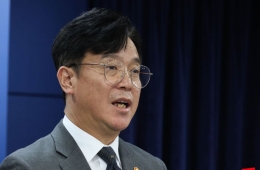
‘Gyeongbuk Province Digital Transformation Committee’ Launched … Co-Chairmen Lee Cheol-woo, Governor of Gyeongbuk, and Kwak Ho-sang, President of Kumoh National Institute of Technology
Gyeongbuk Province will hold the launch ceremony of the ‘Gyeongsangbuk-do Digital Transformation Committee’ at 11 a.m. on the 15th in the Hwabaekdang Hall of the provincial government office and announce the ‘Gyeongsangbuk-do Digital Transformation Basic Plan.’
About 60 people, including Lee Cheol-woo, Governor of Gyeongbuk Province and co-chairman of the committee, Kwak Ho-sang, President of Kumoh National Institute of Technology, and officials from the private digital transformation consultative body, will attend the launch ceremony.
The committee was newly established based on the ‘Gyeongsangbuk-do Digital Transformation and Virtual Convergence Economy Activation Ordinance’ enacted last November. The committee members’ term is two years, and they are responsible for reviewing and advising on the Gyeongbuk Province Digital Transformation Basic Plan and its implementation plan.

The launch ceremony will proceed with the presentation of appointment letters to the committee members and the announcement of the Gyeongbuk Province Digital Transformation Basic Plan.
The basic plan was established over six months after the announcement of the Gyeongbuk Province Digital Grand Transformation Basic Concept last May, reflecting conditions and policy changes under the vision of ‘Digital World! Gyeongsangbuk-do,’ with four major promotion strategies, 112 detailed tasks, and a scale of 5.7373 trillion KRW.
The four major promotion strategies and key detailed tasks of the Digital Transformation Basic Plan are as follows.
The first promotion strategy is the establishment of Gyeongbuk-type digital infrastructure. This includes creating core digital industry infrastructure such as the Gyeongbuk-type Cloud Data Center and Metaverse Data Center, as well as a manufacturing industry AI diffusion cluster.

The second promotion strategy is the creation of a digital ecosystem. Plans include expanding the designation of software industry promotion institutions, realizing ‘Gyeongbuk as the Metaverse Capital,’ building a digital media innovation hub to establish a foundation for global market entry, establishing content research institutions, and designating a metaverse regulatory free zone.
Additionally, to address regional issues, a high-density electronic map and a digital twin national land management platform will be established.
The third promotion strategy is the expansion of digital new value-creating services. This involves building an advanced technology live campus for industrial digital transformation and operating a collaboration support center among industry, academia, research, and government. To enhance the competitiveness of industrial complexes, energy platforms, 5G specialized network-based metaverse industrial complex advancement, and ESG industrial complexes will be promoted.
Digital-level advancement of manufacturing sites will be supported through root industry XR demonstration services, a metaverse eyewear device center, and an ultra-high-performance accelerator data platform.
The K-Kitchen project based on food tech, smart solutions support for small business owners, and digital traditional markets will strengthen the self-sustainability of small business owners.
Cultural and tourism industry regional growth will be promoted through the establishment of the World Cultural Heritage Promotion Institute managing world cultural heritage in 3D data, expansion of a future-oriented cutting-edge storage system for Korean studies materials, a future technology convergence content cluster, an immersive media art exhibition hall, a wellness medical tourism convergence cluster, and expansion of smart tourism hubs.
Social welfare accessibility will be enhanced through projects such as metaverse daycare centers and senior centers, an ICT children’s rehabilitation device demonstration center, and a Gyeongbuk-type digital training center for the disabled.
In the safety and environment sector, smart city construction, integrated disaster information infrastructure, and AI-based smart prevention system platforms will be established to proactively protect the lives and property of residents.

In the agriculture, fishery, and mountain village sectors, future global competitiveness in agriculture will be enhanced through regionally specialized rental-type smart complexes linked to the ‘Agricultural Grand Transformation,’ the creation of digital innovation agricultural towns, and the introduction of robot-based logistics automation systems.
Global software talent will be nurtured through Ecole Gyeongsan, Apple Developer Academy, and Glocal University, and metaverse full-cycle personnel will be trained by establishing digital Meister High Schools, Metaverse Academies, and Advanced Metaverse Academies.
Customized practical talent for companies will be cultivated through the establishment of advanced field and industrial transition joint training centers and operation of the Robot Vocational Innovation Center.
Rapid administrative services will be implemented with digital resident IDs, and policy evaluation and investment effect analysis will be enabled through an integrated population-industry platform. The digital gap among residents will also be resolved through the K-Digital Platform and SW Future Filling.
The final promotion strategy is the establishment of governance to create digital leadership.
The ‘Gyeongsangbuk-do Digital Transformation Committee’ will serve as the control tower for digital policies within the province, and an alliance involving industry, academia, research, and government in cities and counties will be operated to foster a private-led digital transformation culture.
Gyeongbuk Province will effectively promote detailed tasks by sharing roles with related organizations such as the Gyeongbuk Digital Transformation Support Group and the Industry DX Collaboration Support Center, concretizing project planning and commercialization procedures, and establishing a system for project evaluation and feedback through prior evaluation reviews and thorough monitoring.
Kwak Ho-sang, President of Kumoh National Institute of Technology and co-chairman, said, “Digital technology has already permeated all daily lives of residents regardless of users’ intentions, and the ability to utilize it affects income disparities in economic activities and quality of life. We will become a truly private-led committee that carefully examines many projects and regional issues promoted by Gyeongbuk Province.”
Hot Picks Today
 "Stocks Are Not Taxed, but Annual Crypto Gains Over 2.5 Million Won to Be Taxed Next Year... Investors Push Back"
- "Don't Throw Away Coffee Grounds" Transformed into 'High-Grade Fuel' in Just 90 Seconds [Reading Science]
- [Lee Jaemyung Administration 1 Year] 300,000 Benefit from Rural Basic Income, K-Food Hits 'All-Time High' Last Year
- "Groups of 5 or More Now Restricted"... Unrelenting Running Craze Leaves Citizens and Police Exhausted
- "Even With a 90 Million Won Salary and Bonuses, It Doesn’t Feel Like Much"... A Latecomer Rookie Who Beat 70 to 1 Odds [Scientists Are Disappearing] ③
Lee Cheol-woo, Governor of Gyeongbuk Province, stated, “Humanity is facing a monumental civilizational change called digital transformation. The younger generation today has a different DNA from birth. To resolve conflicts between generations and regions and for Korea to prosper evenly, digital innovation in local areas must come first, and Gyeongbuk will stand at the center of this.”
© The Asia Business Daily(www.asiae.co.kr). All rights reserved.