Retail Sales Drop Most in 3 Years and 5 Months... Early-Year Weakness Signals Red Flag
Recently, domestic consumption has continued to slow down as retail sales have sharply declined and production in the service sector has stalled.
According to the National Statistical Portal of Statistics Korea on the 8th, the retail sales index, a representative consumption indicator, recorded 102.6 as of last month. This is a 5.2% decrease compared to 108.2 in August last year. It is also the largest decline in three years and five months since March 2020 (-7.1%), when COVID-19 began in earnest.
Compared to the previous month, it decreased by 0.3%. This marks two consecutive months of decline following July (-3.3%), and it is the first time in about a year since April to July last year.
The retail sales index is based on the sales of 2,700 companies selling personal and consumer goods. It is a figure that excludes seasonal, holiday, and working day variables from the constant amount of current sales adjusted for price factors.
Since both seasonal factors and inflation rates are removed, it can be seen as the actual level of goods consumption by economic agents.
The sector with the largest decline was semi-durable goods such as clothing and footwear, which decreased by 7.6% compared to a year ago. Among non-durable goods, the consumption of food and beverages notably decreased. The retail sales index for food and beverages in August was 95.1, down 8.3% from a year earlier.

On August 5th, rice is being sold at Hanaro Mart Yangjae Branch in Seocho-gu, Seoul, where consumer prices in August rose to the 3% range with the largest increase in four months due to the impact of heatwaves and heavy rain. Photo by Kang Jin-hyung aymsdream@
View original imageThe retail sales index including restaurants, which covers dining-out consumption, also decreased by 5.1%. This is the largest decline in two years and seven months since a 7.5% decrease in January 2021.
Another indicator that gauges consumption, the 'service sector production index,' rose 1.7% year-on-year to 115.6 in August. However, accommodation and food services, which are closely related to consumer sentiment, decreased by 4.4%, and wholesale and retail trade fell by 3.6% respectively.
According to the Bank of Korea's real GDP for the second quarter, private consumption decreased by 0.1% compared to the previous quarter. Although the private consumption growth rate rebounded from -0.5% in the fourth quarter of last year to the first quarter of this year, it failed to grow for two consecutive quarters.
At the time, the Bank of Korea diagnosed this as a temporary consumption contraction, but looking at the statistics for July and August, there is an analysis that the possibility of a noticeable rebound in private consumption in the second half of the year is low.
Hot Picks Today
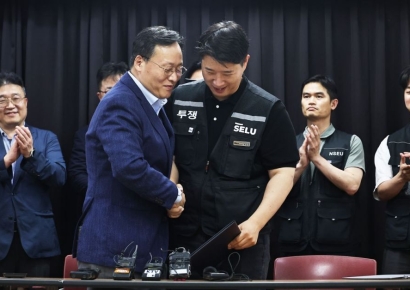 Up to 600 Million Won for Semiconductors, 160 Million Won Bonus for Loss-Making Non-Memory… Samsung Electronics Labor and Management Reach Tentative Deal on Unprecedented Performance Compensation (Comprehensive)
- "Could I Also Receive 370 Billion Won?"... No Limit on 'Stock Manipulation Whistleblower Rewards' Starting the 26th
- "From a 70 Million Won Loss to a 350 Million Won Profit with Samsung and SK hynix"... 'Stock Jackpot' Grandfather Gains Attention
- U.S. Stocks Up 1% on War Negotiation Hopes... Will Korea Recover Recent Losses? [Good Morning Market]
- "Who Is Visiting Japan These Days?" The Once-Crowded Tourist Spots Empty Out... What's Happening?
Structural limitations such as excessive household debt, along with external adverse factors such as high interest rates and high oil prices, are cited as factors limiting household consumption capacity. The U.S. Federal Reserve has forecasted a 'prolonged period of high interest rates,' and international oil prices are showing an upward trend again, which could act as obstacles to domestic consumption amid external adversities.
© The Asia Business Daily(www.asiae.co.kr). All rights reserved.







