Shin Won-sik: "The September 19 Military Agreement Must Be Terminated"
In the National Assembly National Defense Committee Response Materials
Shin Won-sik, the nominee for Minister of National Defense, stated on the 25th that the September 19 inter-Korean military agreement must be terminated due to numerous military vulnerabilities.

Shin Won-sik, the nominee for Minister of National Defense, is arriving at the hearing preparation office in the Army Hall on the 15th. Photo by Heo Young-han younghan@
View original imageIn response to the National Assembly's National Defense Committee ahead of his confirmation hearing, Shin said in his written answers, "Because the September 19 military agreement has caused many military vulnerabilities such as weakening combat power and operational capabilities, I believe the military agreement must be terminated."
He cited examples of military vulnerabilities including ▲ degradation of surveillance and reconnaissance capabilities against North Korea and restrictions on close precision strikes due to the establishment of no-fly zones ▲ isolation of the five northwestern islands and Deokjeokdo Island due to the establishment of ground and maritime buffer zones and no-fly zones ▲ exposure of 26 million residents in the Seoul metropolitan area to threats ▲ restrictions on normal live-fire training and joint exercises. He added, "The September 19 military agreement is a flawed agreement that expanded our military's vulnerabilities," and argued, "Since North Korea is intentionally and repeatedly violating the agreement, it is desirable to strengthen military readiness to counter North Korean threats by terminating the agreement." Shin also said, "North Korea has repeatedly violated the September 19 military agreement and continues to enhance its nuclear, missile, and conventional capabilities, so the agreement is almost ineffective. In this situation, it is not desirable for us alone to cling to compliance with the military agreement."
North Korean Nuclear Issue - Firm Response to Nuclear Tests
Nuclear Possession - Cautious on Tactical Nuclear Redeployment
Strengthening UN Command - Enhancing Cooperation for ROK-US Alliance
Information Sharing - Careful Consideration of Joining Five Eyes
Shin also stated that the possibility of North Korea abandoning its nuclear weapons is low, and responding to North Korea's nuclear and missile threats will be the top priority for our military.
In his written response, Shin said, "Considering the trend of North Korea's advancement in nuclear and missile capabilities, the possibility of North Korea giving up its nuclear weapons is currently low." He added, "Nevertheless, continuous efforts are necessary to make North Korea judge that abandoning nuclear weapons is advantageous." Regarding the possibility of a North Korean nuclear test, he warned, "If North Korea proceeds with a seventh nuclear test, we will respond firmly and in principle by fully utilizing the ROK-US alliance and our military capabilities." He also said, "If North Korea attempts provocations with missiles armed with nuclear warheads, it will clearly recognize that it will face the end of its regime."
In response to a question from Im Byung-heon of the People Power Party about policy priorities, Shin said, "The Ministry of National Defense recognizes North Korea's advanced nuclear and missile threats as the most serious. If appointed, I will harmoniously operate the U.S. extended deterrence forces, including nuclear capabilities, and Korea's own three-axis system, along with our military's advanced conventional forces, to dramatically strengthen deterrence and response capabilities against North Korea's nuclear and missile threats."
However, when asked by Democratic Party's Song Gap-seok and People Power Party's Sung Il-jong about the willingness to pursue indigenous nuclear armament, Shin drew a clear line, saying, "Our government is not considering indigenous nuclear possession, redeployment of tactical nuclear weapons, or NATO-style nuclear sharing, and maintains a consistent stance on compliance with the Nuclear Non-Proliferation Treaty (NPT) regime and denuclearization of the Korean Peninsula." He added, "Considering the international political and economic repercussions and military effectiveness of nuclear armament comprehensively, strengthening extended deterrence capabilities at this point aligns with national interests."
Regarding the need to strengthen the United Nations Command in response to North Korean nuclear threats, Shin responded to People Power Party lawmaker Lee Chae-ik's question, "North Korea still regards the UN Command as the biggest obstacle to its communist unification of the Korean Peninsula. We will strengthen cooperation with the UN Command centered on a strong ROK-US alliance and further solidify our security through robust solidarity with UN Command member countries."
In response to Democratic Party lawmaker Seol Hoon's question about the willingness to join the 'Five Eyes' intelligence alliance, which shares classified information with the U.S., Shin said, "To deter North Korea's advanced nuclear and missile threats, we must share information and cooperate with various countries. If an official proposal is made in the future, we will carefully consider joining in consultation with the Ministry of Foreign Affairs and related agencies."
Hot Picks Today
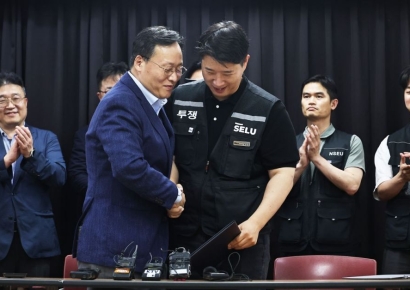 Up to 600 Million Won for Semiconductors, 160 Million Won Bonus for Loss-Making Non-Memory… Samsung Electronics Labor and Management Reach Tentative Deal on Unprecedented Performance Compensation (Comprehensive)
- "Could I Also Receive 370 Billion Won?"... No Limit on 'Stock Manipulation Whistleblower Rewards' Starting the 26th
- "From a 70 Million Won Loss to a 350 Million Won Profit with Samsung and SK hynix"... 'Stock Jackpot' Grandfather Gains Attention
- Opening a Bank Account in Korea Is Too Difficult..."It Costs 150,000 Won Just to Open a Child's Account or Check Card" [Foreigner K-Finance Status]②
- "Who Is Visiting Japan These Days?" The Once-Crowded Tourist Spots Empty Out... What's Happening?
Additionally, regarding North Korea's newly revealed tactical nuclear attack submarine 'Kim Gun-ok Hero Ship' (No. 841) unveiled earlier this month, Shin explained, "It is an abnormal modification of an existing R-class submarine, significantly expanding the conning tower and part of the hull to mount missiles." He added, "There are issues with the ship's stability and stealth, and it is judged that it is not yet in a condition to be operated normally."
© The Asia Business Daily(www.asiae.co.kr). All rights reserved.
!["Please Help": How Much Do Those Bowing 90 Degrees Really Earn? [Data Pick]](https://cwcontent.asiae.co.kr/asiaresize/307/2026052010120870131_1779239528.png)