Low Earth Orbit Satellite Competition Heats Up... Ministry of Science and ICT Invests 480 Billion Won for Preliminary Feasibility Study
Ministry of Science and ICT Announces 'Satellite Communication Activation Strategy'
Lee Jong-ho "3 Billion Dollar Export by 2030"
National Public-Private-Military Consultative Body to Operate from Next Year
The government is launching full-scale research and development (R&D) support to advance low Earth orbit (LEO) satellite communications, which is considered a promising future industry. It will invest 480 billion KRW in a preliminary feasibility study to verify the technology. A nationwide alliance will also be formed to validate the feasibility of securing an independent LEO satellite communication network.
![SpaceX rocket soaring with Starlink satellites <span>[Image source=Yonhap News]</span>](http://www.asiae.co.kr/news/img_view.htm?img=2022051412022366745_1652497343.jpg)
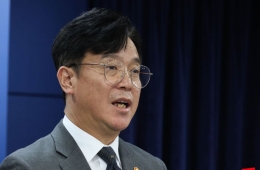
On the 18th, the Ministry of Science and ICT announced the "Satellite Communication Activation Strategy" at an emergency economic ministers' meeting. The strategy aims to secure competitiveness in satellite communication technology and industry, and to reform systems to join the ranks of advanced countries in the satellite communication sector. The goal is to elevate technological capabilities to a world-class level and achieve exports exceeding 3 billion USD in the satellite communication field by 2030.
Global Companies Focus on Low Earth Orbit Satellites
Future communication services are expanding spatially from land to sea and air, increasing the importance of satellite communications. In particular, LEO satellites (altitude 300?1500 km) provide high-speed services with shorter latency compared to geostationary satellites (altitude 36,000 km) and are regarded as the core of next-generation communication infrastructure. Global companies such as SpaceX, OneWeb, and Amazon are competing to secure leadership by focusing on the growth potential of the global LEO satellite communication market.
For example, during the recent Ukraine war, SpaceX's "Starlink" provided stable communication services even in areas where terrestrial networks were cut off. This served as a turning point for LEO satellite communication to be recognized as a complementary means to terrestrial networks.
There are also voices calling for proactive measures to prevent dependence on specific companies or foreign capital for satellite communications, which are important from a national security perspective.
Support for Technology Development and Forums for Discussion
The satellite communication activation strategy announced by the government on this day comprehensively addresses policy tasks to create growth engines through satellite communications and to protect sovereignty over satellite communication networks as future national infrastructure.
First, R&D in the satellite communication field will be continuously strengthened. Along with the development and launch of domestically independent LEO communication satellites, a LEO satellite communication system (pilot network) including terminals and ground stations will be established to verify the technology. To this end, a preliminary feasibility study for related projects will be applied for in September, and some core technologies will be selectively supported for development in advance based on urgency.
The preliminary feasibility study, named "Technology Development to Strengthen Competitiveness in the LEO Satellite Communication Industry," plans to invest about 480 billion KRW from 2025 to 2030.

Additionally, the strategy supports workforce training in the satellite communication field, startup and growth of companies, and global cooperation. It will also actively support the establishment of experimental stations that conduct real-environment tests (On-The-Air) communicating with satellites for export purposes upon companies' requests.
From a mid- to long-term perspective, a nationwide civilian-government-military consultative body called the "K-LEO Communication Alliance (tentative name)" will be formed and operated from next year to review the feasibility of securing an independent LEO satellite communication network.
To proactively secure satellite networks, the government plans to consider providing incentives for private sector satellite network international registrations. It will analyze satellite network demand reflecting the rapidly increasing satellite launch demand and establish a full-cycle management system for satellite networks to prevent and coordinate interference.
Furthermore, based on technology and industry trends and foreign government cases, the supply of frequencies available for satellite communication services will be reviewed. To prepare for the increasing number of satellites, the satellite radio monitoring system for compliance with satellite operation conditions (including ITU radio regulations) will be gradually expanded, and interference to existing terrestrial services by earth stations will be monitored.
Hot Picks Today
 "Stocks Are Not Taxed, but Annual Crypto Gains Over 2.5 Million Won to Be Taxed Next Year... Investors Push Back"
- "Don't Throw Away Coffee Grounds" Transformed into 'High-Grade Fuel' in Just 90 Seconds [Reading Science]
- Signed Without Viewing for 1.6 Billion Won... Jamsil and Seongbuk Jeonse Prices Jump 200 Million Won in a Month [Real Estate AtoZ]
- "Groups of 5 or More Now Restricted"... Unrelenting Running Craze Leaves Citizens and Police Exhausted
- "Even With a 90 Million Won Salary and Bonuses, It Doesn’t Feel Like Much"... A Latecomer Rookie Who Beat 70 to 1 Odds [Scientists Are Disappearing] ③
Lee Jong-ho, Minister of Science and ICT, said, "We will accelerate the implementation of policy tasks to enter the ranks of advanced countries in satellite communications and complete the next-generation network of Digital Korea. We will reform systems and strengthen technology development to achieve exports exceeding 3 billion USD in the satellite communication field by 2030."
© The Asia Business Daily(www.asiae.co.kr). All rights reserved.