Yegyeongje Tong: "The Essence of the Saemaeul Incident Lies in Unyielding High Interest Rates... Possible Spread to Other Financial Institutions"
Hong Sung-kook "Interest Burden Increases by Over 100 Trillion Won Due to Rate Hikes"
Financial Sector Burden of 270 Trillion Won
"Additional Measures Needed, Whether Government Supplementary Budget or Support for Vulnerable Groups"
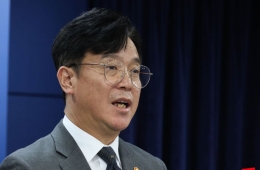
Hong Seong-guk, an economic expert from the Democratic Party of Korea, warned that both household and financial institution conditions are deteriorating. He emphasized the need for additional government measures to support livelihoods, whether through supplementary budgets or aid for vulnerable groups.
On the 11th, at the Democratic Party's floor strategy meeting, Representative Hong pointed out the recent global trend of interest rate hikes and expressed concern. He explained, "When combining the debts of individuals and companies from the period when interest rates were low in 2000 and 2001, the total amounts to about 4,500 trillion won. If interest rates rise above 2% on this 4,500 trillion won, the interest burden increased by about 100 trillion won in 2021, which is one of the main reasons the economy is currently struggling." He continued, "In the U.S., interest rates stabilized but have now risen again to 4%. If rates do not decrease for the time being, the interest burden will remain more than double compared to the past," adding, "This accumulation led to the Saemaeul Geumgo crisis becoming full-blown last week."
He explained, "The essence of the Saemaeul Geumgo crisis is that about 10% of real estate project financing (PF) investments have become non-performing," and added, "Currently, about 132 trillion won remains." Representative Hong noted, "(In addition,) Korea Electric Power Corporation's accumulated deficit of 40 trillion won and Korea Gas Corporation's 12 trillion won will also impact the bond market." He further stated, "By the end of September this year, the maturity repayment deferral for small business owners will begin to expire. It can be gradually reduced, but according to the Financial Services Commission's announcement, it is estimated to be about 85 trillion won. However, it is decreasing too quickly."
Representative Hong said, "Adding up only the announced amounts, the total burden on the financial sector is about 270 trillion won," and explained, "Because this money is disrupting our financial market, our country's economy, especially the secondary financial sector, is facing very difficult situations that are expected to continue."
He criticized, "The government and financial authorities could have foreseen the Saemaeul Geumgo crisis, and the Democratic Party even proposed legislation related to Saemaeul Geumgo supervision," but "Despite this, the government remained unprepared, and just like last year's deliberate default incident triggered by Kim Jin-tae and the Legoland crisis, they neglected the situation, leading to this major problem." Representative Hong warned, "(The government) is implementing policies to block it, but this is not over and could spread to other financial institutions."
He stated, "There are 4.46 million multiple debtors who owe money to three or more financial institutions, with a total amount of 576 trillion won," and said, "A significant portion of the public continues to face very difficult circumstances, and since there are no signs of resolution, I believe more social attention is needed."
Hot Picks Today
 "Stocks Are Not Taxed, but Annual Crypto Gains Over 2.5 Million Won to Be Taxed Next Year... Investors Push Back"
- "Don't Throw Away Coffee Grounds" Transformed into 'High-Grade Fuel' in Just 90 Seconds [Reading Science]
- Signed Without Viewing for 1.6 Billion Won... Jamsil and Seongbuk Jeonse Prices Jump 200 Million Won in a Month [Real Estate AtoZ]
- "Groups of 5 or More Now Restricted"... Unrelenting Running Craze Leaves Citizens and Police Exhausted
- "Even With a 90 Million Won Salary and Bonuses, It Doesn’t Feel Like Much"... A Latecomer Rookie Who Beat 70 to 1 Odds [Scientists Are Disappearing] ③
Regarding this, he also stressed the need for additional government measures. Referring to this year's government fiscal execution, he said, "For budgets related to livelihoods, 62% was spent in the first half of the year, and a staggering 67% of essential living expenses for vulnerable groups was used," adding, "Only 33% remains for the second half." He emphasized, "Given the very poor current situation and the weak economy, the livelihood budget has already been exhausted, so support for vulnerable groups is necessary, whether through supplementary budgets or other means."
© The Asia Business Daily(www.asiae.co.kr). All rights reserved.