Ulsan City Accelerates Support for 'Secondary Batteries and Biotechnology'... Selected for 3 Government Competitions
Ministry of Industry and Trade Secures Total Project Funds of 43.5 Billion Won
Ulsan City has secured 43.5 billion KRW in government funding to support the development of new industries such as secondary batteries and biotechnology.
Ulsan City has had three projects selected so far this year in the Ministry of Trade, Industry and Energy’s public contest, including the establishment of a demonstration center for prismatic secondary battery materials and components for electric vehicles.
Accordingly, the city has secured a total project budget of 43.5 billion KRW and plans to accelerate the fostering of new industries to discover future growth engines for Ulsan, such as secondary batteries and biotechnology.
The newly selected projects this year are ▲Establishment of a demonstration center for prismatic secondary battery materials and components for electric vehicles ▲Support project for mid-sized companies-regional innovation alliance ▲Development of stimulus-responsive plastic upcycling technology.

The ‘Establishment of a demonstration center for prismatic secondary battery materials and components for electric vehicles’ was selected in the 2023 regional base smart specialization infrastructure public contest and is being carried out with a total project cost of 12.28 billion KRW (4.583 billion KRW national funding, 7.65 billion KRW city funding, 48 million KRW private investment).
To build the manufacturing base, 21 units of 9 types of equipment for electrode manufacturing, assembly, evaluation, and analysis will be introduced. By supporting the demonstration of prismatic secondary battery materials and components for electric vehicles, the project aims to attract related companies and strengthen the industrial ecosystem through the formation of supply chains between demand and supply companies.
The ‘Support project for mid-sized companies-regional innovation alliance’ was also finally selected in the contest and will be carried out with a total project cost of 6.21 billion KRW (4.5 billion KRW national funding, 900 million KRW city funding, 810 million KRW private investment).
A mid-sized company innovation research lab will be established at Ulsan University to conduct research and development on technologies demanded by companies, and in connection with master’s and doctoral programs, R&D personnel will be hired by the respective mid-sized companies upon obtaining their degrees.
Through win-win cooperation among mid-sized companies, universities, and research institutes, the project aims to nurture secondary battery specialists by targeting 20 participating innovation institutions, 30 research-based learning projects, 21 master’s and doctoral graduates, and 19 employed personnel, thereby enhancing industrial capabilities and competitiveness.
The ‘Development of stimulus-responsive plastic upcycling technology’ project was selected in the Industrial Technology Alchemist Project contest, with Ulsan National Institute of Science and Technology (UNIST) receiving 200 million KRW in funding for one year to begin phase 1 conceptual research.
The Alchemist project proceeds through a total of three competitive research and development phases: phase 1 (conceptual research) with 6 teams, phase 2 (preliminary research) with 3 teams, and phase 3 (main research) with 1 team. As the project progresses, the number of performing institutions is reduced and the support budget is concentrated on final outcomes, with annual funding of 200 million KRW for conceptual research, 500 million KRW for preliminary research, and 4 billion KRW for main research.
UNIST plans to develop the world’s first commercialization technology capable of decomposing plastics with an on/off switch design and biomimetic-based depolymerization catalysts, securing high added value and economic feasibility for waste plastics.
Hot Picks Today
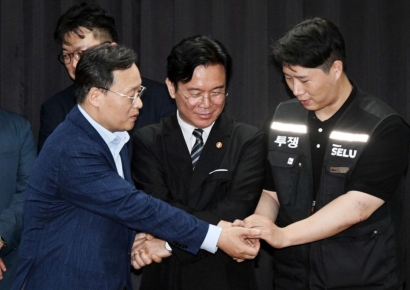 Dramatic Agreement Reached on Eve of Samsung Electronics General Strike... Minister Kim Young-hoon: "Showcased Korea's Strength in Dialogue" (Update)
- "It Has Now Crossed Borders": No Vaccine or Treatment as Bundibugyo Ebola Variant Spreads [Reading Science]
- "From a 70 Million Won Loss to a 350 Million Won Profit with Samsung and SK hynix"... 'Stock Jackpot' Grandfather Gains Attention
- "Stocks Are Not Taxed, but Annual Crypto Gains Over 2.5 Million Won to Be Taxed Next Year... Investors Push Back"
- "Who Is Visiting Japan These Days?" The Once-Crowded Tourist Spots Empty Out... What's Happening?
Through this, it is expected to reduce existing depolymerization processing costs by 30%, create a domestic plastic replacement market of 46,000 tons annually, and achieve total sales of approximately 65 billion KRW by 2028. It is also expected to contribute to solving plastic waste environmental issues by reducing 50,000 to 100,000 tons or more of carbon dioxide (CO2) annually.
© The Asia Business Daily(www.asiae.co.kr). All rights reserved.