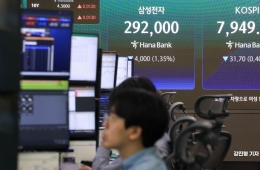
[New York Stock Market] Weakened Santa Rally Expectations... Nasdaq Down 1.38%
[Asia Economy New York=Special Correspondent Joselgina] The major indices of the U.S. New York Stock Exchange, which reopened on the 27th (local time) after the Christmas holiday, closed mixed. Treasury yields surged, leading to notable weakness centered on tech and growth stocks.
On this day at the New York Stock Exchange (NYSE), the Dow Jones Industrial Average closed at 33,241.56, up 37.63 points (0.11%) from the previous session. In contrast, the large-cap S&P 500 index fell 15.57 points (0.40%) to 3,829.25, and the tech-heavy Nasdaq index dropped 144.64 points (1.38%) to 10,353.23.
![[Image source=Reuters Yonhap News]](http://www.asiae.co.kr/news/img_view.htm?img=2022120806301744399_1670448617.jpg)
By sector, Chinese-related stocks surged as China eased its 'zero-COVID' policy. Alibaba and JD.com, listed on the New York Stock Exchange, closed up 4.92% and 4.18%, respectively, compared to the previous session. Casino stocks such as Las Vegas Sands and Wynn Resorts, which have operations in Macau, also rose more than 4% each following news of China's COVID-19 regulation easing.
On the other hand, tech stocks underperformed. Tesla, a representative tech stock, fell 11.41% amid foreign reports that it would reduce production at its Shanghai plant. Nvidia declined 7.14%, and Amazon dropped 2.59%. Apple also fell 1.39%, hitting its lowest level since June 2021. Additionally, Southwest Airlines fell nearly 6% after being investigated by transportation authorities due to thousands of flight cancellations.
Investors on this day focused on the increasingly distant year-end Santa rally expectations, along with China's COVID-19 regulation easing, Russia's export ban on countries participating in the oil price cap, and movements in Treasury yields.
The New York Stock Exchange now has only three trading days left this year. If the three major indices close 2022 at current levels, it will mark the worst performance since the 2008 global financial crisis. The Nasdaq's decline this month is approaching 10%. The S&P 500 and Dow Jones indices have also fallen 6.2% and 3.9%, respectively. This is the largest monthly decline since last September.
However, CNBC reported that "investors who endured a brutal year due to inflation and recession fears are hoping to end 2022 on a positive note," maintaining expectations for a Santa rally. Given the recent sharp declines, there are factors that could trigger a late-year rebound. Typically, the Santa rally is evaluated over the last five trading days of the year and the first two trading days of the new year. Since 1950, the S&P 500 has risen during this period with an average probability of 80%.
Treasury yields rose. The 10-year Treasury yield climbed to around 3.85%. The 2-year yield, which is sensitive to monetary policy, briefly hit 4.445% during the session before easing. The rise in Treasury yields added pressure on interest rate-sensitive tech and growth stocks. In the New York bond market, the yield inversion phenomenon continues, with long-term 10-year yields exceeding short-term 2-year and 3-month yields. This is generally considered a precursor to a recession.
Economic indicators showed mixed results. U.S. home prices declined for the fourth consecutive month. The S&P CoreLogic Case-Shiller Home Price Index released on this day showed a 0.5% drop in October compared to the previous month. Due to rising benchmark interest rates increasing mortgage financing burdens, the downward trend in home prices is expected to continue. The U.S. goods trade deficit in November sharply decreased to its lowest level in about two years. According to the Department of Commerce, the November goods trade deficit fell 15.6% from the previous month to $83.3 billion.
Gold prices rose to a six-month high amid expectations for China's economic reopening. In the spot market, gold prices surged to $1,832.99 early in the session, the highest since late June. Gold futures rose about 1%, closing at around $1,822 per ounce.
Hot Picks Today
 Up to 600 Million Won for Semiconductors, 160 Million Won Bonus for Loss-Making Non-Memory… Samsung Electronics Labor and Management Reach Tentative Deal on Unprecedented Performance Compensation (Comprehensive)
- "Could I Also Receive 370 Billion Won?"... No Limit on 'Stock Manipulation Whistleblower Rewards' Starting the 26th
- "From a 70 Million Won Loss to a 350 Million Won Profit with Samsung and SK hynix"... 'Stock Jackpot' Grandfather Gains Attention
- Opening a Bank Account in Korea Is Too Difficult..."It Costs 150,000 Won Just to Open a Child's Account or Check Card" [Foreigner K-Finance Status]②
- "Who Is Visiting Japan These Days?" The Once-Crowded Tourist Spots Empty Out... What's Happening?
Oil prices closed lower. On the New York Mercantile Exchange, the February contract for West Texas Intermediate (WTI) crude oil fell 3 cents (0.04%) to $79.53 per barrel. Despite expectations for China's economic reopening and Russia's announcement that it will ban oil and petroleum product exports to countries and companies participating in the oil price cap starting February next year, these factors did not significantly drive prices higher.
© The Asia Business Daily(www.asiae.co.kr). All rights reserved.
!["Please Help": How Much Do Those Bowing 90 Degrees Really Earn? [Data Pick]](https://cwcontent.asiae.co.kr/asiaresize/307/2026052010120870131_1779239528.png)