[Good Morning Stock Market] Nasdaq's Longest Bear Market in 4 Years... 'King Dollar' Also Holds Back
European Energy Crisis Deepens, US Economy Relatively Resilient
Dollar Strength Continues, Foreign Investors Shift to Selling Domestic Stocks
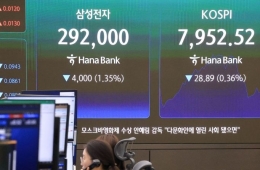
[Asia Economy Reporter Ji Yeon-jin] The U.S. stock market closed lower on the 6th (local time) amid concerns over the worsening energy crisis in Europe. The Dow Jones Industrial Average fell 0.55% from the previous session, while the Standard & Poor's (S&P) 500 index dropped 0.41%, and the tech-heavy Nasdaq index declined 0.74%. The Nasdaq is currently experiencing its longest losing streak since December 2018. The U.S. services Purchasing Managers' Index (PMI) released that day showed resilience, which could fuel dollar strength, and the rise in U.S. Treasury yields is expected to weigh on the domestic stock market.
![[Good Morning Stock Market] Nasdaq's Longest Bear Market in 4 Years... 'King Dollar' Also Holds Back](http://www.asiae.co.kr/news/img_view.htm?img=2022090708111924799_1662505878.jpg)
◆ Kim Seok-hwan, Researcher at Mirae Asset Securities = With U.S. Treasury yields rising again, companies such as Amazon (-1.1%), Alphabet (-1.1%), and Microsoft (-1.1%) all showed weakness. The MSCI Korea Index ETF fell 1.73%, and the MSCI Emerging Markets Index ETF dropped 1.19%. The NDF USD/KRW exchange rate stood at 1,377.94 won, and reflecting this, the USD/KRW rate is expected to open 5 won higher. The KOSPI is anticipated to start down about 0.5%. Recently, trading volume in the stock market has halved compared to last year, with foreign investors maintaining a lukewarm supply and demand balance, and this pattern is expected to continue today. Ultimately, attention should be paid to individual companies or sectors with momentum.
◆ Kim Yu-mi, Researcher at Kiwoom Securities = Since the Jackson Hole meeting at the end of August, major global stock markets, which had given back much of their previous gains during the correction, have struggled to recover in September. As caution surrounding major events such as the August U.S. Consumer Price Index (CPI) and the September Federal Open Market Committee (FOMC) meeting accumulates over time, negative factors emerging in the bond and foreign exchange markets are also adversely affecting the stock market at this point.
Yesterday, the domestic stock market closed higher as perceived overselling of growth stocks attracted buying, and expectations that eco-friendly stocks would benefit from the energy crisis supported gains. Today, influenced by weakness in developed markets due to rising U.S. interest rates, the market is expected to show limited price movement. Additionally, with Korea preparing for a long holiday from the 9th to the 12th, trading is likely to remain sluggish due to concerns over potential external uncertainties during the holiday period. Considering this, the foreign investor supply-demand environment, which had been relatively favorable even amid the sharp rise in the USD/KRW exchange rate near the 1,380 won level, may turn more cautious over the remaining two trading days this week. Therefore, index movements centered on large-cap stocks are expected to remain fragile today, with differentiated market trends likely to emerge focusing on specific sectors and thematic stocks such as beneficiaries of high exchange rates and the energy crisis.
![[Image source=Yonhap News]](http://www.asiae.co.kr/news/img_view.htm?img=2022050116541851137_1651391658.jpg)
◆ Na Jeong-hwan, Researcher at Cape Investment & Securities = The U.S. dollar continues to strengthen against major currencies. The euro-dollar exchange rate fell below $0.99 during the session, and the yen crossed 140 yen per dollar. In China, the foreign currency reserve requirement ratio was lowered from 8% to 6%, supplying foreign currency liquidity to curb yuan weakness; however, the yuan exchange rate reached 9.96 yuan per dollar, marking a yearly high. The dollar index reached 110 points, and the USD/KRW exchange rate closed at 1,378 won, continuing its upward trend.
Amid growing concerns about a global economic recession, U.S. economic indicators have shown resilience, and the U.S. economy remains relatively strong. The U.S. 2-year Treasury yield has risen to around 3.5%, reflecting the Federal Reserve's 79 basis point hike at the September FOMC meeting, contributing to dollar strength. While it is difficult to predict the upper limit of the USD/KRW exchange rate, there are no short-term factors to push it down, indicating upward volatility in the exchange rate. Foreign investors have continued net buying in the KOSPI market despite increased exchange rate volatility following the Jackson Hole speech, but there is also downside pressure on the stock market from potential foreign investor outflows. When the market undergoes corrections, it is advisable to view this as an opportunity to adjust portfolios by increasing weights in sectors benefiting from medium- to long-term issues (energy, semiconductors, nuclear power) or to maintain a conservative stance until the U.S. August CPI announcement.
Hot Picks Today
 If They Fail Next Year, Bonus Drops to 97 Million Won... A Closer Look at Samsung Electronics DS Division’s 600M vs 460M vs 160M Performance Bonuses
- Opening a Bank Account in Korea Is Too Difficult..."Over 150,000 Won in Notarization Fees Just for a Child's Account and Debit Card" [Foreigner K-Finance Status]②
- Whistleblowers Could Earn Tens of Billions by Reporting Collusion... KFTC Announces Administrative Notice to Abolish Reward Cap
- Room Prices Soar from 60,000 to 760,000 Won and Sudden Cancellations: "We Won't Even Buy Water in Busan" — BTS Fans Outraged
- "Who Is Visiting Japan These Days?" The Once-Crowded Tourist Spots Empty Out... What's Happening?
© The Asia Business Daily(www.asiae.co.kr). All rights reserved.
!["Please Help Us": How Much Do Those Bowing 90 Degrees These Days Actually Earn? [Data Pick]](https://cwcontent.asiae.co.kr/asiaresize/307/2026052010120870131_1779239528.png)