FKI "In the Electric Vehicle Era, Indonesia is South Korea's Top ASEAN Cooperation Partner"

[Asia Economy Reporter Park Sun-mi] The surge in direct investment by Korean companies in Indonesia since 2020 is closely related to Indonesia’s national development strategy to become a "Global Hub for the Electric Vehicle Industry," established in 2019 under the directive of President Jokowi.
On the 28th, the Federation of Korean Industries announced that Korean direct investment in Indonesia, which had been declining from $1.3 billion in 2011 to $680 million in 2018, began to increase following the construction project of a Korean complete car factory in the Deltamas Industrial Complex near Jakarta in 2020 (total investment of $1.55 billion), reaching a record high of $1.8 billion in 2021.
Currently, large-scale investment projects such as the construction of a mega petrochemical complex by Korean petrochemical companies in Indonesia and the establishment of a Korea-Indonesia joint electric vehicle battery cell factory have been confirmed, indicating that Korean direct investment in Indonesia is expected to continue growing.
Indonesia is the world’s largest holder and producer of nickel, a key raw material for electric vehicle batteries, and is promoting the realization of a "Global Hub for the Electric Vehicle Industry" by 2030 by creating an electric vehicle ecosystem and transforming into a production and export base for electric vehicles. This includes ▲a complete ban on nickel ore exports in 2020 and encouraging domestic investment in nickel smelting facilities, ▲conversion of 20% of new domestic vehicles to electric vehicles, and ▲providing incentives for foreign electric vehicle companies to invest domestically, actively attracting global electric vehicle and battery companies.
Korean companies are swiftly leveraging Indonesia’s electric vehicle national strategy to establish and execute strategies to secure dominance in the future automotive market within the ASEAN automotive market, which has been dominated by Japan. Although Indonesia became the largest automotive sales market in ASEAN in 2021, Korean brands held only a 0.1% market share as of 2019. Under the ASEAN Free Trade Agreement (AFTA) of 2018, if the localization rate of parts exceeds 40%, automobiles produced in Indonesian factories can be exported tariff-free to all ASEAN member countries, providing an additional advantage.
Kim Bong-man, Director of the International Headquarters at the Federation of Korean Industries, said, “Since the launch of the Indo-Pacific Economic Framework (IPEF) led by U.S. President Biden in May this year, the strategic importance of Indonesia, a country rich in natural resources such as nickel and gas, has increased. Therefore, Korea’s ASEAN direct investment, which has been concentrated in Vietnam, should now diversify to countries like Indonesia.”
He added, “Although about a year and a half has passed since the signing of the Korea-Indonesia CEPA (Comprehensive Economic Partnership Agreement) in December 2020, its implementation has been delayed due to Indonesia’s domestic political circumstances. We hope that following President Jokowi’s visit to Korea, Indonesia’s domestic ratification process will be promptly completed, leading to the elimination of tariffs on Korea’s major export items to Indonesia such as automotive parts, plastics and rubber, machinery parts, and steel products.”
Hot Picks Today
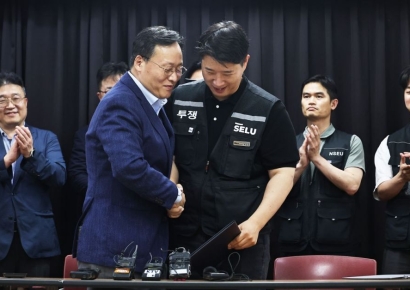 Up to 600 Million Won for Semiconductors, 160 Million Won Bonus for Loss-Making Non-Memory… Samsung Electronics Labor and Management Reach Tentative Deal on Unprecedented Performance Compensation (Comprehensive)
- "Could I Also Receive 370 Billion Won?"... No Limit on 'Stock Manipulation Whistleblower Rewards' Starting the 26th
- "From a 70 Million Won Loss to a 350 Million Won Profit with Samsung and SK hynix"... 'Stock Jackpot' Grandfather Gains Attention
- Opening a Bank Account in Korea Is Too Difficult..."It Costs 150,000 Won Just to Open a Child's Account or Check Card" [Foreigner K-Finance Status]②
- "Who Is Visiting Japan These Days?" The Once-Crowded Tourist Spots Empty Out... What's Happening?
© The Asia Business Daily(www.asiae.co.kr). All rights reserved.
!["Please Help": How Much Do Those Bowing 90 Degrees Really Earn? [Data Pick]](https://cwcontent.asiae.co.kr/asiaresize/307/2026052010120870131_1779239528.png)