The Bunsangje Going Under the Knife... Will the Housing Supply in the Seoul Metropolitan Area Breathe Easier?
Weight on Fine Adjustments Including Lee Ju-bi and Construction Cost Increases
Some Complexes to Gain Momentum but Project Risks Persist Due to Material Price Hikes
Comprehensive Supply Expansion Not Easy

[Asia Economy Reporters Kim Hyemin, Kim Dongpyo] As concerns grow over a contraction in housing supply in the second half of this year, the government has introduced a plan to reform the price ceiling system for pre-sale apartments (Bunsangje). The reform plan, reflecting increased relocation costs and construction expenses, is scheduled to be announced next month, drawing attention to whether the housing market in the Seoul metropolitan area will regain momentum.
According to the maintenance industry on the 24th, reconstruction and redevelopment projects in the Seoul metropolitan area, including Seoul, are postponing their general pre-sale schedules due to issues with price calculation. Conflicts have intensified as the prices expected by the associations have not materialized since the application of the price ceiling system. The industry estimates that at least 5,000 housing units have had their general pre-sale schedules delayed due to price calculation issues.
The price ceiling system sets pre-sale prices lower than the sum of land costs, construction costs, and additional fees. Introduced to private land in 2020, it is effectively applied only in the Seoul metropolitan area, including 18 districts in Seoul and three cities in Gyeonggi Province?Hanam, Gwangmyeong, and Gwacheon. The original purpose was to stabilize housing prices by preventing high pre-sale prices from driving up surrounding apartment market prices and burdening prospective buyers. However, the lower-than-market pre-sale prices only increased competition for subscriptions and eventually followed the surrounding apartment prices, resulting in minimal effect on price stabilization.
On the contrary, conflicts over price calculation have increased in maintenance projects, causing disruptions in housing supply in the metropolitan area. For example, Raemian Onepentace, a reconstruction project of Sinbanpo 15th Complex in Seocho-gu, postponed its general pre-sale originally scheduled for the first half of this year to next year, anticipating reforms to the price ceiling system. Other projects such as redevelopment in Imun 1 District in Dongdaemun-gu, Vermontro Gwangmyeong redeveloping Gwangmyeong 2 District in Gyeonggi, and The H Bangbae (Bangbae 5 District reconstruction) in Seocho-gu are also struggling to resolve conflicts over price calculation.
The reconstruction of Dunchon Jugong in Gangdong-gu, which is experiencing the worst conflicts, also saw the lower-than-expected pre-sale price as a decisive cause of internal disputes within the association. The previous executive promised an average of over 35 million KRW per 3.3㎡ and led to increased construction costs, but due to the price ceiling system, the pre-sale price was set around 29 million KRW per 3.3㎡.
According to Real Estate R114, the total number of units pre-sold in Seoul this year is 3,390, which is only 23.5% of the 14,447 units planned for pre-sale in the first half of the year. The areas where sales occurred are mostly exempt from the price ceiling system, such as Mia-dong in Gangbuk-gu, Gaebong-dong in Guro-gu, and Bongcheon-dong in Gwanak-gu. This is the background behind Land, Infrastructure and Transport Minister Won Heeryong’s decision to advance the expected reform of the price ceiling system from the second half of the year to June.
The government’s reform of the price ceiling system is expected to reflect costs arising from maintenance projects such as relocation expenses for reconstruction associations and incorporate recent construction cost increases due to soaring raw material prices into pre-sale prices. The goal is to reduce factors that have artificially suppressed pre-sale prices rather than abolishing the system. It is understood that a complete abolition could sharply increase the burden on prospective buyers and affect overall housing prices in the metropolitan area.
Hot Picks Today
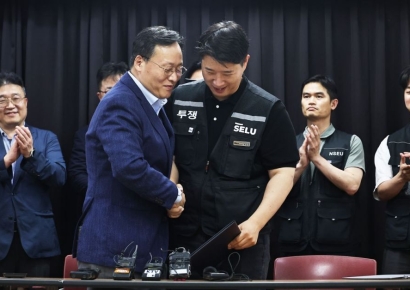 Up to 600 Million Won for Semiconductors, 160 Million Won Bonus for Loss-Making Non-Memory… Samsung Electronics Labor and Management Reach Tentative Deal on Unprecedented Performance Compensation (Comprehensive)
- "Could I Also Receive 370 Billion Won?"... No Limit on 'Stock Manipulation Whistleblower Rewards' Starting the 26th
- "From a 70 Million Won Loss to a 350 Million Won Profit with Samsung and SK hynix"... 'Stock Jackpot' Grandfather Gains Attention
- Opening a Bank Account in Korea Is Too Difficult..."It Costs 150,000 Won Just to Open a Child's Account or Check Card" [Foreigner K-Finance Status]②
- "Who Is Visiting Japan These Days?" The Once-Crowded Tourist Spots Empty Out... What's Happening?
Experts say that while some of the delayed supply will be released through the reform, the effect will be limited as it only addresses specific issues. Yoon Jihae, Senior Researcher at Real Estate R114, said, "With the reform, pre-sale prices, which were previously capped at 80% or less of market prices, will rise to the lower 90% range, releasing some units that cannot be indefinitely delayed considering financial costs." However, she added, "Considering other project risks such as rising construction costs, not many projects will advance their pre-sale schedules solely due to this reform."
© The Asia Business Daily(www.asiae.co.kr). All rights reserved.