[The Editors' Verdict] Abolishing Capital Gains Tax and Fairness
[Asia Economy Reporter Jeon Pil-su] The abolition of capital gains tax on stock transfers for holders with less than 10 billion KRW in a single stock. This is the first practical task for the advancement of the financial market among the new government's national agenda. It means that capital gains tax will be imposed only on investors who invest more than 10 billion KRW per stock, effectively exempting almost all investors except controlling shareholders or ultra-high-net-worth individuals who invest hundreds of billions of KRW in stocks.
According to current law, capital gains tax is paid by major shareholders who hold more than 1 billion KRW in a single stock or have a stake of 1% or more (2% for KOSDAQ). In 2020, the Moon Jae-in administration pushed a bill to impose taxes on anyone earning more than 50 million KRW annually from stocks, regardless of holding amount or stake. Initially, the plan was to provide a deduction up to 20 million KRW, but due to backlash from individual investors, it was expanded to 50 million KRW. The timing for the reduction of securities transaction tax was also advanced, and the bill passed the National Assembly plenary session and is set to be implemented next year.
This roadmap has been completely overturned, and the direction has shifted toward effectively abolishing capital gains tax. The intention is to gain the support of the 14 million stock investors by exempting them from taxes even if they make profits. From the investors' perspective, being able to earn money without paying taxes is certainly a welcome move. As Machiavelli said, "People forget the death of their father faster than the loss of their own property."
However, there is a catch in the policy to abolish capital gains tax. Instead of capital gains tax, the securities transaction tax, which has been gradually lowered annually, will be maintained at an appropriate level. The current transaction tax rate is 0.23% (for KOSPI, 0.08% transaction tax + 0.15% special rural tax). From May 14 last year to May 13 this year, the total amount sold by individual investors was 3,777.7109 trillion KRW (KOSPI 1,841.9014 trillion KRW + KOSDAQ 2,135.8095 trillion KRW). Since a 0.23% transaction tax (including special rural tax) must be paid each time stocks are sold, the transaction tax paid by individuals over the past year alone amounts to 9.1487 trillion KRW.
Korean individual investors have one of the highest turnover rates in the world. According to the Korea Capital Market Institute, the annual turnover rate for small investors with less than 10 million KRW last year was as high as 6,534%. This means that with 10 million KRW, they bought and sold more than 65 times, trading stocks worth 653.4 million KRW. The tax paid by this investor is 1.5 million KRW. Although the transaction tax per trade on 10 million KRW is 23,000 KRW, frequent trading results in a substantial tax burden. This tax is paid regardless of whether the investor made or lost money. The total tax collected this way exceeds 9 trillion KRW.
According to the theory of Roman Emperor Augustus that a fair tax system "collects taxes broadly and shallowly," the transaction tax is a very efficient tax from the collector's perspective. In fact, it is rare to see investors saying they cannot invest because of the transaction tax. On the other hand, capital gains tax is paid by a minority but inevitably faces strong tax resistance. For example, if an investor earns 100 million KRW from stock investment, they must pay 10 million KRW in tax, which is 20% of the 50 million KRW exceeding the tax exemption limit.
Hot Picks Today
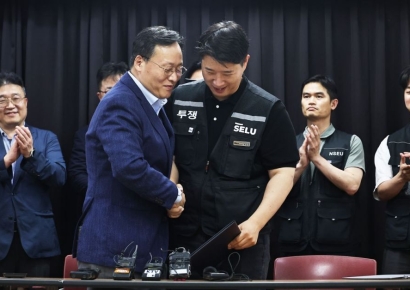 Up to 600 Million Won for Semiconductors, 160 Million Won Bonus for Loss-Making Non-Memory… Samsung Electronics Labor and Management Reach Tentative Deal on Unprecedented Performance Compensation (Comprehensive)
- "Could I Also Receive 370 Billion Won?"... No Limit on 'Stock Manipulation Whistleblower Rewards' Starting the 26th
- "From a 70 Million Won Loss to a 350 Million Won Profit with Samsung and SK hynix"... 'Stock Jackpot' Grandfather Gains Attention
- [Current State of K-Finance for Foreign Nationals]①From Niche to Core... Banks Go All-In on First-Mover Competition
- "Who Is Visiting Japan These Days?" The Once-Crowded Tourist Spots Empty Out... What's Happening?
However, abolishing capital gains tax and reverting to transaction tax undermines the modern state's tax principle of taxing where income is generated. It is also difficult to avoid criticism of being a tax cut for the wealthy. The government claims that through financial market advancement policies such as abolishing capital gains tax, it aims to build a market trusted by investors by enhancing fairness in the capital market and to promote sustainable growth of the capital market and the real economy. 'Fairness' certainly has a hard time.
© The Asia Business Daily(www.asiae.co.kr). All rights reserved.







