To Improve Bed Efficiency... Transfer Orders Expanded and Discharge Procedures Shortened Starting from the 21st
Severe Beds, Isolation Release Orders Twice Weekly
Hospitalization Appropriateness Evaluation Also Shortened to 3 Stages

[Asia Economy Reporter Ki Ha-young] The government will increase the transfer (hospital transfer) orders for patients released from isolation to twice a week starting from the 21st to improve the turnover rate of severe COVID-19 beds, and will shorten the appropriateness evaluation of severe beds to three stages.
The Central Disaster and Safety Countermeasures Headquarters announced these measures for bed expansion and efficiency on the 18th. Accordingly, the transfer orders for severe beds, which were conducted once a week for patients who have passed 20 days from the specimen collection date, will be expanded to twice a week.
For semi-severe and moderate beds, transfer orders will be issued after 10 days from the specimen collection date. Transfer orders for patients admitted to semi-severe beds will be conducted twice a week, and for those in moderate beds, once a week.
The appropriateness evaluation procedure for patients admitted to severe beds with oxygen demand of 5ℓ or less will also be shortened. The four-step process of 'evaluation → discharge recommendation → discharge order → compensation reduction if not complied with' will omit the 'discharge recommendation' step. If a patient is evaluated as a discharge target, the 'discharge order' will be issued immediately without a 'discharge recommendation,' reducing the duration from 5 days to 3 days.
These bed efficiency measures will be implemented starting from the 21st.
Lee Ki-il, the first controller of the Central Disaster and Safety Countermeasures Headquarters, explained, "Hospitals that do not accept discharge orders will have their compensation reduced, and if the patient refuses, a personal charge will be imposed." He added, "If an explanation is provided regarding the discharge order, some cases are accepted."
The government plans to promote bed expansion considering the characteristics and designation principles of each bed type, prioritizing the expansion of severe and semi-severe beds with high utilization rates. As of midnight on the day, the bed utilization rates are 66.5% for severe, 71.6% for semi-severe, and 46.7% for infectious disease dedicated hospitals.
Regarding the high bed utilization rates in some local governments such as Gwangju (98.2%), Jeonnam (82.6%), and Gyeongnam (85.7%), Controller Lee explained, "Recently, many patients have occurred in non-metropolitan areas, and especially in Gwangju and Jeonnam, there are many elderly people aged 60 or older, so many severe patients are expected." He added, "We are preparing measures to quickly expand the insufficient severe beds and to transfer patients who have been hospitalized for more than 20 days as soon as possible."
Hot Picks Today
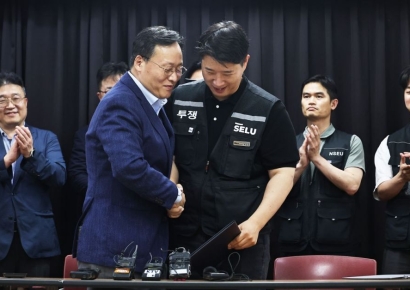 Up to 600 Million Won for Semiconductors, 160 Million Won Bonus for Loss-Making Non-Memory… Samsung Electronics Labor and Management Reach Tentative Deal on Unprecedented Performance Compensation (Comprehensive)
- "Could I Also Receive 370 Billion Won?"... No Limit on 'Stock Manipulation Whistleblower Rewards' Starting the 26th
- "From a 70 Million Won Loss to a 350 Million Won Profit with Samsung and SK hynix"... 'Stock Jackpot' Grandfather Gains Attention
- [Scientists Are Disappearing]④A Shaky Regional Research Ecosystem... "Professors Now Take the Initiative"
- "Who Is Visiting Japan These Days?" The Once-Crowded Tourist Spots Empty Out... What's Happening?
Local governments lacking beds will transfer patients to neighboring local governments. Park Hyang, head of the Central Disease Control Headquarters' quarantine team, explained, "Since bed response is managed by region, areas with particularly high bed utilization rates operate with adjacent regions as well," and added, "We will also consider bed efficiency to enable hospitalization within as close a region as possible."
© The Asia Business Daily(www.asiae.co.kr). All rights reserved.
!["Please Help": How Much Do Those Bowing 90 Degrees Really Earn? [Data Pick]](https://cwcontent.asiae.co.kr/asiaresize/307/2026052010120870131_1779239528.png)