Gwangju-Jeonnam Economic Organizations Federation Proposes Key Agendas for Future Industry Leading City

[Asia Economy Honam Reporting Headquarters Reporter Park Jin-hyung] The Gwangju-Jeonnam Economic Organizations Federation proposed joint agendas for Gwangju City to leap forward as a future economic and industrial leading city to the upcoming 8th local government administration.
Chairman Na Gi-su announced on the 17th that over the past two months, together with companies, research institutes, universities, and related organizations located in the Gwangju area, they identified 10 joint agendas across three sectors to prepare for the industrial transformation accelerated by carbon neutrality and the expansion of artificial intelligence technology, and to ensure swift and thorough implementation of the presidential election pledges.
The three sectors identified are ▲Common Industry ▲Promotion of AI Representative City ▲Establishment of Future Mobility Leading City. The core contents include expanding support for Gwangju industries, supplying demand-based workforce, and promoting projects responding to industrial transformation, with a scale of approximately 66 trillion KRW over up to 10 years.
The ‘Common Industry’ sector emphasizes the digital transformation of all industries and includes expanding the city’s industrial budget from the current approximately 280 billion KRW to about 450 billion KRW to accelerate digital transformation of Gwangju companies, as well as reorganizing an immediate workforce supply system reflecting corporate demand due to digital transformation.
The ‘Promotion of AI Representative City’ sector consists of a request for early establishment of a second AI fund following the early depletion of the AI fund created to discover and nurture promising local AI startups, the creation of a hub for AI-converged digital culture and arts content, and the formation of a pilot district to implement and operate AI-CITY.
Lastly, the ‘Establishment of Future Mobility Leading City’ sector includes reorganizing the support system for the future mobility industry to swiftly implement the presidential election pledge of building a future mobility leading city, creating a pilot urban air mobility (UAM) operation zone to foster a comprehensive ground and air mobility industry-centered city, supporting technology development for local automobile manufacturing companies, and establishing a mobility-centered theme park.
Chairman Na said, “We carefully selected agendas with Gwangju’s industry-academia-research community that can enable Gwangju to leap forward as a future economic and industrial leading city.” He added, “We will ensure these agendas are adopted and promoted in the industrial policies of the 8th local government administration, which will be launched during the period of industrial transformation such as carbon neutrality and digital transformation.”
Hot Picks Today
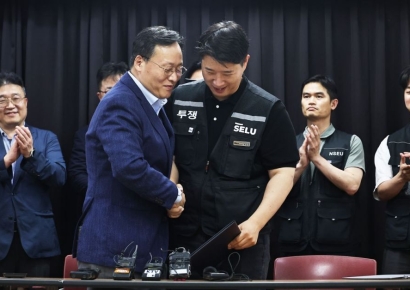 Up to 600 Million Won for Semiconductors, 160 Million Won Bonus for Loss-Making Non-Memory… Samsung Electronics Labor and Management Reach Tentative Deal on Unprecedented Performance Compensation (Comprehensive)
- "Could I Also Receive 370 Billion Won?"... No Limit on 'Stock Manipulation Whistleblower Rewards' Starting the 26th
- "From a 70 Million Won Loss to a 350 Million Won Profit with Samsung and SK hynix"... 'Stock Jackpot' Grandfather Gains Attention
- Opening a Bank Account in Korea Is Too Difficult..."It Costs 150,000 Won Just to Open a Child's Account or Check Card" [Foreigner K-Finance Status]②
- "Who Is Visiting Japan These Days?" The Once-Crowded Tourist Spots Empty Out... What's Happening?
The federation, established in 2018 by 10 small and medium-sized enterprise-related associations, develops and proposes effective policies reflecting regional characteristics. It continuously strives to enable smooth corporate activities in the region through close cooperation with the government, local governments, and local companies.
© The Asia Business Daily(www.asiae.co.kr). All rights reserved.
!["Please Help": How Much Do Those Bowing 90 Degrees Really Earn? [Data Pick]](https://cwcontent.asiae.co.kr/asiaresize/307/2026052010120870131_1779239528.png)