Russian Banks Excluded from SWIFT... Will South Korea's Payment Transactions Be Blocked? (Comprehensive Report 2)
![[Image source=EPA Yonhap News]](http://www.asiae.co.kr/news/img_view.htm?img=2022022709114559933_1645920705.jpg)
[Asia Economy Reporter Seongpil Cho] On the 26th (local time), the United States and other Western countries announced additional sanctions excluding Russian banks from the Society for Worldwide Interbank Financial Telecommunication (SWIFT) payment network in response to Russia's invasion of Ukraine.
The United States, France, Germany, Italy, the United Kingdom, and Canada stated in a joint declaration, "As Russian forces attack Kyiv, the capital of Ukraine, and other cities, we have decided to isolate Russia from the international financial system," adding, "These measures will be implemented soon."
As part of this measure, selected Russian banks will be fully excluded from the SWIFT payment network, and access to the international reserves of the Russian Central Bank will also be restricted.
SWIFT is a highly secure computerized network used by over 11,000 financial institutions worldwide to safely send and receive payment orders. Being expelled from this network means Russia will be unable to receive export payments, making it one of the most powerful economic sanctions. Some refer to it as a "financial nuclear option."
In particular, there have been consistent calls in the United States to exclude Russia from SWIFT, but due to opposition from some European countries including Germany, it was not included in the initial sanctions. This option was also considered in 2014 when Russia forcibly annexed the Crimean Peninsula of Ukraine, but it was not implemented.
A U.S. administration official said, "Considering that the SWIFT financial system is under Belgian jurisdiction, the European Union (EU) will finalize the list of Russian banks to be blocked."
Although this sanction was previously applied to Iran over its nuclear program, foreign media analyzed that excluding Russia from the international payment network could also affect the economies of other countries including the United States and Germany. They added that this SWIFT exclusion is incomplete, leaving room for additional sanctions by the U.S. and Europe in the future.
Ursula von der Leyen, President of the European Commission, announced these measures, stating, "We will freeze the assets of the Russian Central Bank to prevent it from conducting transactions." She also emphasized, "Exclusion from SWIFT will disconnect these banks from the international financial system and damage their global operational capabilities," adding, "Banks will be unable to conduct most financial transactions and will effectively block Russia's exports and imports."
If sanctions on the Russian Central Bank are implemented, access to reserves estimated at $643 billion (approximately 774.5 trillion KRW) will be restricted, potentially causing a direct blow to Russia's finances. Additionally, the so-called "golden passport" sales, which grant citizenship to foreigners who invest a certain amount, will also be restricted for Russians.
The statement explained that this is a measure to prevent Russian oligarchs related to the Russian government from acquiring Western citizenship and accessing the financial system.
Next week, a transatlantic task force (TF) will be formed to review the sanctions situation and begin freezing the assets of sanctioned institutions and individuals within the region.
Since Russia's invasion of Ukraine escalated, Western countries have announced successive financial and export regulatory measures. The day before, sanctions were also announced against key individuals including Russian President Vladimir Putin and Foreign Minister Sergey Lavrov.
Accordingly, the government and financial authorities are examining the impact of the Western sanctions excluding major Russian banks from SWIFT on Korean companies and others. Companies and banks are also preparing related countermeasures. A bank official said, "Once the exact list of Russian banks to be excluded is finalized, alternative remittance methods can be prepared accordingly."
Russia is South Korea's 10th largest trading partner, accounting for 1.6% of exports and 2.8% of imports last year. Automobiles and parts, steel structures, and synthetic resins make up half of South Korea's export volume, while energy such as naphtha, crude oil, thermal coal, and natural gas accounts for about 70% of imports. Currently, over 40 Korean companies, including Samsung Electronics, LG Electronics, POSCO, Hyundai Motor, Kia, Amorepacific, and Orion, have operations in Russia.
Hot Picks Today
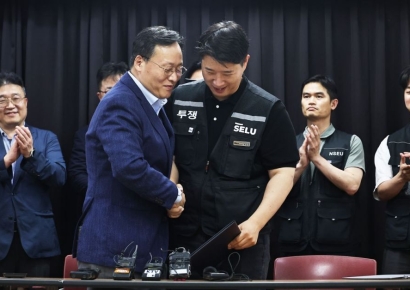 Up to 600 Million Won for Semiconductors, 160 Million Won Bonus for Loss-Making Non-Memory… Samsung Electronics Labor and Management Reach Tentative Deal on Unprecedented Performance Compensation (Comprehensive)
- "Could I Also Receive 370 Billion Won?"... No Limit on 'Stock Manipulation Whistleblower Rewards' Starting the 26th
- "From a 70 Million Won Loss to a 350 Million Won Profit with Samsung and SK hynix"... 'Stock Jackpot' Grandfather Gains Attention
- [Current State of K-Finance for Foreign Nationals]①From Niche to Core... Banks Go All-In on First-Mover Competition
- "Who Is Visiting Japan These Days?" The Once-Crowded Tourist Spots Empty Out... What's Happening?
Meanwhile, the government plans to establish and operate a "Financial Difficulty Counseling Center for Russia-related Financial Sanctions" at the Financial Supervisory Service. Through this center, companies, local residents, and students will be able to report and receive support for difficulties caused by financial sanctions against Russia.
© The Asia Business Daily(www.asiae.co.kr). All rights reserved.