[2022 Economic Policy] Coexistence Landlords, 'Capital Gains Tax Exemption' Actual Residence Requirement Reduced from 2 Years to 1 Year
Government Announces 2022 Economic Policy Directions…Temporary Benefits for Actual Residence Requirement
Limited to New and Renewal Contracts from the 20th of This Year to December 31 Next Year
"Increasing Supply to Control Real Estate Prices"…Pre-sale Expanded to 68,000 Units
Short-term Housing Supply Also Increased by at Least 5,000 Units
Temporary Increase in Monthly Rent Tax Credit Rate for 2022

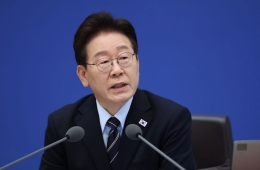
Lee Ok-won, Vice Minister of Strategy and Finance, is presenting the main points at the '2022 Economic Policy Direction Detailed Briefing' held at the Government Sejong Complex on the 17th.
View original image[Sejong= Asia Economy Reporter Kim Hyunjung] As part of strengthening tenant support, the government will temporarily ease the capital gains tax exemption requirements for 'Win-Win Landlords' who raise rent by no more than 5% compared to the previous contract when signing new or renewal leases. Considering the recent expansion of the trend of converting Jeonse (lump-sum deposit lease) contracts to semi-Jeonse (deposit + monthly rent), the monthly rent tax credit rate will also be temporarily increased from the current maximum of 12% to 15% to reduce tenants' monthly rent burden.
The Ministry of Economy and Finance announced these details in the '2022 Economic Policy Directions' on the 20th.
◆ Win-Win Landlord 'Capital Gains Tax Exemption' Actual Residence Requirement Reduced from 2 Years to 1 Year = First, Win-Win Landlords who maintain a lease contract for 2 years will be recognized as having fulfilled 1 year of the actual residence requirement (2 years) needed to qualify for the capital gains tax exemption. However, this is a temporary special case, applicable only to new or renewal contracts signed between December 20 this year and December 31 next year, and only for single-homeowners with one house or rental properties with a publicly announced price of 900 million KRW or less at the start of the lease.
A Win-Win Landlord refers to a landlord who raises rent by no more than 5% compared to the previous contract when signing new or renewal leases. Here, 'previous contract' is limited to cases where ▲ an existing lease contract exists and ▲ the existing contract has been maintained for at least 1 year and 6 months. Newly signed lease contracts after purchasing a house or lease contracts inherited at the time of house purchase are excluded.
![[2022 Economic Policy] Coexistence Landlords, 'Capital Gains Tax Exemption' Actual Residence Requirement Reduced from 2 Years to 1 Year](http://www.asiae.co.kr/news/img_view.htm?img=2021121920444767129_1639914287.jpg)
Along with this, considering the recent increase in cases of converting Jeonse to semi-Jeonse in new lease contracts, the monthly rent tax credit rate will be temporarily raised in 2022 to reduce tenants' monthly rent burden. Under the current law (Article 95-2 of the Restriction of Special Taxation Act), the monthly rent tax credit benefit is given to non-homeowners with a total annual income of 70 million KRW or less who meet the housing requirements of a national housing size (85㎡) or less or a standard market price of 300 million KRW or less. The credit rate is 12% for those with total annual income of 55 million KRW or less and 10% for those exceeding 55 million KRW, which will be raised to 15% and 12%, respectively.
Additionally, support for insurance premiums for Jeonse Return Guarantee Insurance, which is set to expire at the end of this year, will be extended until the first half of next year. To prevent 'empty Jeonse' damage, the guarantee institution (HUG) will separately manage and publicly disclose a list of malicious landlords, and real estate agents will be required to inform tenants to verify this when mediating lease contracts.
To improve convenience for tenants whose contract renewals have been rejected, if tenants apply, local governments will regularly provide lease information of the relevant housing for a certain period. The government plans to publish an annual casebook of dispute mediation cases from the Lease Dispute Mediation Committee to be used as guidelines in case of disputes. Furthermore, to enhance convenience for the general public in applying for dispute mediation, a dispute mediation service app will be developed, and the expertise of the website and call center will be strengthened.
![[2022 Economic Policy] Coexistence Landlords, 'Capital Gains Tax Exemption' Actual Residence Requirement Reduced from 2 Years to 1 Year](http://www.asiae.co.kr/news/img_view.htm?img=2021121920450367130_1639914303.jpg)
◆ Accelerating Supply Schedule and Increasing Volume = The government also plans to expand the supply scale in various ways beyond the already announced quantities to turn the recently softened real estate price rise trend into a stable decline.
Including the 3rd New Town, private sales, and the 2.4 Plan volumes, the 2022 pre-sale scale will be expanded from the initially planned 62,000 units to 68,000 units. The public sector will supply 30,000 units as originally planned, but private volumes and the 2.4 Plan (urban housing public projects) volumes will increase from 32,000 units to 38,000 units. Detailed plans and measures related to this will be separately announced early next year.
Visible measures will also be accelerated for major new public land supply plans announced in the August 4 Plan. Tae-neung CC will complete district designation in the first half of next year, and for Gwacheon, the Gwacheon district (3,000 units) will finalize the district plan within 2022 after environmental impact assessments, and the alternative new land site (13,000 units) will complete district designation by the first half of the year. The unsold site in Magok and the Seoul Public Procurement Service site aim to start construction in July next year and begin temporary office relocation in the second half of the year, respectively.
The 2.4 Plan urban housing public project will promote additional candidate site recruitment within the first quarter, focusing on areas with secured resident consent, and will newly designate main districts for urban public complex projects with more than 30,000 units?three times this year's scale?during next year. Also, for areas designated as main districts this year and the first half of next year, project plans will be sequentially established in the second half of the year.
At the same time, the government will attempt policy responses to the Jeonse shortage issue. First, including Jeonse-type housing supply using vacant rental properties, the supply volume will be increased by at least 5,000 units beyond the 39,000 units announced in the November 19 Plan for this year. The plan for new Jeonse supply next year includes 9,000 public Jeonse housing units, 23,000 newly purchased contracts, and 7,000 non-residential remodeling units, aiming to supply faster than this year.
Hot Picks Today
 "Stocks Are Not Taxed, but Annual Crypto Gains Over 2.5 Million Won to Be Taxed Next Year... Investors Push Back"
- "Don't Throw Away Coffee Grounds" Transformed into 'High-Grade Fuel' in Just 90 Seconds [Reading Science]
- Prison Sentences Finalized for Husband and Son Who Killed 80-Year-Old After 10 Years of Care
- "Groups of 5 or More Now Restricted"... Unrelenting Running Craze Leaves Citizens and Police Exhausted
- "Even With a 90 Million Won Salary and Bonuses, It Doesn’t Feel Like Much"... A Latecomer Rookie Who Beat 70 to 1 Odds [Scientists Are Disappearing] ③
Additionally, to expand short-term housing construction volume, building regulations such as floor area ratio and building coverage ratio will be relaxed for modular housing that can be built quickly. To promote the supply of high-rise modular housing of 13 floors or more, a demonstration complex (Yongin City Happy Housing, 13 floors, 106 units) will be initiated within this year. Furthermore, the government will shorten the move-in period for 140,000 public rental housing units planned for next year as much as possible.
© The Asia Business Daily(www.asiae.co.kr). All rights reserved.