"Privately Driven but Unexpected Obstacles in Public Redevelopment of Old Downtown Areas"

Although the government is accelerating public-led housing supply by announcing the first public redevelopment candidate sites outside Seoul, the path ahead is expected to be challenging as opposition from residents arises in various areas.
According to the maintenance industry on the 19th, conflicts among residents have deepened recently in the Wondang 6 and 7 districts of Goyang City, Gyeonggi Province, which were selected as public redevelopment candidate sites by the government.
The Ministry of Land, Infrastructure and Transport selected this area, along with Gwangmyeong 7R district in Gwangmyeong City and Jinan 1-2 district in Hwaseong City, as the first public redevelopment candidate sites in Gyeonggi Province.
In Wondang, residents of district 6 are in favor of "going ahead with public redevelopment," whereas residents of district 7 are strongly opposed. A representative from real estate agency A in Seongsadong, Deogyang-gu, Goyang City said, "District 7 has considerable expectations for private redevelopment," adding, "Since it is located right next to Wondang Station and has a good location, and private redevelopment is being pursued in nearby districts 1, 2, and 4, it will be difficult for residents to easily agree to public redevelopment."
The situation is not much different in Heukseok 2 district, which had the largest planned supply of 1,310 households among the first public redevelopment candidate sites. The ‘Emergency Countermeasures Committee Against Public Development of Heukseok 2 District,’ mainly composed of commercial property owners, held a press conference in front of the main gate of Seoul City Hall on the 12th and submitted a petition to the city demanding the cancellation of the district designation. Similarly, opposition is strong among commercial property owners in Gangbuk 5 district, which was also selected as a candidate site.
Opposition to public redevelopment shares two main common aspects: infringement on residents' and associations' autonomy due to ‘public’ implementation, and resistance to the increase of rental housing. Since landowners inherently have incentives to minimize public rental housing and maximize profits, there are calls to make policy design more flexible considering these factors.
Lee Tae-hee, a senior researcher at the Korea Research Institute for Construction Industry, said, "Opposition to public redevelopment should not be viewed merely as collective selfishness," and suggested that more choices and sufficient incentives should be provided to owners.
Hot Picks Today
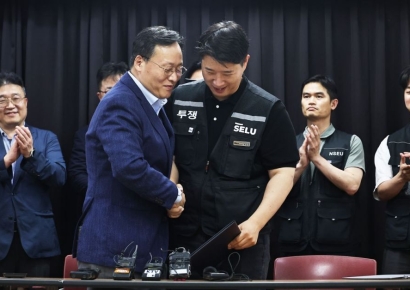 Up to 600 Million Won for Semiconductors, 160 Million Won Bonus for Loss-Making Non-Memory… Samsung Electronics Labor and Management Reach Tentative Deal on Unprecedented Performance Compensation (Comprehensive)
- "Could I Also Receive 370 Billion Won?"... No Limit on 'Stock Manipulation Whistleblower Rewards' Starting the 26th
- "From a 70 Million Won Loss to a 350 Million Won Profit with Samsung and SK hynix"... 'Stock Jackpot' Grandfather Gains Attention
- U.S. Stocks Up 1% on War Negotiation Hopes... Will Korea Recover Recent Losses? [Good Morning Market]
- "Who Is Visiting Japan These Days?" The Once-Crowded Tourist Spots Empty Out... What's Happening?
He also stated, "In the U.S., more incentives are provided when rental housing is supplied to lower-income groups," adding, "It is necessary to consider linking the types and amounts of rental housing supplied by the implementer with incentives, allowing residents to make autonomous decisions."
© The Asia Business Daily(www.asiae.co.kr). All rights reserved.







